吉利银河M9

Search documents
吉利汽车(00175) - 2025年全年业绩演示材料
2026-03-18 08:31
本档包含对吉利汽车控股有限公司("本公司")以及本公司的子公司和关联公司(与本公司合称为"本集团")一般经营计划和战略的前瞻监院 述。前瞻性陈述通常包含"将"、"预期"和"期望"以及其它类似词语。就其本质而言,前瞻性陈达具有一定风险和不确定性,因为其涉及将在 未来发生的事件和情况。许多因素都会导致实际结果与前瞻性陈述出现重大差异,包括本公司未来经营的变化与发展,竞争环境、落实经营战略及 措施的能力,应对技术变革的能力,以及本集团经营所在市场的政治、经济、规管及社会状况。本公司没有任何对这些前瞻性陈述进行更新或修改 以反映未来事件或发展的义务。 2025年全年业绩 吉利汽车控股有限公司 (于开曼群岛注册成立之有限公司) 股票代号: 175( 港币柜台 )及 80175( 人民币柜台 ) 2026/03/18 重要告示 本档之内容仅作演示用途,而任何其他人士不应利用或依赖相关信息。本档亦不应被视为替代阁下作出判断。阁下应单独负责对本演示材料之讨论 要点作独立调查及评估,吉利汽车控股有限公司对本演示材料之内容的准确性、完整性、可靠性服不作任何表示或保证。未经我方事先同意、不得 复制及/或份发本演示材料之内容。吉利汽 ...

吉利汽车发布年度业绩 总收入同比上升25%达3452亿元 再度创下历史新高
Zhi Tong Cai Jing· 2026-03-18 05:16
Core Viewpoint - Geely Automobile reported a significant increase in revenue and vehicle sales for the year ending December 31, 2025, driven by its successful transformation in the new energy and smart vehicle sectors [1][3] Financial Performance - The company achieved a revenue of 345.23 billion RMB, a year-on-year increase of 25% [1] - Profit attributable to shareholders was 16.85 billion RMB, reflecting a slight increase of 0.24% year-on-year [1] - Basic earnings per share were 1.67 RMB, with a proposed final dividend of 0.5 HKD per share [1] Vehicle Sales and Market Strategy - Geely sold a total of 3.02 million vehicles in 2025, a 39% increase year-on-year, exceeding the revised target of 3 million units [1] - Domestic wholesale volume increased by 48% to 2.60 million units, while export wholesale volume rose by 1% to 420,100 units [1] New Energy Vehicle (NEV) Development - The Geely Galaxy brand saw a 150% increase in sales to 1.24 million units, making it the second-largest NEV brand in China [2] - The Lynk & Co brand achieved sales of 350,500 units, a 23% increase, with 65% of sales coming from NEV products [2] - The premium NEV brand Zeekr sold 224,100 units, a 1% increase, with the Zeekr 9X becoming a top seller in the high-end SUV segment [2] Market Position and Future Outlook - In 2025, Geely's NEV sales are projected to grow by 90% to 1.69 million units, accounting for 56% of total sales, positioning the company as the second-largest NEV seller globally [2] - The company benefited from economies of scale, cost efficiencies from its new energy architecture, and the introduction of high-end products, leading to a gross profit increase of 25% and a gross margin of 16.6% [3]
吉利汽车(00175)发布年度业绩 总收入同比上升25%达3452亿元 再度创下历史新高
智通财经网· 2026-03-18 05:14
Core Viewpoint - Geely Automobile reported a revenue of 345.23 billion RMB for the year ending December 31, 2025, marking a 25% year-on-year increase, with a profit attributable to shareholders of 16.85 billion RMB, a slight increase of 0.24% [1] Group 1: Financial Performance - The company achieved a basic earnings per share of 1.67 RMB and proposed a final dividend of 0.5 HKD per share [1] - Gross profit increased by 25% year-on-year, with a gross margin of 16.6%, reflecting a slight rise of 0.1% despite intense price competition in the industry [3] Group 2: Sales and Market Performance - Total vehicle sales reached 3.02 million units, a 39% increase year-on-year, exceeding the revised target of 3 million units [1] - Domestic wholesale volume grew by 48% to 2.60 million units, while export wholesale volume increased by 1% to 420,100 units [1] Group 3: New Energy Vehicle (NEV) Development - The mainstream NEV brand, Geely Galaxy, launched several successful models, contributing to a 150% year-on-year increase in sales to 1.24 million units, securing the second position in China's NEV brand sales [2] - The mid-to-high-end brand Lynk & Co saw sales rise by 23% to 350,500 units, with NEV products accounting for 65% of total sales [2] - The luxury NEV brand Zeekr maintained its growth, with annual sales of 224,100 units, a 1% increase, and its model Zeekr 9X became a top seller in the large SUV segment priced above 500,000 RMB [2] Group 4: Strategic Focus - The company continues to balance the development of both fuel and NEVs, enhancing the intelligence of fuel vehicles to maintain sales growth amid rising NEV penetration in China [1] - Geely is accelerating its NEV exports to diversify its global market presence [1]
吉利AI团队多项研究成果入选ICLR 2026 “超拟人”智能体上车
Huan Qiu Wang· 2026-02-09 03:35
Group 1 - Geely Auto has collaborated with Zhejiang University and Hong Kong University of Science and Technology to achieve three artificial intelligence research results, which have been accepted by ICLR 2026, covering areas such as model compression, in-vehicle interaction, and music generation [1] - ICLR is a top international academic conference focused on machine learning and deep learning, aimed at promoting cutting-edge research and innovation in artificial intelligence theory and methods [1] - The three research results accepted by ICLR 2026 demonstrate breakthroughs in algorithm efficiency, vertical scene applications, and generative AI, exemplifying Geely's deep integration of production, academia, and research [1] Group 2 - Geely's latest AI achievement, the Eva super humanoid intelligent agent, has been first launched in the Galaxy M9 model, capable of self-judgment, planning, and task execution, with "supernatural" emotional voice interaction abilities [3] - With the comprehensive upgrade of the AI 2.0 architecture centered around the WAM model this year, Eva is evolving into a "super humanoid, super intelligent, and super user-friendly" intelligent central system for vehicles, becoming an "ecological intelligent body" that connects everything [3]

车企金融促销战升级,7年低息贷款成标配
Jin Shi Shu Ju· 2026-02-02 01:58
Core Viewpoint - The automotive industry is shifting from direct price competition to financial incentives as companies respond to regulatory pressures against price wars, raising questions about the sustainability and risks of this strategy [2][6]. Group 1: Financial Promotions - Tesla initiated a financial promotion with a "7-year low-interest" plan, offering a minimum down payment of 79,900 yuan and monthly payments of 1,918 yuan for the Model 3 [2]. - Xiaomi, Li Auto, and other companies quickly followed suit with similar financing options, highlighting a trend towards extended loan terms and lower monthly payments to attract consumers [3]. - The trend of "7-year low-interest" financing has become a standard offering among major automakers, with various companies providing competitive down payment and monthly payment options [3]. Group 2: Consumer Behavior and Market Dynamics - There is a growing consumer demand for flexible payment options, particularly among younger buyers, which can lead to an "equivalent price reduction" effect [4]. - The automotive market is facing significant pressure, with retail sales of passenger vehicles dropping by 28% year-on-year in early January 2026, prompting companies to adopt financial promotions to stimulate demand [6]. - The impending reduction of tax incentives for electric vehicles is expected to increase consumer costs, further motivating companies to offer attractive financing solutions [6]. Group 3: Regulatory and Policy Environment - Recent policies from financial regulators have allowed for the extension of personal consumption loans to 7 years, making low-interest financing a compliant option for automakers [7]. - The government has introduced fiscal subsidies for qualifying personal consumption loans, which can help offset the costs of low-interest financing for consumers [8]. - The inclusion of the automotive sector in key fiscal subsidy areas indicates a supportive regulatory environment for financial promotions in the industry [7]. Group 4: Financing and Leasing Controversies - Many automakers are incorporating financing leasing services into their promotional strategies, which can create confusion among consumers regarding ownership and contractual obligations [9]. - The financing leasing model, while innovative, has faced criticism for potentially misleading consumers about ownership rights and responsibilities [10]. - The automotive financing leasing sector is undergoing regulatory improvements to enhance transparency and protect consumer interests [10][11].





车市“价格战”熄火,“金融战”再起?
经济观察报· 2026-02-01 04:30
Core Viewpoint - The automotive industry is shifting from direct price competition to financial incentives as a means to stimulate consumer demand, raising questions about the sustainability and risks associated with this strategy [2][5]. Group 1: Financial Promotions - Tesla initiated a financial promotion in early January 2026, offering a limited-time insurance subsidy and low-interest financing options for its Model 3, with a minimum down payment of 79,900 yuan and monthly payments as low as 1,918 yuan for a 7-year term [3]. - Following Tesla, other companies like Xiaomi, Li Auto, and Lantu launched similar 7-year low-interest financing plans, with down payments starting as low as 32,500 yuan and monthly payments varying across models [4]. - The trend of "7-year low-interest" financing has become a standard offering among major automakers, appealing particularly to younger consumers seeking flexible payment options [5]. Group 2: Market Context - The automotive market faced significant challenges at the beginning of 2026, with retail sales of passenger vehicles dropping by 28% year-on-year and 37% month-on-month during the first 18 days of January [8]. - The impending reduction of tax incentives for electric vehicles starting January 1, 2026, is expected to increase consumer costs, prompting automakers to adopt financial promotions to maintain sales [9]. Group 3: Regulatory Environment - Recent policies from financial regulators have allowed for extended loan terms up to 7 years for consumer financing, facilitating the adoption of low-interest loans in the automotive sector [10]. - The government has also introduced fiscal subsidies for personal consumption loans, which include automotive purchases, effectively reducing the cost of financing for consumers [10]. Group 4: Financing Leasing Controversies - Many automakers are incorporating financing leasing services into their promotional strategies, which can create confusion among consumers regarding ownership and payment structures [12]. - The financing leasing model, while innovative, has faced criticism for its potential to mislead consumers about the nature of their agreements, leading to disputes and legal challenges [13]. - The automotive industry is urged to clarify the terms of financing leasing agreements to protect both consumer interests and brand reputation [13].

车市“价格战”熄火,“金融战”再起?
Jing Ji Guan Cha Wang· 2026-01-31 10:36
Core Viewpoint - The automotive market is experiencing a promotional battle centered around low-interest financing options, initiated by Tesla's aggressive marketing strategy, which has prompted other companies to follow suit in a bid to stimulate consumer demand amid declining sales figures [2][5]. Group 1: Promotional Strategies - Tesla launched a financing promotion offering a minimum down payment of 79,900 yuan and monthly payments of 1,918 yuan for a 7-year loan on the Model 3 [2]. - Xiaomi introduced a similar 7-year low-interest financing plan for its YU7 model, with a minimum down payment of 49,900 yuan and monthly payments starting at 2,593 yuan [2]. - Li Auto and other manufacturers like Lantu and Xpeng have also rolled out competitive financing options, with Li Auto offering a down payment starting at 32,500 yuan and monthly payments as low as 2,578 yuan [3]. Group 2: Market Context - The automotive market faced a challenging start in 2026, with retail sales of passenger vehicles dropping by 28% year-on-year and 37% month-on-month in early January [5]. - The decline in sales is attributed to the expiration of tax incentives for electric vehicles, which had previously driven demand [5]. - The shift from traditional price competition to financing strategies is seen as a response to regulatory pressures against price wars [5]. Group 3: Financial Policies - Recent government policies have allowed for the extension of consumer loan terms from 5 to 7 years, facilitating the introduction of low-interest financing options [6]. - The government has also implemented a subsidy program for personal consumption loans, which includes automotive purchases, effectively reducing the interest burden on consumers [6][7]. - This financial support enables automakers to offer attractive financing terms while maintaining profitability [7]. Group 4: Consumer Behavior and Risks - The demand for flexible payment options is rising among consumers, particularly younger buyers, who are attracted to lower monthly payments that mimic price reductions [3]. - However, there are concerns regarding the long-term implications of financing contracts, as consumers may be locked into agreements for depreciating assets [4]. - The financing lease model, while innovative, poses risks related to ownership and potential disputes, as consumers may not fully understand the terms of their agreements [8][10].

车企掀7年低息促销潮,特斯拉、小米、小鹏等都在列,月供低至千元
2 1 Shi Ji Jing Ji Bao Dao· 2026-01-28 00:59
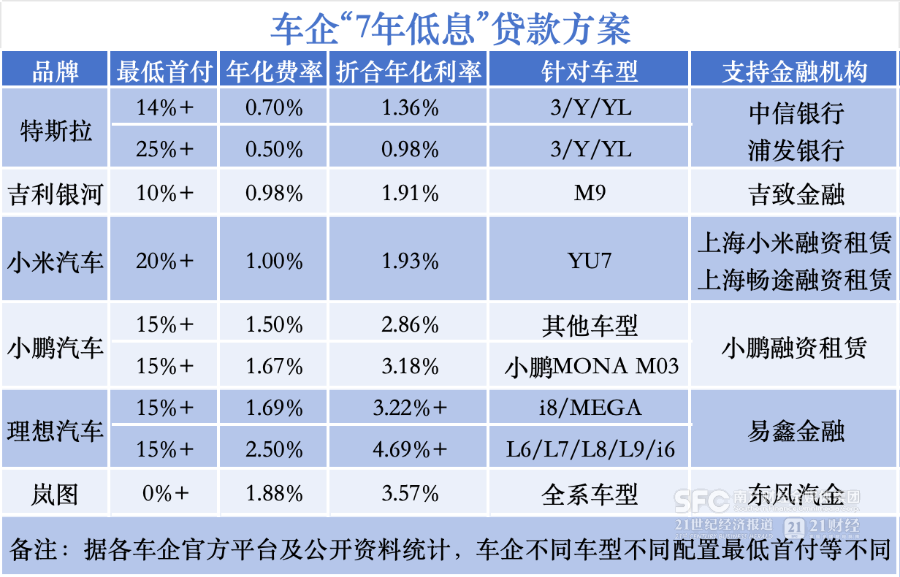
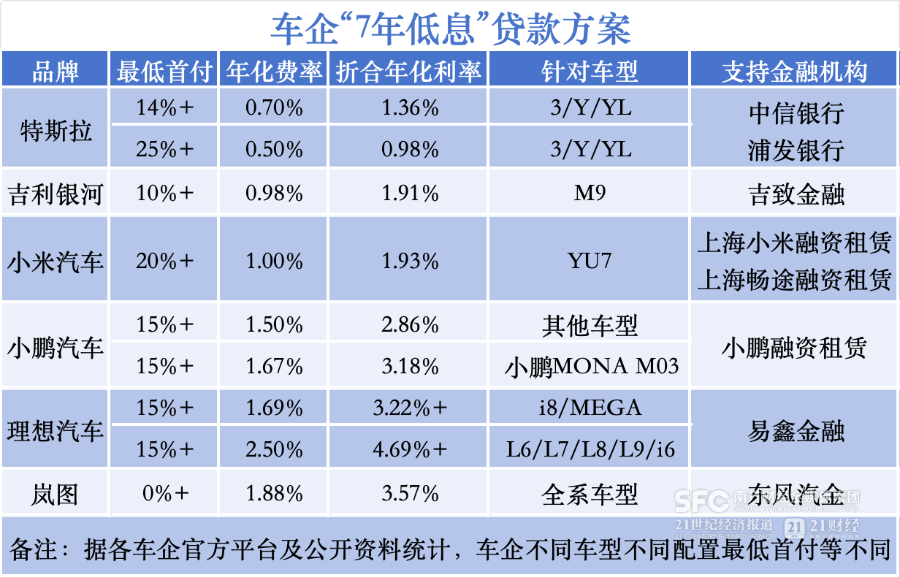
Core Insights - The automotive industry is experiencing a promotional wave of "7-year low-interest" financing plans, initiated by companies like Tesla, Xiaomi, and Xpeng, aimed at stimulating consumer demand and increasing sales before the Chinese New Year [1][2][4] Group 1: Financing Plans Overview - Various automakers have launched "7-year low-interest" loan policies to lower the purchase threshold and stimulate end-consumer demand [4] - The financing plans differ significantly among brands in terms of lending institutions, down payment requirements, funding costs, and model coverage [4][5] - Tesla offers a lower financing cost with a 0.50% annualized fee for a 25%+ down payment option, while other brands like Li Auto have higher costs, reaching up to 2.50% [5][6] Group 2: Consumer Impact - The extended repayment period significantly reduces monthly payment pressure for consumers, but total interest payments will increase [8][10] - For example, under Xiaomi's "7-year low-interest" plan, a consumer would pay a total interest of 14,252.28 yuan over the loan period [8] - Consumers are advised to assess their financial situation carefully, as the longer loan terms may lead to increased financial strain if not managed properly [17] Group 3: Market Dynamics - The push for longer loan terms aligns with national policies aimed at boosting consumption, allowing banks to extend personal consumption loan terms from 5 to 7 years [2] - The automotive market is seeing a shift in consumer preferences, with some opting for higher upfront payments to avoid long-term debt, while others appreciate the lower monthly payments offered by extended loans [10][15] - Concerns about vehicle depreciation and residual values are heightened with longer loan terms, especially for electric vehicles, which may face rapid technological obsolescence [10][11] Group 4: Risk and Regulatory Considerations - Financial institutions face increased risk management challenges due to the longer loan terms and lower down payments, necessitating more stringent consumer assessments [15][16] - The distinction between traditional auto loans and financing leases is crucial, as ownership rights differ significantly, impacting consumer decisions [20][21] - Legal experts emphasize the importance of understanding contract terms related to ownership and repayment obligations in financing leases [22][23]
车企掀7年低息促销潮,特斯拉、小米、小鹏等都在列,月供低至千元
21世纪经济报道· 2026-01-28 00:53
Core Viewpoint - The article discusses the recent trend of car manufacturers offering "7-year low-interest" financing plans to stimulate consumer demand, driven by government policies aimed at boosting consumption [2][5]. Group 1: Financing Trends - Various car manufacturers, including Tesla, Xiaomi, and Xpeng, have launched "7-year low-interest" financing options, breaking away from the traditional 1-5 year loan terms [1][5]. - The financing plans are designed to lower monthly payments and initial down payments, making it easier for consumers to purchase vehicles [1][5]. - The trend is a response to government initiatives encouraging consumer spending, particularly before the Lunar New Year [2][5]. Group 2: Loan Details and Variations - The financing options vary significantly among manufacturers, particularly in terms of lending institutions, down payment requirements, and interest rates [5][6]. - Tesla offers competitive rates, with a 0.50% annual fee translating to an effective annual rate of 0.98% for those making a 25% down payment [6]. - Other brands like Li Auto and Xpeng have higher effective annual rates, ranging from 1.9% to 4.69%, indicating a broader range of financing costs [6]. Group 3: Consumer Perception and Financial Implications - Consumers generally perceive the "7-year low-interest" loans as a way to reduce monthly financial burdens, although total interest payments may increase over the loan term [8][10]. - For example, a Xiaomi YU7 financed over 7 years with a 1% annual fee results in a total interest payment of approximately 14,252.28 yuan [8]. - Some consumers express caution, preferring to pay in full rather than take on long-term debt, indicating a desire to avoid overextending financially [10]. Group 4: Risk and Valuation Concerns - The longer loan terms raise concerns about vehicle depreciation and residual values, especially for electric vehicles, which may not hold their value as well as traditional combustion vehicles [11][14]. - The article notes that the average resale value for electric vehicles is lower than that of traditional vehicles, which could pose risks for consumers taking on long-term loans [11][14]. - The article highlights that the main models offered under these financing plans have relatively high resale values, which may mitigate some concerns [11][13]. Group 5: Consumer Eligibility and Approval Process - The approval process for "7-year low-interest" loans is more stringent, requiring higher credit qualifications compared to shorter-term loans [14][15]. - Financial institutions are increasing their risk assessment criteria, necessitating thorough evaluations of consumers' long-term repayment capabilities [14][15]. - Consumers are advised to assess their financial situations carefully before opting for these extended loan terms to avoid potential rejections or financial strain [15].

21调查|7年期车贷来了 车企“超低息”大促有点儿猛
2 1 Shi Ji Jing Ji Bao Dao· 2026-01-27 14:33
Core Viewpoint - The automotive industry is experiencing a promotional wave of "7-year low-interest" financing plans, driven by government policies aimed at boosting consumer spending and sales before the Lunar New Year [2][5]. Group 1: Promotional Trends - Multiple automakers, including Tesla, Xiaomi, Xpeng, Li Auto, Geely Galaxy, and Lantu, have launched "7-year low-interest" financing options, breaking away from the traditional 1-5 year loan terms [1][5]. - The promotional period for these financing plans is limited, primarily from January to February 2026, aimed at increasing sales volume [6]. Group 2: Financing Details - The financing plans vary significantly among automakers in terms of lending institutions, down payment requirements, and annualized interest rates [6][7]. - Tesla offers a minimum down payment of 14% with an annualized interest rate as low as 0.98% for certain plans, while other brands like Li Auto have higher rates, reaching up to 4.69% [3][7]. - The down payment requirements range from 0% for Lantu to over 25% for Tesla, indicating a wide disparity in accessibility for consumers [6][7]. Group 3: Consumer Impact - The extended loan terms reduce monthly payment burdens, making it easier for consumers to afford new vehicles, but they also lead to higher total interest payments over the loan's duration [10]. - For example, a Xiaomi YU7 financed over 7 years results in a total interest payment of approximately 14,252.28 yuan, compared to a higher monthly payment with a shorter loan term [10]. Group 4: Market Dynamics - The introduction of these financing options is a response to consumer demand for lower upfront costs and monthly payments, particularly before the Lunar New Year [2][5]. - However, concerns about vehicle depreciation and the long-term viability of such financing options exist, especially given the rapid technological advancements in electric vehicles [13][14]. Group 5: Risk and Regulation - Financial institutions face increased risk management challenges due to the longer loan terms and lower down payments, necessitating more stringent consumer assessments [19][20]. - The approval process for "7-year low-interest" loans is more rigorous, with banks requiring higher credit qualifications compared to shorter-term loans [20][21].