相控阵

Search documents
卫星互联网低轨19组卫星成功发射
Ren Min Wang· 2026-01-20 08:16
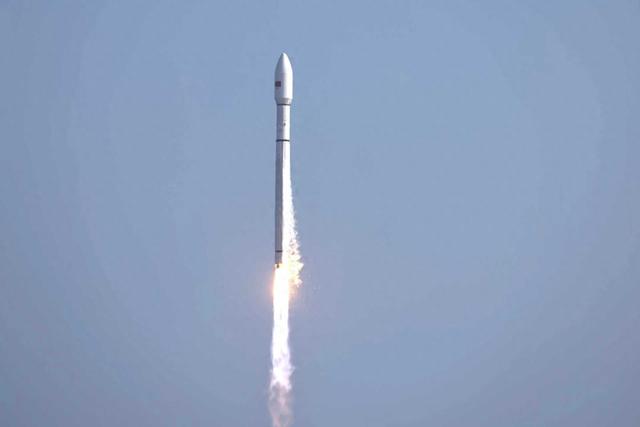
Core Viewpoint - The successful launch of 19 low Earth orbit satellites for satellite internet by China on January 19, 2023, marks a significant advancement in the country's commercial space capabilities and satellite technology [1] Group 1: Launch Details - The launch was conducted using the Long March 12 rocket at the Hainan commercial space launch site, achieving a successful mission with the satellites entering their designated orbits [1] - The Long March 12 rocket is a new generation of cryogenic liquid launch vehicle developed by the China Aerospace Science and Technology Corporation, with a near-Earth orbit carrying capacity of no less than 12 tons and a 700 km sun-synchronous orbit capacity of no less than 6 tons [1] - This launch represents the 628th mission of the Long March series of rockets [1] Group 2: Satellite Technology - The 19 satellites were developed by Galaxy Space, featuring core technologies such as phased array, millimeter-wave antennas, integrated electronics, and energy systems aimed at reducing costs [1] - The development process of this batch of satellites achieved a fully digital workflow for the first time, incorporating automated testing, intelligent assembly and inspection, and optimized launch site processes to significantly enhance efficiency [1]
中国星网低轨19组卫星成功发射 卫星研制方系银河航天
Guo Ji Jin Rong Bao· 2026-01-19 17:27
Core Insights - Satellite mass production has become a key capability for the development of new space infrastructure [2][3] - The China Star Network, responsible for the first giant satellite internet project in China, aims to establish a global integrated communication system with a target of 400 satellites in orbit by 2027 [2] Group 1: Company Overview - Galaxy Space, founded in 2018, is a leading private satellite internet company in China and the first unicorn in the commercial space sector [3] - The company focuses on the independent research and low-cost mass production of communication payloads, core components, and satellite platforms [3] Group 2: Technological Advancements - The recent satellite group developed by Galaxy Space incorporates several core technologies, including phased array, millimeter-wave antennas, and integrated electronics, showcasing industry-leading technical levels and cost advantages [3] - The company has achieved a fully digital process for satellite production, implementing automated testing, intelligent assembly, and optimized launch procedures to significantly enhance production efficiency [3] Group 3: Recent Developments - On January 19, 2024, Galaxy Space successfully launched a group of 19 low-orbit satellites, marking its second batch of satellites for space infrastructure construction [2] - The company’s satellite factory has established a complete industrial ecosystem from component development to satellite integration testing, continuously improving batch production efficiency and shortening development cycles [3]

我国成功发射卫星互联网低轨19组卫星 银河航天承担研制
Zheng Quan Ri Bao Wang· 2026-01-19 11:46
Group 1 - The successful launch of 19 low-orbit satellites by Galaxy Space using the Long March 12 rocket marks a significant achievement in China's commercial space sector, which is transitioning from a supplementary role to a strategic pillar in national space infrastructure [1] - The satellites are equipped with advanced technologies developed by Galaxy Space, including phased array antennas and integrated electronic systems, enhancing cost-effectiveness and operational efficiency [1] - The development process of these satellites has achieved a fully digital workflow, incorporating automated testing and intelligent assembly, which significantly improves production efficiency [1] Group 2 - The rapid growth of space infrastructure construction is evident, particularly in satellite broadband and mobile direct-to-satellite markets, with Galaxy Space successfully launching satellites capable of direct mobile connectivity [2] - China's commercial space sector is evolving from experimental exploration to ecological cultivation, with Galaxy Space securing numerous satellite product orders and successfully launching over 40 advanced satellites, establishing a commercial loop [2] - To seize opportunities in the new space era, Galaxy Space is committed to continuous innovation, supporting the development of a modern, self-reliant aerospace industry in China [2]
低轨卫星19组成功发射:银河航天承担研制,GW星座部署提速
2 1 Shi Ji Jing Ji Bao Dao· 2026-01-19 11:46
Group 1 - The deployment speed of the GW constellation has accelerated from a "bi-monthly launch" to a "weekly launch" within 13 months, with the latest batch of 19 satellites launched just 6 days after the previous group [1] - The GW constellation features a dual-layer design, with the GW-A59 sub-constellation planning for 6,080 satellites in very low Earth orbit (VLEO) below 500 km, and the GW-A2 sub-constellation planning for 6,912 satellites in low Earth orbit (LEO) at 1,145 km [1] - The satellites are developed by Galaxy Space, which has independently undertaken the development of two groups of such space infrastructure satellites, utilizing advanced technologies such as phased array antennas and digital full-process integration for cost-effective production [1] Group 2 - The recent launch is the second mission from the Hainan commercial space launch site in 2026 and marks the 12th successful launch from this site [2] - A new command team was introduced for this mission, including five new commanders, with the chief commander being a post-90s individual, marking a first for the Hainan commercial launch company [2] - The team implemented a "status confirmation system" to optimize task processes and improve work efficiency, accommodating the high-frequency networking demands of the SF-13 mission [2]
卫星互联网低轨19组卫星发射,北京商业航天企业承研
Xin Lang Cai Jing· 2026-01-19 09:56
Group 1 - The successful launch of 19 low-orbit satellites by the company Galaxy Space using the Long March 12 rocket marks a significant achievement in China's commercial space sector [1] - The satellites are equipped with core technologies developed by Galaxy Space, including phased array antennas and millimeter-wave technology, showcasing advancements in digital and automated production processes [3] - The company has successfully launched over 40 satellites, establishing a commercial closed loop and indicating a shift from experimental exploration to ecosystem cultivation in China's commercial space industry [3] Group 2 - The rapid growth of space infrastructure construction is highlighted, with increasing demand for satellite broadband and direct satellite connectivity for mobile phones [3] - Galaxy Space has developed a complete industrial ecosystem for satellite production, including components research, manufacturing, and integration testing, positioning itself for future growth in the space infrastructure market [3] - The company is actively pursuing technological innovation to embrace the upcoming 6G era, having successfully tested satellites with direct mobile connectivity capabilities [3]