
卫星批产

Search documents
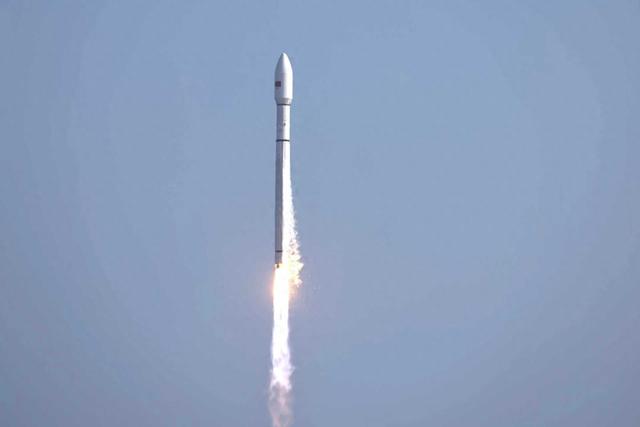
卫星互联网低轨19组卫星发射,北京商业航天企业承研
Xin Lang Cai Jing· 2026-01-19 09:56
Group 1 - The successful launch of 19 low-orbit satellites by the company Galaxy Space using the Long March 12 rocket marks a significant achievement in China's commercial space sector [1] - The satellites are equipped with core technologies developed by Galaxy Space, including phased array antennas and millimeter-wave technology, showcasing advancements in digital and automated production processes [3] - The company has successfully launched over 40 satellites, establishing a commercial closed loop and indicating a shift from experimental exploration to ecosystem cultivation in China's commercial space industry [3] Group 2 - The rapid growth of space infrastructure construction is highlighted, with increasing demand for satellite broadband and direct satellite connectivity for mobile phones [3] - Galaxy Space has developed a complete industrial ecosystem for satellite production, including components research, manufacturing, and integration testing, positioning itself for future growth in the space infrastructure market [3] - The company is actively pursuing technological innovation to embrace the upcoming 6G era, having successfully tested satellites with direct mobile connectivity capabilities [3]

商业航天,进入深度洗牌期
3 6 Ke· 2026-01-04 10:22
Core Insights - The Chinese commercial space industry is transitioning from a "technical validation period" to a commercialization and scaling phase, with 2026 marking a pivotal year for the sector [1] - Increased investment from social capital and state-owned funds is driving the market, while challenges such as tight launch site availability and the need for cost-effective solutions are emerging [1][2] - The industry is undergoing a deep reshuffle focused on cost, capacity, and delivery capabilities, moving away from exploratory phases to a more structured competitive environment [1][4] Investment Trends - Recent surges in interest for leading commercial space projects have led to a rapid consumption of existing shares, with state-owned institutions actively seeking to invest [2] - The market's recognition of top commercial space companies is becoming clearer, leading to a more concentrated investment focus [2][3] - The total financing for commercial space reached 18.6 billion yuan in 2025, a 32% increase year-on-year, with rocket manufacturing and satellite applications being the primary areas attracting capital [4] Policy Support - The Chinese government has been increasingly supportive of the commercial space sector since 2015, with recent reports emphasizing the promotion of commercial space industry clusters [3] - New guidelines for commercial rocket companies to access the domestic capital market have improved long-term capital expectations for the sector [3] Industry Dynamics - The number of commercial rocket launches in China exceeded 92 in 2025, marking a 48% year-on-year increase, indicating a significant uptick in industry activity [6] - Major players like Blue Arrow Aerospace and Starry Sky Power are leading advancements in reusable rocket technology, which is crucial for reducing launch costs [7][10] - The competitive landscape is expected to consolidate, with only 5-6 leading companies likely to survive due to the high sensitivity of pricing in the industry [8] Launch Infrastructure - The availability of launch sites is a critical bottleneck, with only 18 operational commercial launch sites as of mid-2025, leading to long wait times for launches [13][15] - New launch facilities are being planned to alleviate the pressure, but the timeline for these developments means that resource constraints may persist in the near term [15] Satellite Manufacturing - The shift from traditional satellite manufacturing to a more industrialized, batch production model is underway, driven by the need for large-scale satellite constellations [16][17] - Companies are adopting advanced manufacturing techniques to enhance production efficiency, significantly reducing the time required to manufacture satellites [18] - The growth of commercial space enterprises is contributing to the evolution of satellite production, with a focus on automation and modular assembly [17][18] Future Outlook - The year 2026 is anticipated to be a critical year for the development of reusable rockets, with multiple models set to compete in the market [12][9] - The industry's focus will shift towards long-term, stable, and low-cost operations, determining the success of commercial space companies [18]
商业航天2026:老股或遭疯抢
财联社· 2026-01-03 04:36
Core Viewpoint - The Chinese commercial aerospace industry is transitioning from a technology validation phase to a commercialization and scaling phase, with 2026 marking a critical turning point for the industry [2][3]. Group 1: Investment Trends - There is a surge in social capital and state-owned fund investments in leading commercial aerospace projects, with a notable increase in inquiries about the transfer of existing shares [4]. - The demand for old share transfers has significantly increased since the second half of 2025, indicating a growing interest from institutions in entering the commercial aerospace sector [5]. - The commercial aerospace sector is now recognized as a strategically significant emerging industry, with state-owned capital increasingly participating in this space [4][5]. Group 2: Policy and Market Dynamics - The government has been actively promoting the development of commercial aerospace, with recent reports emphasizing the need for industry cluster development [6]. - The introduction of specific listing standards for commercial rocket companies on the Sci-Tech Innovation Board has opened up new funding avenues for these firms [6][7]. - The overall financing in the commercial aerospace sector reached 18.6 billion yuan in 2025, a 32% increase year-on-year, with rocket manufacturing and satellite applications being the primary areas attracting investment [7]. Group 3: Industry Competition and Challenges - The commercial rocket launch industry is undergoing a significant reshuffle, with at least 10 companies initiating IPO processes, indicating a rapid acceleration in the market [8]. - The number of rocket launches in China exceeded 92 in 2025, marking a 48% increase, reflecting the industry's growing capabilities [9]. - The competition is intensifying, particularly around the development of reusable rockets, which are crucial for reducing launch costs and achieving market dominance [10][11]. Group 4: Technological Advancements - The focus on reusable rockets is becoming critical, with companies aiming to reduce launch costs significantly, targeting a cost of under 20,000 yuan per kilogram [11][12]. - The domestic reusable rocket technology is still in a catch-up phase, with various companies pursuing different technical routes [13]. - By 2026, multiple models of reusable rockets are expected to compete, with significant advancements anticipated in the first half of the year [14][15]. Group 5: Satellite Manufacturing Evolution - The traditional model of satellite manufacturing is shifting towards batch production, driven by the large-scale requirements of low Earth orbit satellite constellations [18][19]. - Companies are adopting industrialized production methods to enhance efficiency and reduce manufacturing cycles, with some firms achieving an 80% reduction in production time [20]. - The growth of satellite manufacturing capabilities is essential for supporting the deployment of large satellite constellations, which is becoming a critical aspect of the commercial aerospace landscape [19][20].

带你探秘银河航天!他们是如何“造星”“织网”的
Jin Rong Shi Bao· 2025-06-20 14:46
Core Insights - Galaxy Space is recognized as China's first unicorn in the commercial aerospace sector, having successfully launched 25 advanced satellites, including the world's first high-frequency low-orbit millimeter-wave satellite and China's first batch of low-orbit broadband communication satellites [1][2] Group 1: Satellite Development and Launches - The company has demonstrated its vertical integration capabilities by successfully launching four InSAR satellites on March 30, 2023, with all components being independently controlled [1] - The successful launch of the Lingxi 03 satellite on July 23, 2023, marked the first use of flexible solar wings in a satellite, supporting low-orbit broadband communication and validating multi-satellite stacking technology [1] Group 2: Industry Landscape and Achievements - Beijing is the birthplace of China's aerospace industry, hosting over 50% of the core R&D units and a majority of the national aerospace infrastructure and specialized technical talent [2] - The city has seen the successful launch of eight low-orbit broadband communication satellites, establishing China's first low-orbit broadband communication experimental constellation, known as the "Little Spider Web" [2] - Over 300 high-tech enterprises in the commercial aerospace sector are based in Beijing, covering the entire industry chain from launch vehicles to satellite manufacturing and application services, forming a "South Arrow North Star" pattern [2]