石油ETF富国

Search documents
金融工程日报:沪指低开震荡,封板率创近一个月新低-20260309
Guoxin Securities· 2026-03-09 13:58
- The market experienced a broad decline, with the CSI 1000 index performing relatively well among scale indices[2][6] - The coal, computer, electric power, and petroleum and petrochemical industries performed well, while the communication, transportation, machinery, electronics, and non-bank industries performed poorly[2][7] - The photovoltaic inverter, high transfer, IDC (computing power leasing), Zhipu AI, and cloud computing concepts performed well, while the PTA, shipping selection, port selection, airport selection, and cultivated diamond concepts performed poorly[2][10] - The market sentiment showed 50 stocks hitting the daily limit up and 10 stocks hitting the daily limit down, with a sealing rate of 53% and a continuous board rate of 15%, marking the lowest sealing rate in nearly a month[2][13][17] - The financing balance was 26,277 billion yuan, and the securities lending balance was 179 billion yuan, with the two financing balances accounting for 2.5% of the circulating market value and 9.1% of the market turnover[2][19][22] - The ETF with the highest premium was the Sci-Tech Composite Index Enhanced ETF, and the ETF with the highest discount was the Petroleum ETF[3][24] - The median annualized discount rates for the main contracts of the SSE 50, CSI 300, CSI 500, and CSI 1000 stock index futures over the past year were 0.78%, 3.96%, 11.01%, and 13.37%, respectively[3][29] - The stocks with the most institutional attention in the past week included Litong Technology, Guangli Technology, Siling Zhiju, Guoji Jinggong, Xinkaiyuan, Yi Wang Yi Chuang, Aipeng Medical, and Wanxiang Qianchao[4][31] - The top ten stocks with net inflows from institutional seats included Dongyangguang, Wanze Shares, Hand Information, Shunwang Technology, Huilv Ecology, COSCO Shipping Energy, Tuowei Information, China Merchants South Oil, Southern Network Energy, and Meiliyun[4][36] - The top ten stocks with net inflows from Northbound Trading included Huasheng Tiancheng, COSCO Shipping Energy, Intercontinental Oil & Gas, Shunwang Technology, China Merchants South Oil, Southern Network Energy, Tongkun Shares, Guodian Nanzi, Southern Network Digital, and Zeyu Intelligent[4][37]
历史性两连板!溢价超20%,换手率翻倍,新一轮石化周期来临?
券商中国· 2026-03-04 01:31
Core Viewpoint - The article discusses the recent surge in oil prices driven by geopolitical tensions, particularly between the U.S. and Iran, and highlights the investment opportunities in oil stocks and ETFs as a result of this situation [2][3][5]. Group 1: Oil Price Surge - The "Big Three" oil companies in China experienced historic stock price increases, with collective trading halts due to price surges on March 2 and 3 [2][3]. - Brent crude oil prices have risen sharply since mid-February, driven by concerns over shipping safety in the Strait of Hormuz and potential disruptions in oil supply [3][5]. - Multiple factors are contributing to the current oil price spike, including geopolitical catalysts, improved supply-demand dynamics, and supply clearing [2][5]. Group 2: ETF Performance - Several oil and gas ETFs saw significant price increases, with some reaching their daily limit, indicating strong investor interest [3][4]. - The SPDR S&P Oil & Gas ETF experienced a premium rate of 20.76%, while another ETF had a premium of 16.36%, leading to trading halts to manage market volatility [3][4]. - High turnover rates were observed in oil-related ETFs, with some exceeding 100%, reflecting active trading and investor engagement [4]. Group 3: Economic Implications - The geopolitical tensions are expected to create short-term volatility in the market, but the long-term impact on the economy may be limited [6]. - Rising oil prices could increase consumer spending costs, particularly affecting low-income households, and may also contribute to inflationary pressures [6]. - Despite the potential economic challenges, the overall market sentiment remains relatively strong, with consumer confidence and stock market performance showing resilience [6]. Group 4: Broader Market Impact - The escalation of tensions in the Middle East has led to increased interest in gold and other safe-haven assets, with gold prices surpassing $5,300 per ounce [7]. - The chemical industry is experiencing a recovery, with demand improving alongside domestic production resuming, indicating a shift from reliance on oil price increases to profitability recovery and market optimization [7][8]. - The current oil and chemical market dynamics suggest a clear logic for investment, driven by geopolitical factors, improved supply conditions, and recovering demand [7][8].

满屏涨停!原油基金,太火爆!这些产品却大跳水,是何缘故?
券商中国· 2026-03-03 09:42
Core Viewpoint - The article highlights the ongoing surge in oil prices and the strong performance of oil and gas-related funds, while also noting a significant pullback in military, silver, and gold funds, indicating a mixed sentiment in the resource sector [1][3][4]. Oil and Gas Sector Performance - Multiple oil and gas ETFs, including those from 嘉实, 银华, 富国, 博时, and 汇添富, have hit the daily limit up, reflecting a robust market sentiment [1][4]. - As of March 3, the WTI crude oil price increased by 5.02% to $74.803 per barrel, while Brent crude rose by 5.03% to $81.653 per barrel [2]. - Year-to-date, several oil and gas ETFs have recorded gains exceeding 40%, with some surpassing 60% [4][5]. Fund Performance and Market Trends - The article provides a detailed table of various funds, showing significant daily and year-to-date returns for oil-related funds, with some funds like 原油LOF易方达 and 石油基金LOF achieving daily increases of around 10% [2][6]. - Conversely, military and precious metal funds experienced notable declines, with silver funds dropping over 8% and military funds falling by approximately 6% [3][5]. Market Sentiment and Future Outlook - The article notes a divergence in resource fund performance, with oil and gas funds continuing to rise while other sectors like military and precious metals face corrections [4][5]. - Analysts suggest that while the resource sector remains promising, there is a need for caution regarding short-term trading risks, emphasizing a return to fundamental analysis for investment decisions [8][10]. - The geopolitical landscape, particularly tensions involving Iran, is influencing oil prices and market dynamics, with potential implications for supply chains and inflation [9][11]. Strategic Insights - Investment strategies are shifting towards a focus on long-term fundamentals rather than short-term market movements, with an emphasis on cost analysis and sector rotation within the resource space [10]. - The article suggests that the demand structure is transitioning from real estate-driven to manufacturing-driven, particularly in technology and industrial sectors, which may present new investment opportunities [10].
油气板块大涨!买哪只ETF?一文看懂!
Zhong Guo Ji Jin Bao· 2026-02-24 11:19
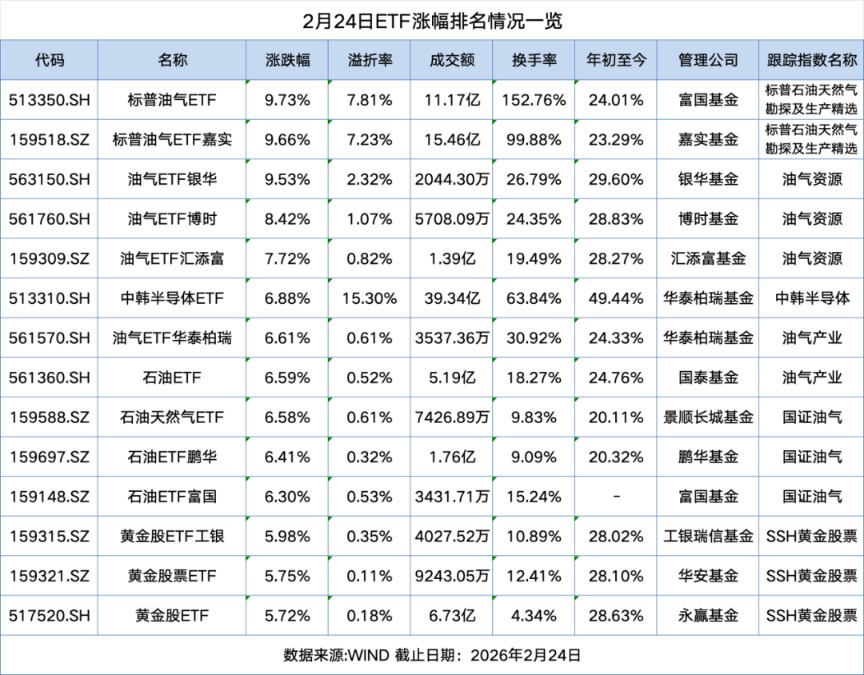
Core Viewpoint - The oil and gas sector has shown strong performance, with multiple oil ETFs leading the market on the first trading day after the Spring Festival, reflecting a significant increase in investor interest and market activity [1][4][10]. ETF Performance Summary - On February 24, a total of 919 ETFs rose, with the highest increase reaching 9.73%. The leading oil ETFs included: - The S&P Oil & Gas ETF (513350) increased by 9.73%, with a trading volume of 1.117 billion and a turnover rate of 152.76% [2][8]. - The S&P Oil & Gas ETF by Harvest Fund (159518) rose by 9.66%, with a trading volume of 1.546 billion and a turnover rate of 99.88% [2][8]. - Other notable increases included the Silverhua Oil & Gas ETF (563150) at 9.53% and the Bosera Oil & Gas ETF (561760) at 8.42% [6][7]. Market Trends - The oil and gas sector's strong performance is attributed to geopolitical risks and a tight supply-demand situation, leading to a significant rise in related stock prices and indices [10]. - The market is currently driven by geopolitical factors rather than supply-demand dynamics, with expectations of high volatility in oil prices in the near term [10]. ETF Index Tracking - There are four main oil and gas indices tracked by ETFs in the domestic market: - CSI Oil and Gas Resource Index (931248) - CSI Oil and Gas Industry Index (H30198) - National Oil and Gas Index (399439) - S&P Oil & Gas Exploration and Production Select Industry Index (SPSIOP) [5][17]. - The ETFs tracking these indices have shown similar performance, with the same fee structure and relatively close year-to-date returns [19]. Investor Considerations - Investors are advised to be cautious as the S&P Oil & Gas ETF has issued a premium risk warning, indicating that its market price is significantly higher than its indicative net asset value (IOPV), which could lead to potential losses if investments are made blindly [10].