标普油气ETF

Search documents
北向资金联手机构扫货通鼎互联,游资与机构激烈博弈航天彩虹
摩尔投研精选· 2026-03-04 10:16
Core Viewpoint - The article highlights the trading activities in the Shanghai and Shenzhen stock markets, focusing on the top traded stocks, sector performances, and significant fund flows, indicating potential investment opportunities and market trends. Group 1: Trading Volume and Top Stocks - The total trading volume of the Shanghai and Shenzhen Stock Connect reached 329.78 billion, with Zijin Mining and Zhongji Xuchuang leading in trading volume for the Shanghai and Shenzhen markets respectively [1] - The top ten stocks by trading volume in the Shanghai market included Zijin Mining (26.03 billion), Kweichow Moutai (18.89 billion), and Zhaoyi Innovation (18.34 billion) [4] - In the Shenzhen market, Zhongji Xuchuang topped the list with 37.15 billion, followed by CATL (29.25 billion) and Tianfu Communication (27.93 billion) [5] Group 2: Sector Performance - The electric grid equipment sector saw the highest net inflow of funds, amounting to 28.54 billion, with a net inflow rate of 2.50% [7] - Other sectors with notable performance included agriculture and military industries, while sectors like port shipping, natural gas, and coal experienced declines [6][9] Group 3: Fund Flows - The top ten stocks with net inflows included Baiwei Storage (10.68 billion) and Huagong Technology (6.70 billion), indicating strong interest from institutional investors [10] - Conversely, the stocks with the highest net outflows were led by Zijin Mining (-18.79 billion) and Zhongji Xuchuang (-17.91 billion), suggesting potential caution among investors [11][12] Group 4: ETF Trading - The top traded ETF was the Gold ETF (518880) with a trading volume of 109.81 billion, followed by the A500 ETF (512050) at 101.82 billion [14] - The S&P Oil & Gas ETF (513350) saw a remarkable 509.95% increase in trading volume compared to the previous trading day, indicating heightened investor interest [15] Group 5: Institutional and Retail Activity - Institutional activity was notable, with Tongding Interconnection receiving 202 million from four institutions, while Aerospace Rainbow faced significant selling pressure [17] - Retail investors showed interest in stocks like Baiwei Storage and Tongding Interconnection, with substantial buying activity reported [19]


ETF市场日报 | 中韩半导体ETF暴涨9.64%,短融ETF成交破660亿
Sou Hu Cai Jing· 2026-02-26 08:15
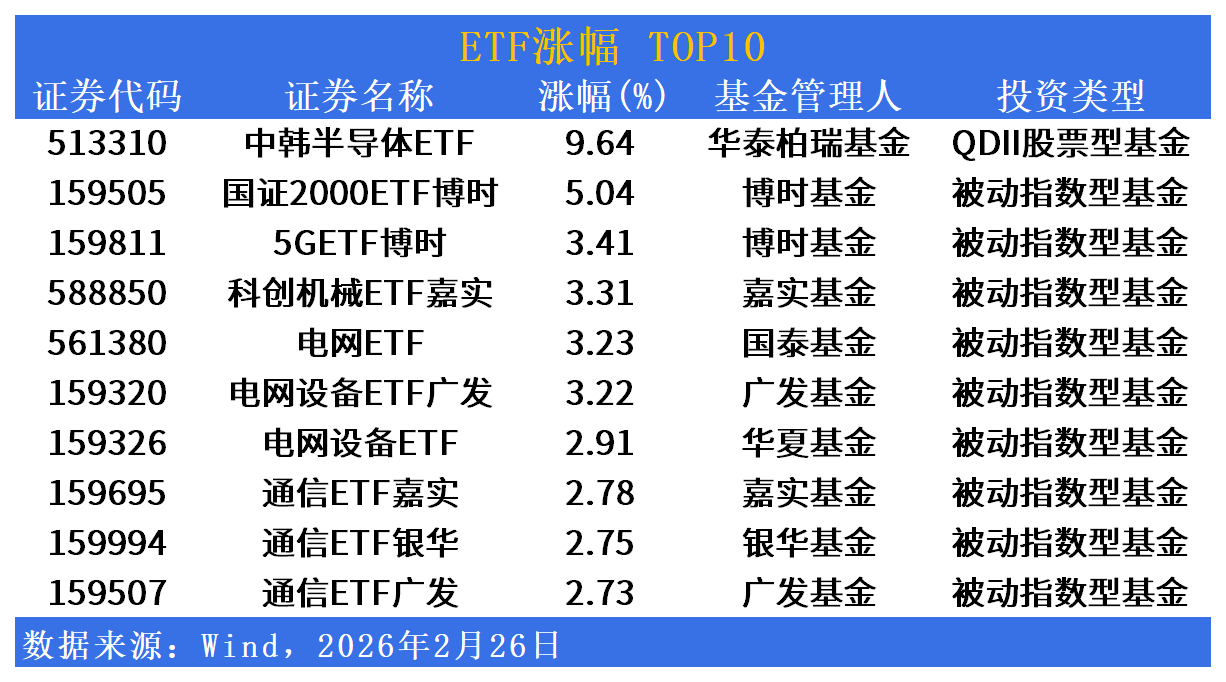
Market Overview - A-shares showed mixed performance with the Shanghai Composite Index down 0.01%, Shenzhen Component Index up 0.19%, and ChiNext Index down 0.29% as of market close [1] - Total trading volume in Shanghai, Shenzhen, and Beijing reached 25,568 billion, an increase of 756 billion from the previous day [1] ETF Performance - The China-Korea Semiconductor ETF surged by 9.64%, leading the market, driven by the recovery in the semiconductor supply chain [2] - The National 2000 ETF rose by 5.04%, indicating a rebound in small-cap growth stocks [2] - The Electric Grid sector performed well, with the Electric Grid ETF up 3.23% and the Electric Grid Equipment ETFs rising by 3.22% and 2.91% respectively [2] Communication Sector - The communication sector also saw gains, with ETFs in this category rising between 2.73% and 2.78% [3] Declining Sectors - The pharmaceutical sector faced a broad retreat, with the Hang Seng Biotechnology ETF showing the largest decline at -3.89% [4] - Other related ETFs in the healthcare and biotechnology sectors also experienced significant drops, indicating a market shift from defensive sectors to technology growth [4] Trading Activity - The Short-term Bond ETF had a trading volume exceeding 66 billion, leading in activity among ETFs [5] - The top traded ETFs included the Short-term Bond ETF at 661.12 billion and the Silver Day Benefit ETF at 167.16 billion [5] Turnover Rates - Cross-border products showed high trading activity, with the Brazil ETF and China-Korea Semiconductor ETF having turnover rates of 171.99% and 125.76% respectively [6][7] - The National Debt ETF also maintained a strong turnover rate of 88.09%, indicating active trading in interest rate bonds and cross-border assets [7] New ETF Launch - A new Technology Growth ETF by Industrial Bank is set to launch on February 27, with a focus on hard technology and a multi-factor strategy targeting the top 50 securities in various tech sectors [8]
稀土ETF走强 港股ETF成香饽饽
Zhong Guo Zheng Quan Bao· 2026-02-25 20:22
Market Overview - On February 25, the A-share market saw all major indices close in the green, with the ChiNext Index rising over 1.4% in a single day [1] - More than 1,000 out of over 1,400 ETFs in the market recorded gains, with rare earth and rare metal-themed ETFs performing particularly well [1] ETF Performance - On February 25, all eight industry-themed ETFs focused on rare earth and rare metals closed higher, with four products linked to the CSI Rare Earth Industry Index rising over 6% and reaching historical highs during trading [1][2] - The CSI Rare Earth Industry Index includes 43 constituent stocks, with only one stock declining by the close, while several stocks like Baotou Steel and Northern Rare Earth hit the daily limit [1][2] Fund Flows - On February 24, the ETF market experienced a net inflow of over 11 billion yuan, marking the highest single-day net inflow in six trading days [1] - ETFs focused on the Hong Kong market attracted significant capital, with seven of the top ten products by net inflow, totaling over 7 billion yuan [2] Investment Directions - The seven Hong Kong ETFs primarily target the Hang Seng Technology and Hong Kong Internet sectors, with four linked to the Hang Seng Technology Index [3] - Despite a strong performance in the Hong Kong market post-Chinese New Year, the Hang Seng Technology Index is still down over 4% year-to-date as of February 25 [3] Sector Insights - Analysts suggest that the strong performance of the rare earth sector is due to improved supply-demand dynamics, with demand driven by rapid developments in industries like robotics and low-altitude economy [2] - In contrast, energy-related ETFs have seen some pullback, with two S&P Oil & Gas ETFs experiencing the largest declines in the market [2] Future Investment Focus - Investment institutions are focusing on three main directions: technology, consumption, and resources, with emerging technology expected to be a key theme [3][4] - There is an emphasis on sectors with high growth potential, such as AI hardware, commercial aerospace, and smart driving, as well as undervalued sectors like food and beverage, construction materials, and renewable energy [4][5]
超30只QDII基金扎堆预警,纳指ETF溢价高企
2 1 Shi Ji Jing Ji Bao Dao· 2026-02-25 12:54
Core Viewpoint - The recent surge in premium risks associated with QDII funds has raised concerns, with over 30 funds announcing premium risks shortly after the Spring Festival holiday, indicating a significant disparity between secondary market prices and net asset values [1][2][6]. Group 1: Premium Risk Announcements - More than 30 QDII funds issued announcements regarding premium risks within two trading days after the Spring Festival, including products like Nasdaq ETF, S&P 500 ETF, and others [1][2]. - On February 25, eight QDII funds reported that their secondary market prices were significantly higher than their reference net asset values, with some products showing a premium of up to 6% [2]. - The frequency of premium risk announcements has increased, with some funds issuing multiple warnings within a short period [4]. Group 2: Trading Suspension Measures - Some QDII funds have taken suspension measures to protect investors, such as the E Fund's crude oil LOF, which suspended trading on February 25 due to high premium levels [3]. - The Huatai-PineBridge Korea-China Semiconductor ETF also suspended trading on February 24, indicating a proactive approach to manage premium risks [4]. Group 3: Market Dynamics and Investor Behavior - The high frequency of premium risks is attributed to two main factors: strong market interest in overseas high-growth assets and limited QDII investment quotas [6]. - Analysts suggest that the current high premiums may lead to significant losses for investors if they purchase QDII funds at inflated prices, emphasizing the need for caution [6]. - The overall market sentiment reflects a growing demand for cross-border investments, with a notable shift in investor behavior towards high-premium products [6][12]. Group 4: Purchase Restrictions - A significant number of QDII products are currently under purchase restrictions, with over 60% of them limiting new subscriptions due to tight quotas [10]. - Fund managers are implementing these restrictions to protect existing investors and ensure stable fund operations amid high demand [9][10]. - The trend of imposing purchase limits is becoming more common as fund managers seek to balance supply and demand in the context of limited foreign exchange quotas [8][10].
油气板块大涨!买哪只ETF?一文看懂!
Zhong Guo Ji Jin Bao· 2026-02-24 11:19
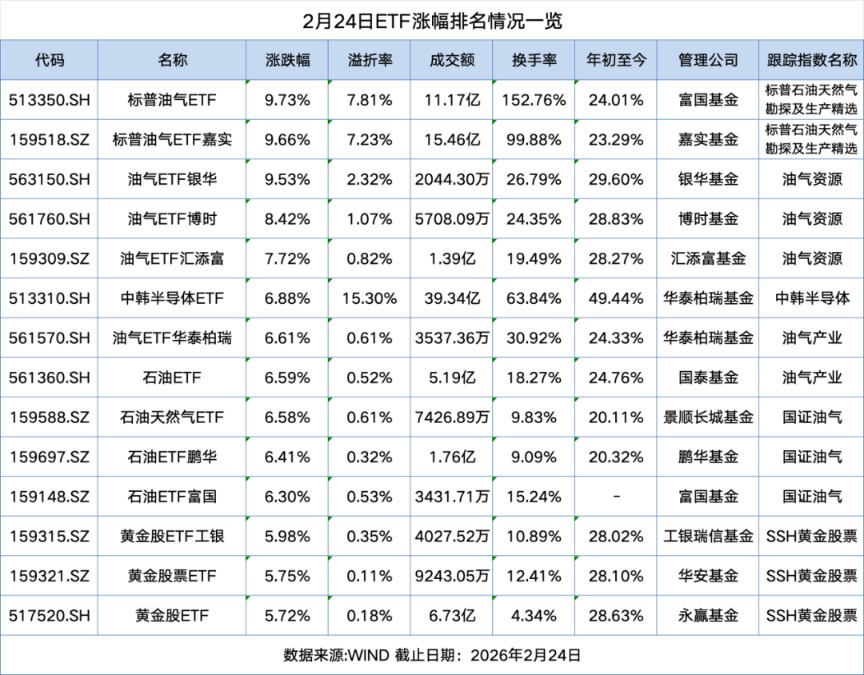
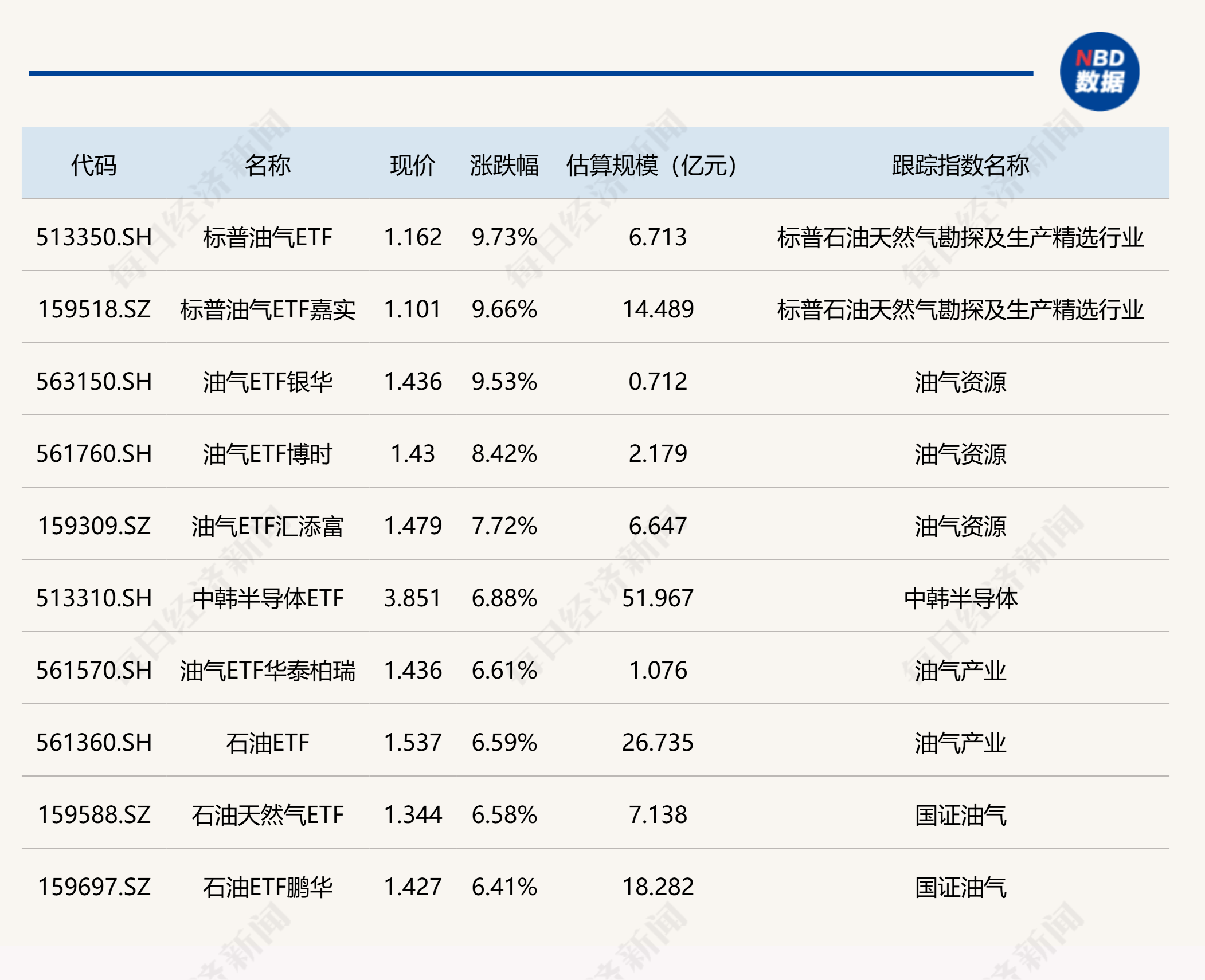
Core Viewpoint - The oil and gas sector has shown strong performance, with multiple oil ETFs leading the market on the first trading day after the Spring Festival, reflecting a significant increase in investor interest and market activity [1][4][10]. ETF Performance Summary - On February 24, a total of 919 ETFs rose, with the highest increase reaching 9.73%. The leading oil ETFs included: - The S&P Oil & Gas ETF (513350) increased by 9.73%, with a trading volume of 1.117 billion and a turnover rate of 152.76% [2][8]. - The S&P Oil & Gas ETF by Harvest Fund (159518) rose by 9.66%, with a trading volume of 1.546 billion and a turnover rate of 99.88% [2][8]. - Other notable increases included the Silverhua Oil & Gas ETF (563150) at 9.53% and the Bosera Oil & Gas ETF (561760) at 8.42% [6][7]. Market Trends - The oil and gas sector's strong performance is attributed to geopolitical risks and a tight supply-demand situation, leading to a significant rise in related stock prices and indices [10]. - The market is currently driven by geopolitical factors rather than supply-demand dynamics, with expectations of high volatility in oil prices in the near term [10]. ETF Index Tracking - There are four main oil and gas indices tracked by ETFs in the domestic market: - CSI Oil and Gas Resource Index (931248) - CSI Oil and Gas Industry Index (H30198) - National Oil and Gas Index (399439) - S&P Oil & Gas Exploration and Production Select Industry Index (SPSIOP) [5][17]. - The ETFs tracking these indices have shown similar performance, with the same fee structure and relatively close year-to-date returns [19]. Investor Considerations - Investors are advised to be cautious as the S&P Oil & Gas ETF has issued a premium risk warning, indicating that its market price is significantly higher than its indicative net asset value (IOPV), which could lead to potential losses if investments are made blindly [10].
ETF市场日报 | 影视游戏ETF重挫逾7%领跌,油气板块逆势爆发涨超9%
Sou Hu Cai Jing· 2026-02-24 07:56
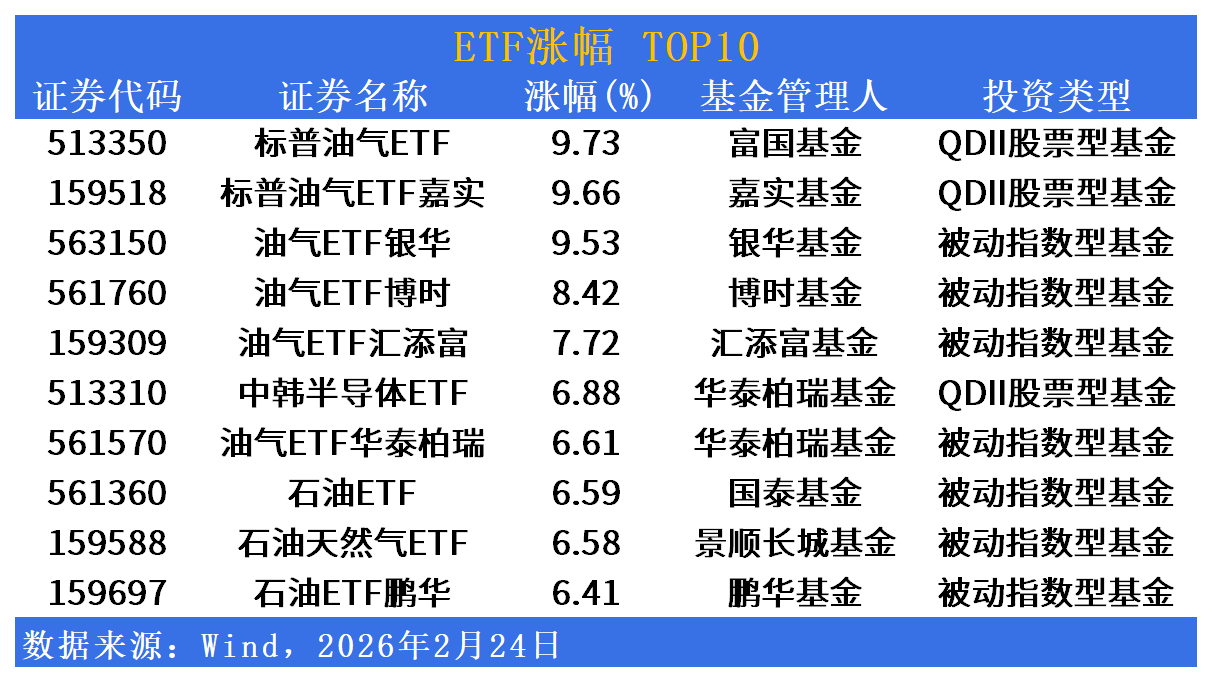
Market Overview - A-shares opened positively in the Year of the Horse, with the Shanghai Composite Index rising by 0.87%, the Shenzhen Component Index increasing by 1.36%, and the ChiNext Index up by 0.99% [1] - The total trading volume in Shanghai, Shenzhen, and Beijing reached 22,184 billion, an increase of 2,193 billion compared to the previous trading day [1] Sector Performance - The oil and gas sector experienced a significant surge, with the S&P Oil & Gas ETF rising nearly 10% in a single day [2] - The top-performing ETFs in the oil and gas category included: - S&P Oil & Gas ETF (213350) up by 9.73% - S&P Oil & Gas ETF by Harvest (159518) up by 9.66% - Oil & Gas ETF by Yinhua (263150) up by 9.53% [2] - The semiconductor sector saw the China-Korea Semiconductor ETF (513310) rise by 6.88%, making it the only technology stock in the top ten gainers [3] Declining Sectors - The film and gaming sectors faced significant adjustments, with multiple ETFs in these categories experiencing declines: - Film ETF (516620) down by 7.80% - Gaming ETF by Huatai (516770) down by 4.80% [4] - The Hong Kong internet sector also faced pressure, with several products dropping over 4% as market risk aversion increased [4] Trading Activity - The Short-term Bond ETF (211360) recorded a trading volume exceeding 55 billion, indicating strong activity in bond and cross-border products [5] - The top ETFs by trading volume included: - Short-term Bond ETF (211360) at 551.98 billion - Yinhua Daily Profit ETF (211880) at 189.18 billion [5] Turnover Rates - The Brazil ETF (159100) had a turnover rate of 216.31%, while the S&P Oil & Gas ETF (513350) had a turnover rate of 152.76%, indicating high trading activity in cross-border QDII products [6][7] - The China-Korea Semiconductor ETF (159700) also showed a turnover rate exceeding 120%, reflecting rapid fund rotation between fixed income and cross-border assets [7] New ETF Launch - Harvest Fund's Livestock ETF (159172) will begin fundraising on February 25, focusing on the entire livestock breeding industry chain [8] - The ETF will track the CSI Livestock Breeding Industry Index, covering sectors such as feed, livestock breeding, and meat processing, providing investors with a tool to invest in the pig breeding cycle [8]
ETF今日收评 | 多只油气相关ETF涨超9%,影视ETF跌超7%
Sou Hu Cai Jing· 2026-02-24 07:21
Market Overview - The market experienced a pullback after a rise, with the ChiNext Index briefly increasing by over 2% [1] - Oil and gas stocks collectively rose, while the film and AI application sectors saw significant declines [1] ETF Performance - Multiple oil and gas-related ETFs saw gains exceeding 9%, with specific performances as follows: - S&P Oil and Gas ETF (513350.SH) rose by 9.73% to 1.162 - S&P Oil and Gas ETF (159518.SZ) increased by 9.66% to 1.101 - Other notable ETFs include: - Oil and Gas ETF (563150.SH) up by 9.53% to 1.436 - Oil and Gas ETF (561760.SH) up by 8.42% to 1.43 [2] Sector Analysis - Brokerages indicate that despite geopolitical uncertainties, the medium to long-term oil supply and demand dynamics remain favorable, maintaining a positive outlook on major oil companies and oil service sectors [3] - The recovery of the macro economy is expected to boost chemical demand, with long-term benefits for leading companies in refining, coal chemical, and ethylene sectors [3] Declining Sectors - The film sector faced significant declines, with the Film ETF (516620.SH) dropping by 7.8% to 1.182 and other related ETFs also experiencing losses [4][5] - The National Film Bureau reported that the box office for the 2026 Spring Festival reached 5.752 billion yuan, with 120 million attendees, indicating a diverse range of film genres catering to various demographics [5]
ETF午评:油气ETF博时领涨7.88%,影视ETF领跌6.71%
Jin Rong Jie· 2026-02-24 03:50
Group 1 - The oil and gas ETFs led the market with significant gains, with Bosera Oil and Gas ETF (561760) rising by 7.88%, Yinhua Oil and Gas ETF (563150) increasing by 7.32%, and S&P Oil and Gas ETF (513350) up by 7.27% [1] - The film industry ETFs experienced notable declines, with the Film ETF (516620) dropping by 6.71% and the Film ETF (159855) falling by 6.58% [1] - The gaming ETF from Huatai-PB (516770) also saw a decrease, with a decline of 4.45% [1]
ETF龙虎榜 | 连续涨停!明天全天停牌
Zhong Guo Zheng Quan Bao· 2026-01-29 14:29
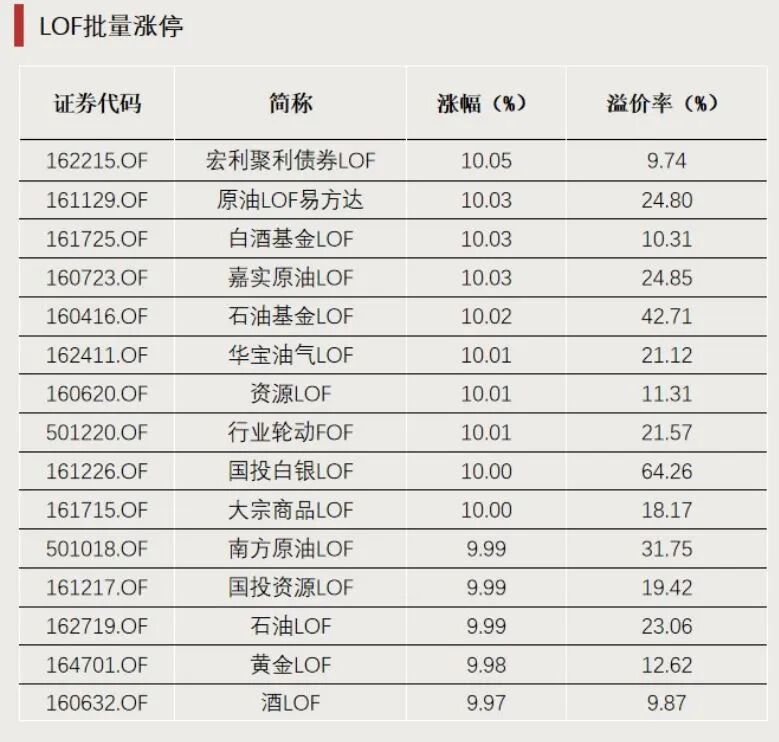
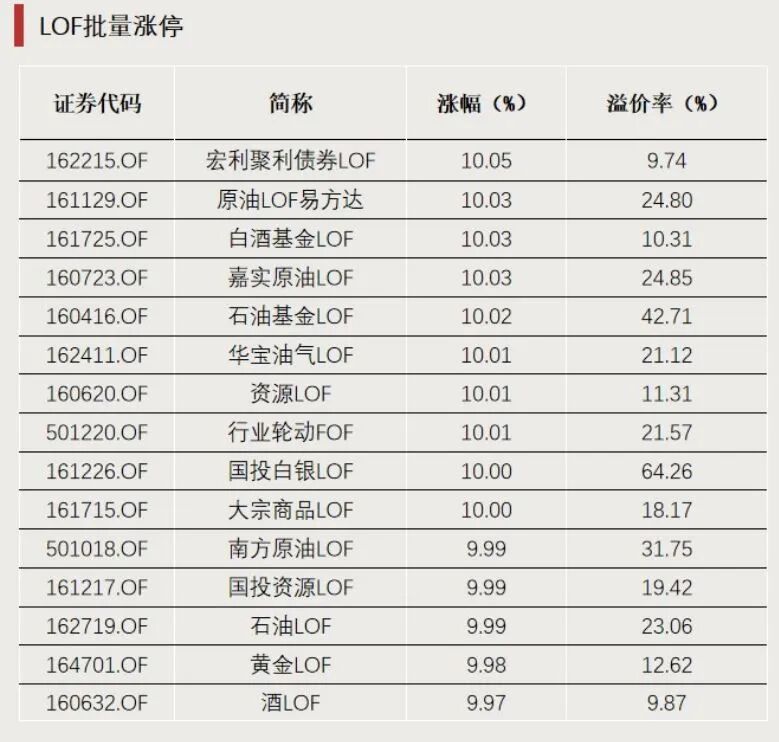
Core Viewpoint - International gold and silver prices reached new highs on January 29, leading to significant increases in the prices of various commodities such as oil, gas, copper, and aluminum, with multiple related ETFs and LOFs hitting the daily limit [1]. Group 1: LOF Market Activity - Several LOFs, including those focused on oil and silver, experienced consecutive daily limit increases, with premium rates continuing to rise [1]. - The National Investment Silver LOF announced a suspension of trading from January 30, following a previous all-day suspension on January 22, indicating potential market risks if premium rates do not decrease [3]. - Other oil-related LOFs, such as the E Fund and Jiashi Oil LOFs, will also suspend trading for one hour starting January 30, while the Oil Fund LOF will limit large purchases and investments to a daily cap of 2 yuan [4]. Group 2: ETF Performance - Major broad-based index ETFs saw a significant decrease in trading volume, with notable declines in the trading amounts of the CSI 300 ETF, the CSI 500 ETF, and the SSE 50 ETF compared to the previous trading day [6]. - The wine sector ETF and several food and beverage ETFs experienced substantial gains, with the wine ETF hitting the daily limit [5]. - The gold ETF recorded a trading volume of 177.99 billion yuan, reflecting a significant increase in trading activity due to rising gold prices [7]. Group 3: Fund Inflows - The gold ETF saw a net inflow of 30.38 billion yuan on January 28, with a total net inflow of 128.33 billion yuan for the year [8]. - Other ETFs, including the colored metal ETF and the chemical ETF, also reported significant net inflows, indicating strong investor interest in these sectors [9]. - New fund issuances have been robust, with several funds raising substantial amounts within short periods, reflecting a strong demand for investment products [10].
连续涨停!明天全天停牌
Zhong Guo Zheng Quan Bao· 2026-01-29 13:05
Core Insights - International gold and silver prices reached new highs on January 29, leading to significant increases in the prices of various commodities including oil, gas, copper, and aluminum, with multiple related ETFs and LOFs hitting the daily limit [1][2]. Group 1: LOF Market Activity - Several LOFs, including those focused on oil and silver, experienced consecutive trading halts due to high demand and rising premium rates [2][4]. - The National Investment Silver LOF announced a trading halt effective January 30, following a previous halt on January 22, with potential for further halts if premium rates do not decrease [4]. - A range of LOFs, such as the Easy Fund Oil LOF and the Jia Shi Oil LOF, are set to halt trading for one hour starting January 30, while large purchases and investments in certain oil-related LOFs will be restricted [5]. Group 2: ETF Performance - Major broad-based index ETFs saw a significant drop in trading volume, with notable declines in the trading amounts of the CSI 300 ETF and others [7]. - The gold ETF recorded a substantial increase in trading volume, with a net inflow of 30.38 billion yuan on January 28, contributing to a total net inflow of 128.33 billion yuan for the year [9][10]. - Other ETFs, including those focused on precious metals and chemicals, also saw significant net inflows, indicating strong investor interest in these sectors [10]. Group 3: New Fund Issuance - The recent issuance of new funds has been robust, with several funds raising significant amounts in a short period, indicating strong market demand [11].