
标普油气ETF嘉实

Search documents
一天两次停牌难降资金热情,油气ETF为何这么“疯”?
第一财经· 2026-03-26 15:52
Core Viewpoint - The article discusses the significant premium rates in oil and gas ETFs driven by escalating geopolitical conflicts, highlighting the market's volatility and investor behavior amidst these conditions [3][4][8]. Group 1: Market Dynamics - The ongoing geopolitical tensions in the Middle East have pushed oil and gas products into a "high premium vortex," with the S&P Oil & Gas ETF experiencing a premium rate exceeding 27% [4][5]. - On March 26, the S&P Oil & Gas ETF from Fuguo saw a trading halt due to its high premium, with an intraday premium rate of 27.28% and a trading volume exceeding 2.07 billion yuan [5][6]. - Similar trends were observed in other oil-related products, with multiple LOF products also experiencing premium rates above 40% and trading volumes surpassing 1 billion yuan [5][6]. Group 2: Investor Behavior - Despite over 560 premium risk warnings issued in the past month, investor enthusiasm remains high, with significant net inflows into oil and gas ETFs, such as the S&P Oil & Gas ETF from Jiashi, which attracted 228 million yuan in net inflows since March 10 [6][8]. - The article notes that the high premium environment has led to frequent temporary trading halts, indicating a heightened level of market activity and investor speculation [6][7]. Group 3: Future Outlook - The article suggests that the current extreme premium situation is a result of geopolitical tensions, supply-demand mismatches, and trading mechanisms, with the ongoing Middle Eastern conflicts being a key catalyst [8][9]. - Analysts predict that oil prices may experience high volatility in the short term, influenced by Iran's actions in the Strait of Hormuz, with potential for rapid price adjustments if geopolitical tensions ease [9][10]. - Investment strategies are recommended to focus on domestic oil-related funds, emphasizing a long-term perspective rather than chasing short-term price spikes [9][10].


一线游资、量化资金涌入西部材料超12亿元资金砸盘明阳智能
摩尔投研精选· 2026-03-26 10:26
Core Viewpoint - The article highlights the trading activities in the Shanghai and Shenzhen stock markets, focusing on the top traded stocks, sector performances, and significant capital flows, indicating potential investment opportunities and trends in the market. Group 1: Trading Volume and Top Stocks - The total trading volume for the Shanghai and Shenzhen Stock Connect today was 249.55 billion, with Zijin Mining and CATL leading in trading volume for the Shanghai and Shenzhen markets respectively [1] - The top ten stocks traded on the Shanghai Stock Connect included Zijin Mining at 25.83 billion, followed by China Ping An at 14.56 billion and Baidu Storage at 11.36 billion [3] - On the Shenzhen Stock Connect, CATL topped the list with 30.20 billion, followed by Zhongji Xuchuang at 29.51 billion and Xinyi Sheng at 29.48 billion [4] Group 2: Sector Performance - The energy metals sector saw the highest net inflow of capital, amounting to 11.43 billion, with a net inflow rate of 4.26% [6] - Other sectors with positive capital inflows included construction materials and petroleum and petrochemicals, both at 0.29 billion [6] - Conversely, the electronics sector experienced the largest capital outflow, totaling 175.27 billion, with a net outflow rate of -5.87% [7][8] Group 3: Institutional and Retail Activity - Institutional activity showed mixed results, with significant selling in Mingyang Smart Energy, which saw a sell-off of 12.18 billion from four institutions [15] - Retail investors were active in West Materials, which hit a strong limit-up, attracting 1.92 billion from two retail funds [17] - Quantitative funds also showed interest in West Materials, purchasing 0.93 billion, indicating a diverse interest in this stock [18] Group 4: ETF Trading - The S&P Oil & Gas ETF (159518) had the highest trading volume today at 133.67 billion, reflecting a 65% increase from the previous trading day [12][13] - The Gold ETF (518880) followed with a trading volume of 105.26 billion, but saw a decrease of 7.97% [12]



大幅溢价!午后临时停牌
天天基金网· 2026-03-24 05:11
Core Viewpoint - The recent surge in oil and gas ETFs is primarily driven by ongoing geopolitical conflicts and significant capital inflows, leading to high premiums and volatility in these products [5][7]. Group 1: Market Performance - On March 23, several oil and gas ETFs experienced a trading halt after reaching their daily limit, with a notable rebound on March 24, where the S&P Oil & Gas ETF from Wanhua surged nearly 7% and the one from Jiashi rose over 5% [2][3]. - As of March 23, oil and gas ETFs have seen a net subscription of nearly 5.2 billion units in March alone, with specific funds like Guotai Zhongzheng Oil and Gas ETF and Penghua National Oil and Gas ETF attracting over 1 billion units each [7]. - The trading volume for the S&P Oil & Gas ETFs from Jiashi and Wanhua reached approximately 53.8 billion yuan and 42.8 billion yuan respectively in March [7]. Group 2: Investment Drivers - Analysts attribute the strong performance of oil and gas ETFs to the escalation of geopolitical tensions, which has heightened inflation expectations in the U.S. and increased uncertainty in global markets [9][10]. - The current macroeconomic uncertainty has made the oil and gas sector attractive due to its defensive characteristics and high dividend yields, resulting in a continuous influx of capital into these ETFs [10]. Group 3: Risks and Opportunities - The high premiums and volatility of oil and gas ETFs are notable, with a premium rate of around 33% for the S&P Oil & Gas ETF from Wanhua as of March 24 [7]. - If geopolitical tensions escalate further, oil prices may remain elevated; conversely, any signs of de-escalation could lead to a rapid correction in these products [5][12]. - Different types of oil and gas ETFs have shown varied performance due to their underlying assets, with upstream exploration and production companies benefiting the most from rising oil prices [13].

这些石油基金集体公告!停牌一小时
证券时报· 2026-03-24 04:33
Core Viewpoint - The oil funds have shown remarkable performance amidst a broader market decline, with several funds hitting the daily limit up on March 23, 2026, indicating strong investor interest and potential risks associated with price premiums in the secondary market [1][2]. Group 1: Fund Performance - Multiple oil funds, including Southern Oil LOF (501018), Jiashi Oil LOF (160723), and E Fund Oil LOF (161129), experienced significant gains, with Southern Oil LOF leading at a year-to-date increase of 62.92% as of March 23, 2026 [2][3]. - The top seven performing oil funds have all outperformed the market, with Jiashi Oil LOF and E Fund Oil LOF both nearing a 60% increase year-to-date [2][3]. - The recent surge in oil fund prices has led to warnings about potential price premiums, with Jiashi Oil LOF reaching a historical high of 2.904 yuan [3][4]. Group 2: Market Dynamics - The geopolitical situation, particularly conflicts in the Middle East, has significantly influenced oil prices, with supply disruptions leading to an increase in oil prices and a projected supply shortfall of 2 million barrels per day [7][8]. - The ongoing conflict has prompted a wave of new oil and gas-themed funds, with 12 fund companies reporting new oil and gas funds this year, indicating strong market demand [7]. - The average forecast for Brent crude oil prices in 2026 has been raised to $90 per barrel, up from a previous estimate of $78 per barrel, reflecting expectations of sustained high prices due to supply constraints [8].

沪指盘中创近五个月新低,什么情况?
第一财经· 2026-03-23 12:22
Core Viewpoint - The A-share market experienced a significant adjustment, with major indices dropping over 3%, while energy sectors like coal and oil showed resilience, becoming a rare safe haven amidst the downturn [3][5][6]. Market Adjustment Analysis - The market's decline is attributed to external disturbances and heightened geopolitical tensions, leading to concentrated pricing of risk aversion. Core assets that had previously seen high gains became the focus of sell-offs [3][6]. - The technology sector, which thrived last year, is now facing substantial declines, with some funds down over 10% year-to-date. The performance gap among actively managed equity funds has widened to over 72 percentage points [3][7][9]. Sector Performance - On March 23, the A-share market saw the Shanghai Composite Index drop to a new low since October, closing at 3813.28 points, down 3.63%. Over 5100 stocks fell, with more than 130 hitting the daily limit down [5][6]. - Only the coal and oil sectors showed slight increases, with coal up 0.2% and oil and petrochemicals up 0.06%. Notable stocks included Yunmei Energy and Liaoning Energy, which hit the daily limit up [5][6]. Fund Performance Disparity - Despite the strong performance of energy and materials-themed products, the top-performing actively managed equity funds are still primarily in the technology sector. For instance, Guangfa Yuanjian Zhixuan A leads with a 49.22% return year-to-date [9][10]. - A significant number of actively managed funds are experiencing losses, with 171 funds down over 10% year-to-date, highlighting a stark performance disparity [9][10]. Investment Strategy Adjustments - In response to market volatility, institutions are shifting strategies from concentrated technology investments to exploring structural opportunities in energy and cyclical sectors, aiming to enhance portfolio defensiveness [11][12]. - The prevailing investment strategy is moving towards a balanced approach, focusing on high cash flow and low correlation sectors, while also considering growth opportunities in less crowded areas [12][13]. Future Outlook - Analysts suggest that the current market conditions may present structural opportunities in technology, particularly in domestic computing and robotics, while also advising caution regarding geopolitical tensions [12][13]. - The recommendation is to maintain a diversified investment strategy to mitigate risks, with an emphasis on balancing equity exposure with quality bonds, commodities, and alternative investments [13].

历史性两连板!溢价超20%,换手率翻倍,新一轮石化周期来临?
券商中国· 2026-03-04 01:31
Core Viewpoint - The article discusses the recent surge in oil prices driven by geopolitical tensions, particularly between the U.S. and Iran, and highlights the investment opportunities in oil stocks and ETFs as a result of this situation [2][3][5]. Group 1: Oil Price Surge - The "Big Three" oil companies in China experienced historic stock price increases, with collective trading halts due to price surges on March 2 and 3 [2][3]. - Brent crude oil prices have risen sharply since mid-February, driven by concerns over shipping safety in the Strait of Hormuz and potential disruptions in oil supply [3][5]. - Multiple factors are contributing to the current oil price spike, including geopolitical catalysts, improved supply-demand dynamics, and supply clearing [2][5]. Group 2: ETF Performance - Several oil and gas ETFs saw significant price increases, with some reaching their daily limit, indicating strong investor interest [3][4]. - The SPDR S&P Oil & Gas ETF experienced a premium rate of 20.76%, while another ETF had a premium of 16.36%, leading to trading halts to manage market volatility [3][4]. - High turnover rates were observed in oil-related ETFs, with some exceeding 100%, reflecting active trading and investor engagement [4]. Group 3: Economic Implications - The geopolitical tensions are expected to create short-term volatility in the market, but the long-term impact on the economy may be limited [6]. - Rising oil prices could increase consumer spending costs, particularly affecting low-income households, and may also contribute to inflationary pressures [6]. - Despite the potential economic challenges, the overall market sentiment remains relatively strong, with consumer confidence and stock market performance showing resilience [6]. Group 4: Broader Market Impact - The escalation of tensions in the Middle East has led to increased interest in gold and other safe-haven assets, with gold prices surpassing $5,300 per ounce [7]. - The chemical industry is experiencing a recovery, with demand improving alongside domestic production resuming, indicating a shift from reliance on oil price increases to profitability recovery and market optimization [7][8]. - The current oil and chemical market dynamics suggest a clear logic for investment, driven by geopolitical factors, improved supply conditions, and recovering demand [7][8].
满屏涨停!原油基金,太火爆!这些产品却大跳水,是何缘故?
券商中国· 2026-03-03 09:42
Core Viewpoint - The article highlights the ongoing surge in oil prices and the strong performance of oil and gas-related funds, while also noting a significant pullback in military, silver, and gold funds, indicating a mixed sentiment in the resource sector [1][3][4]. Oil and Gas Sector Performance - Multiple oil and gas ETFs, including those from 嘉实, 银华, 富国, 博时, and 汇添富, have hit the daily limit up, reflecting a robust market sentiment [1][4]. - As of March 3, the WTI crude oil price increased by 5.02% to $74.803 per barrel, while Brent crude rose by 5.03% to $81.653 per barrel [2]. - Year-to-date, several oil and gas ETFs have recorded gains exceeding 40%, with some surpassing 60% [4][5]. Fund Performance and Market Trends - The article provides a detailed table of various funds, showing significant daily and year-to-date returns for oil-related funds, with some funds like 原油LOF易方达 and 石油基金LOF achieving daily increases of around 10% [2][6]. - Conversely, military and precious metal funds experienced notable declines, with silver funds dropping over 8% and military funds falling by approximately 6% [3][5]. Market Sentiment and Future Outlook - The article notes a divergence in resource fund performance, with oil and gas funds continuing to rise while other sectors like military and precious metals face corrections [4][5]. - Analysts suggest that while the resource sector remains promising, there is a need for caution regarding short-term trading risks, emphasizing a return to fundamental analysis for investment decisions [8][10]. - The geopolitical landscape, particularly tensions involving Iran, is influencing oil prices and market dynamics, with potential implications for supply chains and inflation [9][11]. Strategic Insights - Investment strategies are shifting towards a focus on long-term fundamentals rather than short-term market movements, with an emphasis on cost analysis and sector rotation within the resource space [10]. - The article suggests that the demand structure is transitioning from real estate-driven to manufacturing-driven, particularly in technology and industrial sectors, which may present new investment opportunities [10].
ETF市场日报 | 中韩半导体ETF暴涨9.64%,短融ETF成交破660亿
Sou Hu Cai Jing· 2026-02-26 08:15
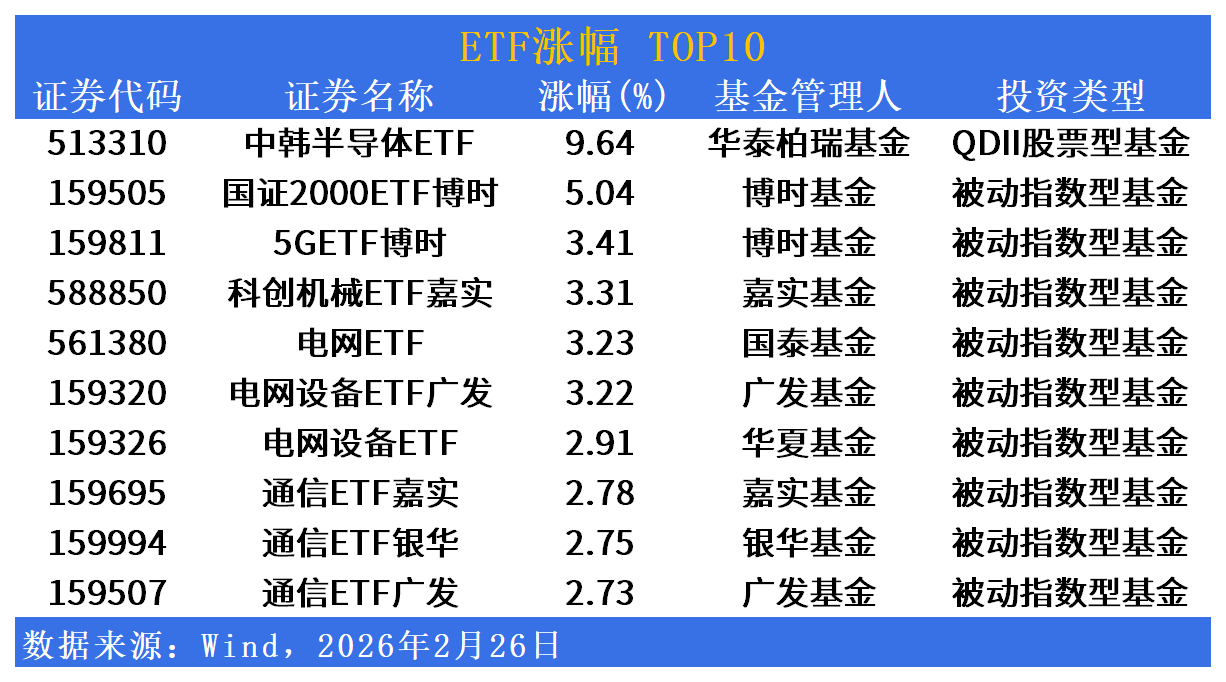
Market Overview - A-shares showed mixed performance with the Shanghai Composite Index down 0.01%, Shenzhen Component Index up 0.19%, and ChiNext Index down 0.29% as of market close [1] - Total trading volume in Shanghai, Shenzhen, and Beijing reached 25,568 billion, an increase of 756 billion from the previous day [1] ETF Performance - The China-Korea Semiconductor ETF surged by 9.64%, leading the market, driven by the recovery in the semiconductor supply chain [2] - The National 2000 ETF rose by 5.04%, indicating a rebound in small-cap growth stocks [2] - The Electric Grid sector performed well, with the Electric Grid ETF up 3.23% and the Electric Grid Equipment ETFs rising by 3.22% and 2.91% respectively [2] Communication Sector - The communication sector also saw gains, with ETFs in this category rising between 2.73% and 2.78% [3] Declining Sectors - The pharmaceutical sector faced a broad retreat, with the Hang Seng Biotechnology ETF showing the largest decline at -3.89% [4] - Other related ETFs in the healthcare and biotechnology sectors also experienced significant drops, indicating a market shift from defensive sectors to technology growth [4] Trading Activity - The Short-term Bond ETF had a trading volume exceeding 66 billion, leading in activity among ETFs [5] - The top traded ETFs included the Short-term Bond ETF at 661.12 billion and the Silver Day Benefit ETF at 167.16 billion [5] Turnover Rates - Cross-border products showed high trading activity, with the Brazil ETF and China-Korea Semiconductor ETF having turnover rates of 171.99% and 125.76% respectively [6][7] - The National Debt ETF also maintained a strong turnover rate of 88.09%, indicating active trading in interest rate bonds and cross-border assets [7] New ETF Launch - A new Technology Growth ETF by Industrial Bank is set to launch on February 27, with a focus on hard technology and a multi-factor strategy targeting the top 50 securities in various tech sectors [8]
ETF午评 | 沪指微跌0.08%,电力板块领涨,电网ETF、电网设备ETF均涨3%
Xin Lang Cai Jing· 2026-02-26 04:14
Market Overview - The Shanghai Composite Index fell by 0.08% and the ChiNext Index decreased by 0.39% [1] - Sectors such as AI applications, lithium batteries, fintech, photovoltaic, gold, and innovative pharmaceuticals showed weakness, while real estate and insurance industries experienced significant declines [1] Sector Performance - The storage chip sector continued to rise, with the South Korea-China semiconductor ETF increasing by 4.82% [1] - The AI hardware sector strengthened, with the 5G ETF from Bosera rising by 3.28%, and the communication ETFs from Huaxia and others increasing by 2.79% and 2.49% respectively [1] - The electric grid sector performed well, with both the electric grid ETF and electric grid equipment ETF rising by 3% [1] - The machinery sector also saw gains, with the Jiashan technology machinery ETF and industrial mother machine ETF increasing by 2.94% and 2.48% respectively [1] Declining Sectors - Oil and gas stocks declined, with the S&P oil and gas ETF from Jiashan dropping by 2.8% [1] - The real estate sector faced a pullback, with the real estate ETF and the real estate ETF from Yinhua falling by 2.74% and 2.71% respectively [1] - Automotive stocks were also down, with the Hong Kong automotive ETF and the Hong Kong Stock Connect automotive ETF from Fuguo decreasing by 2.38% and 2.09% respectively [1]
ETF收评 | A股放量上涨,周期股全线上扬,稀土ETF嘉实涨6%
Ge Long Hui· 2026-02-25 07:31
Market Performance - The three major A-share indices collectively rose, with the Shanghai Composite Index increasing by 0.72%, the Shenzhen Component Index by 1.29%, and the ChiNext Index by 1.41% [1] - The total trading volume in the Shanghai, Shenzhen, and Beijing markets reached 24,809 billion yuan, an increase of 2,627 billion yuan compared to the previous day, with over 3,700 stocks rising [1] Sector Performance - Leading sectors included small metals, phosphate chemicals, steel, rare earth permanent magnets, batteries, PCB, real estate, PET copper foil, and port shipping, all showing significant gains [1] - Conversely, sectors such as film and cinema, banking, computing power leasing, and gaming experienced declines [1] ETF Performance - ETFs related to small metals, phosphate chemicals, steel, and rare earth permanent magnets saw substantial increases, with specific ETFs rising by 6.07%, 5.68%, 4.60%, 4.27%, 4.13%, 4.06%, 4.02%, and 3.85% respectively [1] - The semiconductor sector surged in the afternoon, with the Sci-Tech Semiconductor ETF and Semiconductor Equipment ETF rising by 5.04% and 4.56% respectively [1] Oil and Energy Sector - Oil prices fell, leading to a decline in the S&P Oil and Gas ETF by 2.72%, while the Energy ETF and Energy Chemical ETF dropped by 0.95% and 0.84% respectively [1] Consumer and Media Sector - The film and cinema sector declined, with the Online Consumption ETF, Media ETF, and Online Consumption ETF experiencing drops of 1.24%, 1.14%, and 1.04% respectively [1]