移动宽带

Search documents
(新春走基层)数字反哺正当时:跨越代际的数字年味
Zhong Guo Xin Wen Wang· 2026-02-18 08:27
Core Viewpoint - The article discusses the phenomenon of "digital reciprocity," where younger generations assist older generations in using digital technology, particularly during the Chinese New Year, highlighting its growing importance in intergenerational communication [1][2]. Group 1: Digital Reciprocity in Family and Society - Digital reciprocity refers to the supportive actions of younger generations in teaching older generations how to access and use digital tools [1]. - The trend of digital reciprocity has expanded from family settings to broader social contexts, as seen in various interactions during the Spring Festival [1]. - The increasing number of elderly individuals using smartphones and the internet necessitates more support from younger family members to navigate technology [2]. Group 2: Challenges Faced by the Elderly - Many elderly individuals face difficulties with smart devices, such as operating remote controls for televisions, which often lack user-friendly interfaces [1]. - Instances of financial scams targeting the elderly highlight the need for education on online safety and the identification of phishing attempts [2]. - Despite growing familiarity with smartphones, older adults still require assistance in understanding new features and ensuring their online security [2]. Group 3: Future Directions for Digital Inclusion - By December 2025, it is projected that 53.7% of internet users in China will be aged 60 and above, emphasizing the need for effective digital integration strategies [3]. - Experts suggest that digital reciprocity should evolve from basic operations to deeper engagement, helping the elderly to connect socially and creatively online [3]. - Recommendations for creating a senior-friendly digital environment include simplifying internet products, enforcing strict anti-fraud measures, and fostering community support to alleviate feelings of isolation among the elderly [3].
平安证券(香港)港股晨报-20260112
Ping An Securities Hongkong· 2026-01-12 02:26
Market Overview - The Hong Kong stock market experienced fluctuations, with the Hang Seng Index closing at 23,831 points, down 145 points or 0.61% [1] - The net inflow of funds through the Hong Kong Stock Connect reached 484 million HKD, with the Shanghai and Shenzhen Stock Connects contributing 283 million HKD and 201 million HKD respectively [1] - The US stock market saw all three major indices rise, with the Nasdaq up 0.81% and the Dow Jones reaching a historical closing high [2] Investment Opportunities - The report emphasizes the importance of "technological self-reliance" as a core theme for future developments in the Hong Kong stock market, particularly in sectors like artificial intelligence, semiconductors, and industrial software [3] - There is a recommendation to focus on sectors benefiting from domestic consumption expansion policies, such as sports apparel and non-essential service consumption [3] - Companies in the upstream non-ferrous metals sector are expected to benefit from anticipated interest rate cuts by the Federal Reserve in 2026, alongside strong performance in Q1 earnings [3] Sector Performance - The satellite industry has shown significant growth, with the China Satellite Industry Index rising by 64.99% in the past month, indicating strong market interest in commercial space ventures [9] - Gold prices have continued to rise, with COMEX gold futures increasing by 1.29% to 4,518.4 USD per ounce, suggesting a strategic asset appeal amid global uncertainties [9] - The report highlights the performance of specific companies, such as China Unicom, which has seen a 4.3% year-on-year increase in its smart network business revenue [10] Stock Recommendations - China Unicom (0762.HK) is recommended due to its strong revenue growth in digital services and a consistent dividend yield of over 6% [10] - The report suggests monitoring companies in the aerospace sector, such as AVIC (2357.HK) and Aerospace Holdings (0031.HK), as they are positioned to benefit from the growing satellite industry [9]
联合国报告指出:全球数字连接失衡问题依然突出
Jing Ji Ri Bao· 2025-11-24 03:08
Core Insights - The International Telecommunication Union's report highlights significant improvements in global digital connectivity, but persistent imbalances remain [1][2][3] Digital Connectivity Trends - Global internet usage is projected to reach 74% by 2025, equating to nearly 6 billion people, marking a 3 percentage point increase from 2024, although the growth rate is slowing [1] - Approximately 2.2 billion people remain completely offline, primarily in low-income and rural areas, with internet penetration rates of only 34% and 38% in least developed and landlocked developing countries, respectively [1][2] Gender and Income Disparities - The gender gap in digital connectivity remains largely unchanged, with male internet usage at 77% and female at 71%, a 6 percentage point difference [2] - In low-income countries, the gap widens significantly, with male usage at 29% compared to female at 18% [2] - Internet penetration in high-income countries is 94%, while it is only 23% in low-income countries, a fourfold difference [2] Mobile Broadband Coverage - Global mobile broadband coverage has reached 96%, but the last 4% remains difficult to connect, with only a 6 percentage point increase since 2018 [1] - 5G network coverage exceeds 55% globally, but only 4% in low-income countries, with significant regional disparities [3] Pricing and Affordability Issues - Mobile data costs have decreased, with global expenses as a percentage of income dropping from 1.5% to 1.4%, yet 75 economies still do not meet the 2% target [4] - In low-income countries, fixed broadband costs consume about 28% of income, compared to around 1% in high-income countries, severely limiting usage [4] - The affordability of mobile broadband remains a critical barrier, particularly in Africa, where costs exceed the global average [4]
联合国报告指出—— 全球数字连接失衡问题依然突出
Jing Ji Ri Bao· 2025-11-23 23:12
Core Insights - The International Telecommunication Union's report highlights significant improvements in global digital connectivity, but persistent imbalances remain [1][2][3][4] Digital Connectivity Trends - Global internet usage is projected to reach 74% by 2025, equating to nearly 6 billion people, an increase of 3 percentage points from 2024, although the growth rate is slowing [1] - Approximately 2.2 billion people remain completely offline, primarily in low-income and rural areas, with internet penetration rates of only 34% and 38% in least developed and landlocked developing countries, respectively [1][2] Gender and Income Disparities - The gender gap in digital connectivity remains largely unchanged, with male internet usage at 77% and female at 71%, a 6 percentage point difference [2] - In low-income countries, the gap widens to 29% for men and 18% for women [2] - Internet penetration in high-income countries is 94%, compared to just 23% in low-income countries, a fourfold difference [2] Mobile Broadband Coverage - Global mobile broadband coverage has reached 96%, but the last 4% remains difficult to connect, with only a 6 percentage point increase since 2018 [1] - 5G network coverage exceeds 55% globally, but only 4% in low-income countries, with significant regional disparities [3] Pricing and Affordability Issues - Although mobile data costs have decreased, about one-third of economies have not met the target of mobile data costs being less than 2% of income [4] - In low-income countries, fixed broadband costs account for approximately 28% of income, while in high-income countries, this figure is around 1% [4] - The affordability of mobile broadband is a critical barrier to internet access in low-income regions, where mobile broadband costs represent 5.3% of income in Africa, exceeding the global average of 1.4% [4]
平安证券(香港)港股晨报-20251017
Ping An Securities Hongkong· 2025-10-17 02:41
Market Overview - The Hong Kong stock market experienced a decline, with the Hang Seng Index closing at 23,831 points, down 145 points or 0.61% [1] - The market turnover decreased to 82.799 billion, with net inflows of 484 million from the Hong Kong Stock Connect [1] - The US stock market also faced a downturn, with the Dow Jones falling by 301.07 points or 0.65%, closing at 45,952.24 points, amid concerns over bank sector bad debts [2] Investment Opportunities - The report emphasizes the potential for investment in Hong Kong stocks due to their relatively low valuations and increasing trading activity [3] - Key sectors to watch include artificial intelligence, semiconductors, and industrial software, which are expected to drive long-term growth [3] - Companies like ZTE, which have lower valuation levels, are highlighted as potential beneficiaries in the technology sector [3] Sector Performance - High-dividend assets such as banks, insurance, coal, and electric power sectors showed strong performance, while local real estate, software, and 5G concept sectors faced declines [1] - The gold sector performed well, with gold prices surpassing $4,300 per ounce, reflecting a year-to-date increase of over 60% [9] - The AI sector is experiencing explosive growth, with significant increases in usage of AI models, indicating a robust demand for related technology [9] Company Highlights - China Unicom reported a 4.3% year-on-year increase in its net business income for the first half of 2025, reaching 45.4 billion [10] - The company is transitioning towards a technology-driven digital enterprise, with a focus on cloud computing, IoT, and AI [10] - The report suggests that China Unicom's current valuation is relatively low, making it an attractive investment opportunity [10]
2024年Q4我国固定宽带网速大提升,平均下载速率近百兆!
Sou Hu Cai Jing· 2025-06-10 12:08
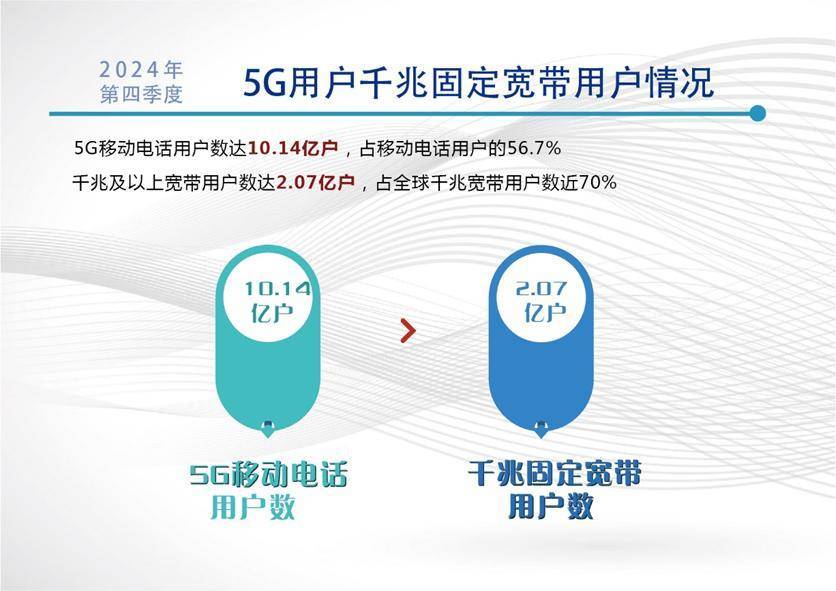
Core Insights - The report reveals significant improvements in broadband user experience in China, with fixed broadband average download speed reaching 99.14 Mbit/s in Q4 2024, a 3.51% increase from the previous quarter and a year-on-year growth of 15.26 Mbit/s, equating to an 18.2% annual growth rate [1] - Mobile broadband users also experienced enhanced speeds, with an average download rate of 157.53 Mbit/s for 4G and 5G networks, reflecting a year-on-year increase of 21.78% [1][2] - The implementation of the "14th Five-Year Plan" has led to substantial advancements in broadband infrastructure, with fiber access (FTTH/O) ports reaching 96.5% by the end of 2024, and nearly 80% of global gigabit access ports located in China, totaling 28.2 million [1] Fixed Broadband Performance - In Q4 2024, the top three cities for fixed broadband download speeds were Shanghai, Tianjin, and Beijing, with China Telecom achieving the highest average fixed broadband download speed of 99.69 Mbit/s [4] - The overall fixed broadband user download speed has increased by 1.86 times compared to the end of the "13th Five-Year Plan" period [2] Mobile Broadband Performance - The average download speed for 4G networks was recorded at 47.41 Mbit/s, while 5G networks achieved an impressive average of 248.68 Mbit/s, with year-on-year increases of 9.04% and 8.71% respectively [6][7] - Major cities such as Shanghai, Beijing, and Tianjin led in mobile broadband download speeds, with China Mobile reporting an average mobile broadband download speed of 160.38 Mbit/s [4] Infrastructure Development - By the end of 2024, gigabit broadband users reached 207 million, accounting for 30.9% of total users and nearly 70% of global gigabit broadband users [1] - The number of 5G base stations reached 4.251 million, enabling "5G access in every town" and resulting in 1.014 billion 5G mobile phone users, representing 56.7% of mobile phone users [2]

广西移动:全力开展龙胜突发山洪通信保障
Huan Qiu Wang· 2025-05-27 09:22
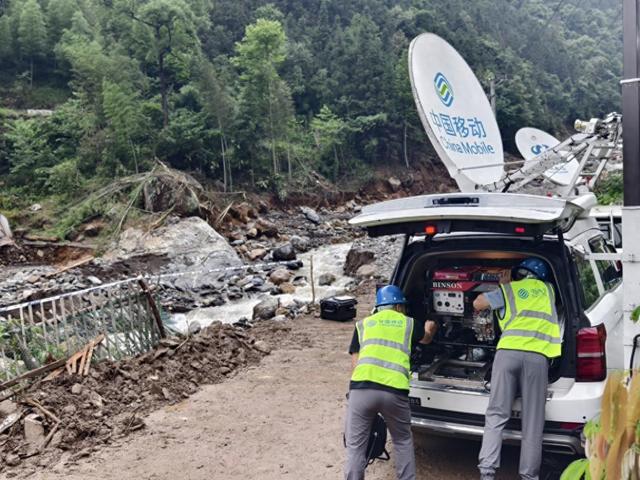
Core Viewpoint - The article highlights the rapid response and efforts of China Mobile Guangxi Guilin Branch in restoring communication services following a flash flood disaster in Longsheng County, Guangxi, ensuring effective support for rescue operations [1][3][5]. Group 1: Emergency Response - China Mobile Guangxi Guilin Branch activated its flood emergency response mechanism immediately after the disaster, focusing on restoring damaged communication facilities to support rescue efforts [1][3]. - The company deployed a team of network technicians and emergency communication vehicles to the disaster area, emphasizing the principle of "communication first, guarantee second" [3][5]. Group 2: Communication Restoration Efforts - Technicians faced challenging conditions, including rocky roads and mudslides, but remained committed to restoring communication signals, which are critical for rescue operations [5][8]. - A satellite communication backpack was utilized to establish a communication channel in the disaster-stricken area, overcoming significant obstacles such as steep terrain and poor satellite signal reception [5][9]. Group 3: Resource Mobilization - A total of 117 personnel, 15 emergency vehicles, 20 oil machines, and various communication equipment were mobilized by China Mobile to support the rescue operations [9]. - The company successfully repaired 3 kilometers of optical fiber and established emergency communication lines, including a video link to the regional command center, enhancing coordination during the rescue efforts [9]. Group 4: Commitment to Service - The actions of China Mobile personnel exemplified their commitment to public service, with a focus on ensuring continuous communication during the disaster response [9]. - The article emphasizes the company's mission of "People's Postal and Telecommunications for the People," showcasing their dedication to providing essential communication services in times of crisis [9].