
红利低波ETF永赢

Search documents
红利低波ETF华泰柏瑞(512890)近60天狂吸金48.6亿!机构:2026年科技与非科技都有机会,质量策略正当时
Xin Lang Cai Jing· 2026-02-24 09:02
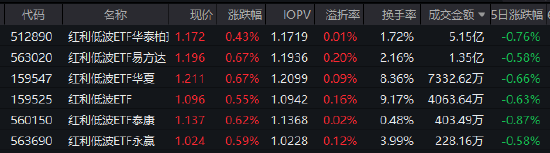
Core Viewpoint - The market experienced fluctuations with the ChiNext Index rising over 2% at one point, while the Shanghai Composite Index closed up by 0.87%. In this context, the Huatai-PineBridge Low Volatility ETF (512890) increased by 0.43%, closing at 1.172 yuan, with a turnover rate of 1.72% and a trading volume of 5.15 billion yuan, leading its category [1][6]. ETF Performance - The Huatai-PineBridge Low Volatility ETF (512890) reported a trading volume of 154.12 billion yuan over the last 20 trading days, averaging 7.71 billion yuan per day. Since the beginning of the year, the total trading volume reached 250.40 billion yuan, with an average of 8.08 billion yuan per day [2][7]. - The ETF has seen significant net inflows, with 3.6 billion yuan in the last 5 trading days, 9 billion yuan in the last 10 days, 29.2 billion yuan in the last 20 days, and 48.6 billion yuan in the last 60 days [2][7]. Top Holdings - The top ten holdings of the Huatai-PineBridge Low Volatility ETF include major companies across various sectors such as banking, food and beverage, home appliances, and pharmaceuticals. Notable holdings include Shanghai Bank, Nanjing Bank, Ping An Bank, and Gree Electric Appliances, with a total market value of approximately 6.72 billion yuan, accounting for 25.34% of the ETF's total market value [2][7]. Market Outlook - Multiple institutions have expressed optimistic views on the post-holiday market and dividend strategies. CITIC Securities believes that the A-share market, primarily driven by manufacturing and finance, will be less affected by AI disruptions compared to US and Hong Kong markets, suggesting a continuation of the spring rally [4][9]. - Guotai Junan Securities noted that with China's economic policy focusing on domestic demand, investor pessimism towards traditional domestic industries is likely to be corrected, contributing to a more stable economic outlook for 2026 [4][9]. Investment Strategy - The Huatai-PineBridge Low Volatility ETF, established on December 19, 2018, has achieved a return of 76.88% over the past five years, outperforming its benchmark and ranking 51st among 909 funds. Investors are encouraged to consider regular investment strategies to mitigate volatility risks [10].

红利低波ETF华泰柏瑞(512890)流通规模突破301亿元 机构建议“持股过节” 高股息板块配置逻辑更清晰
Xin Lang Cai Jing· 2026-02-11 09:02
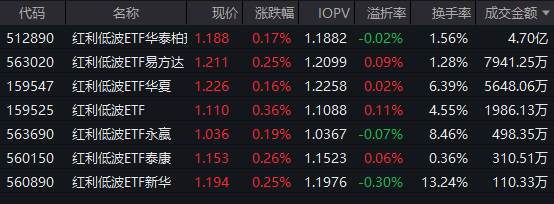
Market Overview - On February 11, the A-share market exhibited a volatile trend, with the ChiNext Index dropping over 1% and the Shanghai Composite Index slightly rising by 0.09% [1][6] - In this market environment, the Huatai-PB Low Volatility ETF (code: 512890) increased by 0.17%, closing at 1.188 yuan, with a turnover rate of 1.56% and a transaction amount of 470 million yuan, ranking first among similar ETFs in terms of transaction volume [1][6] ETF Performance - As of February 11, the Huatai-PB Low Volatility ETF has accumulated a total transaction volume of 23.061 billion yuan over 28 trading days this year, with an average daily transaction of 824 million yuan [2][7] - Fund flow data indicates that as of February 10, the ETF saw a net inflow of 880 million yuan over the last 10 trading days, 3.472 billion yuan over the last 20 days, and 4.470 billion yuan over the last 60 days, with a circulating scale of 30.128 billion yuan [2][7] Investment Recommendations - Recent recommendations from various institutions suggest a "hold stocks over the holiday" strategy, indicating that the A-share market's performance before the Spring Festival may influence post-holiday trends [4][9] - Huajin Securities noted that the current spring market is not yet over, with expectations for improved economic and corporate profit forecasts during the Spring Festival, and a neutral risk appetite anticipated [4][9] - Zhongtai Securities emphasized that the configuration logic for high-dividend sectors is becoming clearer, with expectations for policy measures related to growth stabilization and consumption promotion to gradually materialize after the Spring Festival [4][9] ETF Characteristics - The Huatai-PB Low Volatility ETF was established on December 19, 2018, with a benchmark of the CSI Low Volatility Index [4][9] - As of February 10, 2026, the ETF has achieved a return of 79.95% over the past five years, outperforming its benchmark and ranking 51st among 909 funds [4][9] - Investors can participate through a systematic investment plan to smooth out volatility risks, and those without stock accounts can access it through its off-market linked funds [4][9]
市场风格切换,红利低波ETF永赢(563690)涨幅超1.3%
Xin Lang Cai Jing· 2025-11-04 05:35
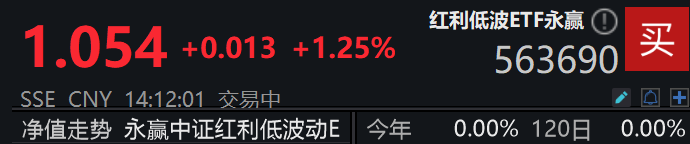
Core Viewpoint - High dividend assets continue to strengthen, with significant buying activity from insurance funds in the banking sector, indicating a shift towards stable dividend-paying stocks in a low-interest-rate environment [2] Group 1: Market Performance - As of November 4, 2025, the CSI Dividend Low Volatility Index (H30269) rose by 1.13%, with notable increases in constituent stocks such as Xiamen Bank (up 6.20%), Shanghai Bank (up 3.51%), and Jianfa Co. (up 2.86%) [1] - The Yongying Dividend Low Volatility ETF (563690) increased by 1.23%, with a cumulative rise of 0.38% over the past week as of November 3, 2025 [1] Group 2: Institutional Investment Trends - Insurance funds have been actively increasing their holdings in bank stocks, with China Life Insurance becoming a top ten shareholder in Industrial and Commercial Bank of China, holding 757 million shares (0.21% stake) as of September 30 [2] - Ping An Life Insurance entered the top ten shareholders of Agricultural Bank of China with 4.913 billion shares (1.4% stake) as of September 30 [2] - Other banks such as Wuxi Bank, Nanjing Bank, and Changshu Bank also saw new insurance capital entering their top ten shareholders during the third quarter [2] Group 3: Future Outlook - According to Zhongtai Securities, during Q3 2025, insurance funds focused on increasing their stakes in banking, telecommunications, and steel sectors, reflecting a strategy to enhance returns in a persistently low-interest-rate environment [2] - The fourth quarter of 2025 is anticipated to be a critical period for positioning in dividend stocks, as pessimistic expectations may have been fully priced in, highlighting the appeal of undervalued assets and the potential for increased capital allocation [2]
险资持续加仓股市,红利低波ETF永赢(563690)上涨超1%
Xin Lang Cai Jing· 2025-11-03 06:38
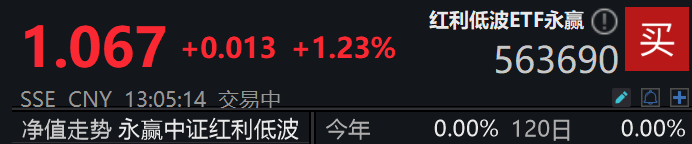
Group 1 - The core viewpoint of the news highlights a strong performance in the Chinese stock market, particularly in the low volatility dividend index and specific stocks like China Media and PetroChina [1] - The low volatility dividend ETF has shown a cumulative increase of 3.79% over the past month, indicating positive market sentiment [1] - Insurance capital has been increasingly investing in the stock market, with a 14% growth in the number of shares held by insurance institutions by the end of Q3, totaling over 650 billion yuan [2] Group 2 - The trend of insurance capital moving from large state-owned banks to high-quality regional banks is evident, with institutions like China Life and Taikang Life entering the top ten shareholders of several regional banks [2] - A-share market shows a calendar effect, suggesting that November to January could be a favorable period for both active and long-term investors [3] - The downward trend in interest rates is expected to enhance the absolute returns of dividend assets, particularly in a market lacking strong fundamental trends [3]
近一个月公告上市股票型ETF平均仓位22.66%
Zheng Quan Shi Bao Wang· 2025-10-15 02:43
Core Viewpoint - The announcement of the Huaan Guozheng Hong Kong Stock Connect Consumer Theme ETF indicates a significant development in the ETF market, with a focus on consumer sectors and a substantial portion of assets allocated to cash and deposits during the initial phase [1] Group 1: ETF Launch Details - The Huaan Guozheng Hong Kong Stock Connect Consumer Theme ETF will be listed on October 20, 2025, with a total of 639 million shares [1] - As of October 13, 2025, the fund's asset allocation includes 86.75% in bank deposits and settlement reserves, while stock investments account for 13.24% [1] - The fund is currently in its building phase, which is typical for newly launched ETFs [1] Group 2: Recent ETF Trends - In the past month, 24 stock ETFs have announced their listings, with an average allocation of only 22.66% [1] - The highest allocation is seen in the Chuangjin Hexin CSI State-Owned Enterprises Dividend ETF at 98.80%, followed by other ETFs with allocations of 48.23%, 38.23%, and 33.83% [1] - Some ETFs, such as the Penghua CSI Financial Technology Theme ETF and the Invesco Low Volatility ETF, reported a 0.00% allocation, indicating a lack of investment in stocks at the time of their announcements [1] Group 3: Fundraising and Institutional Participation - The average fundraising for newly announced ETFs in the past month is 552 million shares, with leading funds including the Invesco National Robot Industry ETF and the Guolian An CSI A500 Low Volatility ETF [2] - Institutional investors hold an average of 12.49% of the shares in these ETFs, with the highest proportions in the Guolian An CSI A500 Low Volatility ETF (98.93%) and the Penghua Hong Kong Stock Connect Low Volatility Dividend ETF (97.57%) [2] - Conversely, some ETFs like the Huaan Growth Board Artificial Intelligence ETF have very low institutional ownership, at only 0.55% [2]
近一个月公告上市股票型ETF平均仓位23.07%
Zheng Quan Shi Bao Wang· 2025-10-14 02:48
Core Insights - Three stock ETFs have recently published listing announcements, with the highest stock allocation being 98.80% for the CCB China State-Owned Enterprises Dividend ETF [1] - In the past month, 23 stock ETFs have announced listings, with an average allocation of only 23.07%, indicating varying levels of investment commitment among these funds [1] Group 1: ETF Stock Allocations - The CCB China State-Owned Enterprises Dividend ETF has the highest stock allocation at 98.80%, followed by the Huabao CSI All-Index Agriculture, Animal Husbandry, and Fishery ETF at 48.23%, and the Fortune Shanghai Stock Exchange Science and Technology Innovation Board 100 ETF at 38.23% [1] - The lowest allocations are seen in the Penghua CSI Financial Technology Theme ETF, the Dividend Low-Volatility ETF Yongying, and the Invesco Great Wall Hang Seng Stock Connect 50 ETF, all at 0.00% [1] Group 2: ETF Fundraising and Institutional Holdings - The average number of shares raised for newly announced ETFs in the past month is 5.48 million, with the largest being the Fortune National Robot Industry ETF at 23.44 million shares [2] - Institutional investors hold an average of 12.88% of the shares, with the highest proportions in the Guolian An CSI A500 Dividend Low-Volatility ETF at 98.93% and the Penghua Hong Kong Stock Connect Low-Volatility Dividend ETF at 97.57% [2] Group 3: ETF Listing Details - The listing details for several ETFs include the CCB China State-Owned Enterprises Dividend ETF, which has a fundraising scale of 4.45 billion and is set to list on October 17, 2025, with a stock allocation of 98.80% [2] - Other notable ETFs include the Fortune Shanghai Stock Exchange Science and Technology Innovation Board 100 ETF with a fundraising scale of 5.56 billion and a stock allocation of 38.23%, also listing on October 17, 2025 [2][3]
25只ETF公告上市,最高仓位54.12%
Zheng Quan Shi Bao Wang· 2025-10-10 03:09
Core Insights - Two stock ETFs have recently announced their listing, with the latest positions showing that the GF Shanghai Stock Exchange Science and Technology Innovation Board 200 ETF has a stock position of 33.29% and the Guotai Shanghai Stock Exchange Science and Technology Innovation Board Artificial Intelligence ETF has a stock position of 25.82% [1] ETF Listings and Positions - In the past month, a total of 25 stock ETFs have announced their listings, with an average position of only 20.02%. The highest position is held by the CCB Shanghai Stock Exchange Science and Technology Innovation Board 200 ETF at 54.12% [1] - Other ETFs with significant positions include the Huabao CSI All-Share Agriculture, Animal Husbandry, and Fishery ETF at 48.23%, the Huabao Hong Kong Stock Connect Hang Seng China (Hong Kong-listed) 30 ETF at 33.83%, and the E Fund CSI A500 Enhanced Strategy ETF at 33.31% [1] - Conversely, the Penghua CSI Financial Technology Theme ETF, the Dividend Low Volatility ETF Yongying, and the Invesco Hang Seng Hong Kong Stock Connect 50 ETF have positions of 0.00% [1] Fundraising and Shareholder Structure - The average fundraising for the newly announced ETFs in the past month is 543 million shares, with the largest being the Fuguo National Index Robotics Industry ETF at 2.344 billion shares, followed by the Guolian An CSI A500 Dividend Low Volatility ETF at 1.247 billion shares and the Huaan Hang Seng Biotechnology ETF at 918 million shares [1] - Institutional investors hold an average of 9.65% of the shares, with the highest proportions in the Guolian An CSI A500 Dividend Low Volatility ETF (98.93%), CCB Shanghai Stock Exchange Science and Technology Innovation Board 200 ETF (32.48%), and Guotai CSI Hong Kong Stock Connect Automotive Industry Theme ETF (12.45%) [2]
9月以来公告上市股票型ETF平均仓位22.33%
Zheng Quan Shi Bao Wang· 2025-09-30 03:23
Group 1 - The core point of the news is the announcement of the listing of the Huabao Hong Kong Stock Connect Hang Seng China (Hong Kong Listed) 30 ETF, which will be listed on October 13, 2025, with a total of 680 million shares [1] - As of September 26, 2025, the fund's asset allocation consists of 66.17% in bank deposits and settlement reserves, and 33.83% in stock investments, indicating that the fund is still in the accumulation phase [1] - In September, a total of 30 stock ETFs announced their listings, with an average position of only 22.33%, highlighting a trend of low investment levels among newly listed ETFs [1] Group 2 - The average fundraising for the newly announced ETFs in September is 562 million shares, with the largest being the Fortune National Robot Industry ETF at 2.344 billion shares [2] - Institutional investors hold an average of 9.17% of the shares in these ETFs, with the highest proportions in the National Union A500 Dividend Low Volatility ETF at 98.93% [2] - The data table lists various ETFs with their respective establishment dates, fundraising sizes, and stock positions, showing a range of investment strategies and levels of institutional participation [3]
9月以来公告上市股票型ETF平均仓位21.94%
Zheng Quan Shi Bao Wang· 2025-09-29 03:48
Group 1 - Two stock ETFs have announced their listing, with both the Yongying Dividend Low Volatility ETF and the Invesco Hang Seng Stock Connect 50 ETF having a stock position of 0.00% [1] - Since September, a total of 29 stock ETFs have announced their listings, with an average position of 21.94%. The highest position is held by the E Fund Shanghai Stock Exchange Science and Technology Innovation Board Comprehensive Enhanced Strategy ETF at 69.33% [1][2] - The ETFs with the lowest positions include the Yongying Dividend Low Volatility ETF, Invesco Hang Seng Stock Connect 50 ETF, and Guolian An CSI 500 Dividend Low Volatility ETF, all at 0.00% [1] Group 2 - The average number of shares raised by the newly announced ETFs in September is 5.58 million, with the largest being the Invesco National Index Robotics Industry ETF at 23.44 million shares [1] - Institutional investors hold an average of 9.40% of the shares, with the highest proportions in the Guolian An CSI 500 Dividend Low Volatility ETF (98.93%), Jianxin Shanghai Stock Exchange Science and Technology Innovation Board 200 ETF (32.48%), and Ping An CSI 500 Dividend Low Volatility ETF (13.53%) [2] - ETFs with lower institutional ownership include the Huaan Growth Enterprise Board Artificial Intelligence ETF (0.55%), Penghua Growth Enterprise Board Comprehensive ETF (1.52%), and Invesco Shanghai Stock Exchange Science and Technology Innovation Board 200 ETF (1.64%) [2]