美原油WTI

Search documents
ATFX:美原油突破64美元 霍尔木兹海峡成焦点
Xin Lang Cai Jing· 2026-01-29 15:20
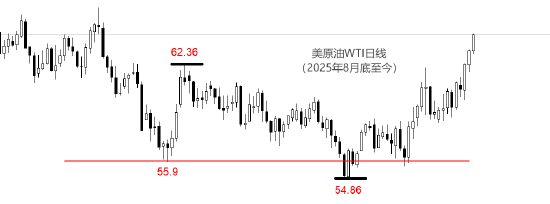
Group 1 - The core viewpoint of the article highlights the significant potential of crude oil, referred to as the "initial bull," compared to the "crazy bull" of gold, which is currently experiencing a notable rise [1][6] - As of January 8, WTI crude oil has shown a strong upward trend, with a closing price that increased by $2 from the opening price, reaching a peak of $64.26, marking a four-month high [1][6] - The rise in both gold and crude oil prices is attributed to a sharp decline in the US dollar index, which fell from near the 100 mark to around 95 within two weeks, providing upward momentum for both commodities [2][7] Group 2 - The current market focus is on the geopolitical tensions between Iran and the US-Israel alliance, with the US aircraft carrier Lincoln entering the Persian Gulf, raising concerns about potential conflict [2][8] - Should a conflict arise, gold prices are expected to surge due to increased safe-haven demand, while crude oil prices may rise significantly if the Strait of Hormuz is blocked, affecting the transport of 20 million barrels of oil daily [8] - The article suggests that while gold may be nearing the end of its upward trend, crude oil is positioned at the beginning of a potential bull market, with projections indicating it could become a leading investment opportunity by 2026 [2][8] Group 3 - In terms of market structure, WTI crude oil has formed a double bottom at $55.9 and $54.86, with the latter serving as a reliable support level, and the price has accelerated upward since January 8 [5][10] - The previous mid-term high of $62.36 has been surpassed, and the market is currently seeking new mid-term highs, with $54.86 identified as the most dependable support level [5][10] - Close attention is advised for the formation of a daily top pattern, which could indicate that the upward trend is approaching mid-term resistance levels [10]

ATFX:美原油连涨三日 今日试探60美元关口
Xin Lang Cai Jing· 2026-01-13 09:32
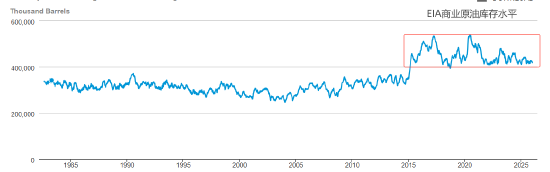
Core Viewpoint - The recent performance of WTI crude oil shows a rare consecutive increase, with prices approaching the critical $60 mark, influenced by market caution regarding the EU's price cap on Russian oil [1][5]. Price Movement - On January 8, WTI opened at $56.25 and peaked at $58.59; on January 9, it reached $59.58, nearing $60; on January 10, it tested the $60 level, hitting a high of $59.71 [1][5]. - As of the latest session, WTI reached a high of $59.77, just $0.23 away from the $60 threshold, indicating potential for a breakout [1][5]. Market Sentiment - Market participants are cautious about the $60 level due to the EU's price cap on Russian oil, which has been in effect since late 2022, creating a psychological barrier despite not directly impacting WTI prices [1][5]. - The price cap has not significantly stimulated the market, as Russian Urals oil prices remain below $40 [1][5]. Inventory Levels - As of January 2, the EIA reported U.S. crude oil inventories at 419.056 million barrels, a relative low since 2015, which was a period of significant shale oil production growth [3][7]. - The historical inventory levels have fluctuated between approximately 400 million and 533 million barrels over the past decade, indicating a potential for future inventory increases [3][10]. Price Trends - The recent three-day increase in WTI has boosted short-term buying sentiment, with January 9's long bullish candle breaking a downward trend line [9][12]. - If the closing price remains above the downward trend line, it may confirm an upward breakout, suggesting a potential short-term strengthening in prices [9][12].
ATFX:马杜罗事件提振作用消散,WTI再次跌破56美元
Xin Lang Cai Jing· 2026-01-08 10:51
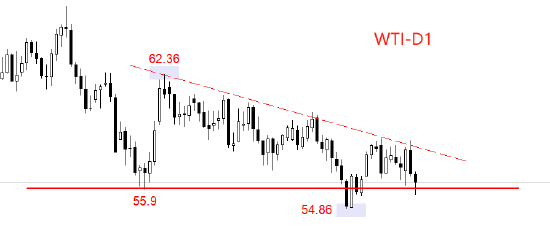
Core Viewpoint - The performance of WTI crude oil in 2025 remains subdued despite ongoing geopolitical tensions, with the impacts of conflicts such as the Russia-Ukraine war and the Israel-Iran conflict diminishing over time [1][6][7]. Group 1: Geopolitical Events and Oil Prices - The ongoing Russia-Ukraine conflict has had a weak impact on the oil market by 2025, with the market's response to the conflict significantly reduced [1][6]. - The Israel-Iran conflict, which escalated in June 2025, saw WTI crude oil reach a peak of $78.4 but closed at $64.97, indicating a substantial decline from its peak [1][7]. - The recent capture of Venezuelan President Maduro, who was taken by U.S. forces, was expected to disrupt oil exports due to Venezuela's significant oil reserves, yet the market's reaction was muted [1][7]. Group 2: Market Reactions and Trends - Following the Maduro event, WTI crude oil prices initially rose from an opening price of $57.47 to a high of $58.51, but quickly fell back, with prices hitting a low of $55.76, marking a new weekly low [1][7]. - The lack of sustained market reaction to the Maduro event is attributed to the rapid execution of U.S. actions, which left little room for market speculation and investment [2][8]. - Since reaching a high of $130 in 2022, WTI crude oil has been in a downward trend, although the pace of decline has slowed in recent years [5][10]. Group 3: Support Levels and Future Outlook - The price range of $54.86 to $55.9 is identified as a potential support zone, with $54.86 being a significant low point from October 2025 [5][10]. - If WTI prices rebound in the coming days, it could confirm a double bottom structure; otherwise, the downward trend may continue under high inventory pressures [5][10].