美元指数下跌

Search documents
ATFX:美原油突破64美元 霍尔木兹海峡成焦点
Xin Lang Cai Jing· 2026-01-29 15:20
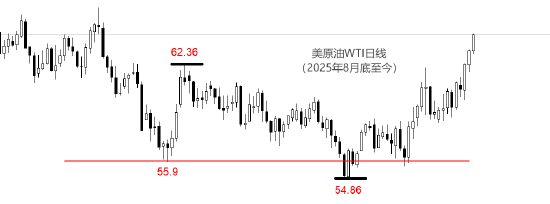
Group 1 - The core viewpoint of the article highlights the significant potential of crude oil, referred to as the "initial bull," compared to the "crazy bull" of gold, which is currently experiencing a notable rise [1][6] - As of January 8, WTI crude oil has shown a strong upward trend, with a closing price that increased by $2 from the opening price, reaching a peak of $64.26, marking a four-month high [1][6] - The rise in both gold and crude oil prices is attributed to a sharp decline in the US dollar index, which fell from near the 100 mark to around 95 within two weeks, providing upward momentum for both commodities [2][7] Group 2 - The current market focus is on the geopolitical tensions between Iran and the US-Israel alliance, with the US aircraft carrier Lincoln entering the Persian Gulf, raising concerns about potential conflict [2][8] - Should a conflict arise, gold prices are expected to surge due to increased safe-haven demand, while crude oil prices may rise significantly if the Strait of Hormuz is blocked, affecting the transport of 20 million barrels of oil daily [8] - The article suggests that while gold may be nearing the end of its upward trend, crude oil is positioned at the beginning of a potential bull market, with projections indicating it could become a leading investment opportunity by 2026 [2][8] Group 3 - In terms of market structure, WTI crude oil has formed a double bottom at $55.9 and $54.86, with the latter serving as a reliable support level, and the price has accelerated upward since January 8 [5][10] - The previous mid-term high of $62.36 has been surpassed, and the market is currently seeking new mid-term highs, with $54.86 identified as the most dependable support level [5][10] - Close attention is advised for the formation of a daily top pattern, which could indicate that the upward trend is approaching mid-term resistance levels [10]

调整,调整!交易所最新通知!
券商中国· 2026-01-28 11:29
Core Viewpoint - The article discusses the recent adjustments in trading margins and price limits for precious metals, particularly gold and silver, in response to rising international prices and a declining US dollar index. It highlights the increased investment interest and the measures taken by financial institutions to manage risks associated with these investments. Group 1: Trading Adjustments - The Shanghai Gold Exchange has adjusted the margin level for silver deferred contracts to 20% and the price fluctuation limit to 19% [1] - The Shanghai Futures Exchange has also made changes to the price limits and margin ratios for gold, silver, and nickel futures contracts [1] - The Chicago Mercantile Exchange announced adjustments to margin parameters for certain silver, platinum, and palladium futures contracts, with some silver contracts now requiring a margin of approximately 11% of nominal value [1] Group 2: Market Performance - On January 28, gold futures prices on the New York Commodity Exchange surpassed $5300 per ounce, while domestic gold prices approached 1200 yuan per gram, marking a daily increase of 3.6% [2] - The precious metals sector saw significant stock price increases, with companies like Zhaojin Gold and China Gold hitting daily limits, and the gold stock ETF (159562) rising by 9.25% on the same day [2] - The futures market experienced an influx of nearly 4.7 billion yuan in precious metals, with 4.4 billion yuan flowing into Shanghai gold alone [2] Group 3: Banking Sector Adjustments - Banks have raised the investment thresholds for retail gold accounts and personal accumulation gold services, with several banks setting the minimum at over 1200 yuan per gram [4] - Investment suitability management has been strengthened, with banks adjusting the risk assessment levels for gold-related services to higher categories, reflecting a shift in the perception of gold from a stable savings alternative to a high-volatility risk asset [4][5] - More banks are expected to follow suit in increasing their risk assessment standards for gold investment services in 2026 [4] Group 4: Price Forecasts - Analysts predict that the declining US dollar index will be a significant factor driving gold prices higher, with the index recently dropping to around 95, a low not seen since February 2022 [6] - Citigroup has raised its silver price target from $100 to $150 per ounce, while the Royal Bank of Canada believes that the upward momentum for gold has not yet peaked, projecting potential prices of up to $7100 per ounce by the end of 2026 [6]
陆家嘴财经早餐2026年1月28日星期三
Wind万得· 2026-01-27 23:00
Group 1 - UK Prime Minister Starmer will visit China from January 28 to 31, marking the first visit by a UK Prime Minister in eight years. Discussions will focus on bilateral relations and trade investment cooperation [3][6] - US President Trump stated that he is not concerned about the decline of the US dollar, which has recently dropped over 1% to a nearly four-year low of 95.7905 [3][6] - A new wave of price increases is sweeping the global chip industry, with Samsung and SK Hynix significantly raising prices for LPDDR memory used in iPhones by over 80% and nearly 100%, respectively [3][6] Group 2 - Clawdbot has gained significant attention in the tech industry, seen as a precursor to the future of AI agents. Meanwhile, domestic AI models are also gaining traction, with DeepSeek releasing a new OCR model [4] - The Ministry of Human Resources and Social Security announced plans to enhance labor rights for new employment forms and revise paid leave regulations [5] - The National Bureau of Statistics reported that profits of large industrial enterprises in China reached 7.4 trillion yuan in 2025, a 0.6% year-on-year increase, reversing a three-year decline [5] Group 3 - Anta Sports announced a deal to acquire a 29.06% stake in Puma for 15.06 billion euros (approximately 122.8 billion yuan), making Anta the largest shareholder of Puma [9] - The China Fund Industry Association released a performance benchmark database for public funds, focusing on stock indices [9] - The resource product LOF purchase limit has been upgraded, with major funds suspending large purchases starting January 28 [9] Group 4 - Companies such as Guotai Junan and Shenwan Hongyuan expect significant profit increases in 2025, with projected growth rates ranging from 41.76% to 115% [11] - Aisen Co. plans to invest 20 billion yuan in a semiconductor materials manufacturing base in East China [12] - The central bank reported a decrease in real estate loans, with a total balance of 51.95 trillion yuan at the end of 2025, down 963.6 billion yuan year-on-year [12]

黄金突破5000美元
Di Yi Cai Jing Zi Xun· 2026-01-26 00:00
Group 1 - International spot and futures gold prices have historically broken through the $5000 per ounce mark, reaching the highest level ever recorded in the global gold market [2] - As of the report, spot gold has increased by approximately 0.8%, while spot silver has risen over 2% [2] - This price breakthrough is seen as a significant indicator of a deep structural change in global asset allocation logic [2] Group 2 - Current prices include London gold at $5019.880, with a rise of $38.571 or 0.77%, and COMEX gold at $5021.7, increasing by $42.0 or 0.84% [3] - The dollar index briefly fell below 97, contributing to the rise in precious metal prices [3]
再次见证历史!金价,又爆了!
中国基金报· 2026-01-12 01:36
Core Viewpoint - The article highlights the surge in spot gold prices, which reached a historical high of $4601.38 per ounce, driven by geopolitical risks and increased demand for safe-haven assets [2][6]. Group 1: Gold Market Performance - Spot gold prices have risen significantly, breaking through key levels of $4400, $4500, and $4550, ultimately reaching $4601.38 per ounce [2]. - As of the latest update, spot gold is reported at $4580.393 per ounce, reflecting a daily increase of 1.58% [2][3]. - The New York futures gold price also surpassed $4610 per ounce, currently reported at $4602.5, with a daily increase of 2.26% [3][4]. Group 2: Silver Market Performance - Spot silver prices have increased by 4%, reaching a high of $84 per ounce, marking a new historical peak [4][5]. - The latest report indicates spot silver at $83.527 per ounce, showing a rise of 4.72% [5]. Group 3: Geopolitical Influences - Rising geopolitical risks associated with Iran and Venezuela have reignited market demand for gold as a safe-haven asset [5][6]. - The strong performance of gold, silver, and platinum at the beginning of the year reflects a combination of geopolitical hedging, financial flows, and structural investment themes [6]. Group 4: Central Bank Activities - In 2025, global central banks have increased their gold holdings multiple times to enhance portfolio diversity and stability, contributing to the surge in international gold prices [6]. - Conversely, the US dollar index has been in a continuous downward trend since the beginning of 2025, leading to a declining share of the dollar in global foreign exchange reserves [7].
全球流动性充裕,贵金属价格偏多
Ge Lin Qi Huo· 2025-12-31 06:50
Report Industry Investment Rating No relevant content provided. Core Viewpoints of the Report - In 2025, the gold and silver markets showed significant upward trends. The outlook for the precious metals market in 2026 remains optimistic. The continued fiscal expansion of major countries, the expected further decline of the US dollar, and the existence of stagflation risks in the US may further support the investment demand for gold. The industrial and investment demand for silver may also remain strong [2]. Summary by Directory Part I: Review of Precious Metals Market Gold Market Review - **Historical Gold Market Review**: Gold has experienced three major bull markets in the past 60 years. From 1971 - 1980, the price rose from $35/ounce to $850/ounce, a nearly 24 - fold increase. From 1980 - 2000, it was a bear market. From 2001 - 2011, the price soared from $255/ounce to $1920/ounce, a 650% increase. From 2016 - 2025, it entered a new bull market [6]. - **2025 Gold Market Review**: Affected by factors such as the implementation of the US tariff policy, the Fed's interest - rate cuts, and geopolitical crises, the London spot gold price rose from $2610.85/ounce at the end of 2024 to over $4500/ounce at the end of 2025, a cumulative increase of over 70%. The SHFE gold futures also showed a similar trend [13]. Silver Market Review - **Historical Silver Market Review**: Over the past 60 years, international silver prices have fluctuated significantly. From 1971 - 1980, it soared from $1.5/ounce to $49.45/ounce. From 1980 - 2000, it plummeted. From 2001 - 2011, it rose from $4/ounce to $49/ounce. From 2021 - 2025, it was driven by multiple factors to break through $80/ounce [18]. - **2025 Silver Market Review**: The London spot silver price rose from $28.91/ounce at the end of 2024 to over $80/ounce at the end of 2025, with a maximum annual increase of over 170%. The SHFE silver also showed a similar upward trend [23]. Part II: Analysis of the Impact of Macroeconomic and Geopolitical Factors on Precious Metals Prices Impact of the US Economic Situation on Precious Metals Prices - **Impact of the US Interest - Rate Cut Cycle**: The expectation of the US interest - rate cut cycle is one of the underlying logics supporting the sharp rise in precious metals prices. In 2025, the Fed cut interest rates three times, weakening the yields of traditional assets and increasing the attractiveness of gold [31]. - **Impact of the US Economy**: In 2025, the US economy maintained a certain growth rate, but the "Big and Beautiful" tax and expenditure bill worsened the medium - and long - term fiscal prospects, consolidating the bullish trend of gold [33]. - **Impact of the US Dollar Index Trend**: The US dollar index has a negative correlation with precious metals prices. In 2025, the weakening dollar index supported precious metals prices, but in 2026, its support may weaken [49]. Impact of Central Bank Gold Purchases on Precious Metals Prices - In recent years, global central banks have continuously increased their gold reserves. In 2025, central banks' gold - buying pace accelerated in the third quarter. In 2026, the pace of central bank gold allocation may slow down [51]. Impact of Geopolitical Crises on Precious Metals Prices - Geopolitical conflicts such as the Middle East situation, the Russia - Ukraine conflict, and the Palestine - Israel conflict have increased market uncertainty, leading investors to turn to gold for risk - aversion. They also affect the supply and demand pattern of gold [56]. Part III: Analysis of Precious Metals Supply and Demand Gold Supply and Demand Analysis - **Supply Analysis**: In the first three quarters of 2025, domestic raw material gold production was 271.782 tons, and imported raw material gold production was 121.149 tons. The global total gold supply in the first three quarters was 3717.4 tons [59]. - **Demand Analysis**: The global total gold demand in the first three quarters of 2025 was 3717.4 tons, showing a slight upward trend. China's gold consumption decreased by 7.95% year - on - year [63]. - **Inventory Analysis**: In 2025, SHFE gold inventory continued to rise, while COMEX gold inventory remained stable after an initial increase and then gradually declined slightly [65]. Silver Supply and Demand Analysis - **Supply Analysis**: It is expected that the global silver supply in 2025 will increase by 2% year - on - year to 1030.6 million ounces, mainly due to a 2% increase in mined silver [69]. - **Demand Analysis**: It is expected that the global silver demand in 2025 will decrease by 1% year - on - year to 1148.3 million ounces. Industrial demand will decrease slightly, while investment demand will increase by 7% [75]. - **Inventory Analysis**: SHFE, COMEX, and Shanghai Gold Exchange silver inventories all showed significant fluctuations in 2025 [78]. Part IV: Arbitrage and Position Analysis of the Precious Metals Market Gold Market Arbitrage and Position Analysis - **Domestic Gold Spot - Futures Arbitrage Analysis**: In 2025, the basis of SHFE gold futures active contracts was mostly negative, with occasional positive values presenting arbitrage opportunities [88]. - **Gold Inter - Period Arbitrage Analysis**: The inter - period spread of SHFE gold futures active contracts and continuous contracts was mostly positive, with occasional large declines presenting arbitrage opportunities [91]. - **Gold - Silver Ratio Analysis**: In 2025, the gold - silver ratio fluctuated sharply, and its future direction is difficult to judge after breaking through the previous range [95]. - **Analysis of SHFE Gold Positions and Capital Inflows**: In 2025, domestic institutional net long positions in SHFE gold futures showed fluctuations, and the inflow of funds increased with the rise in gold prices [97]. Silver Market Arbitrage and Position Analysis - **Silver Basis Analysis**: In 2025, the basis of SHFE silver futures active contracts was mostly negative, with large positive spreads appearing at the end of the year [106]. - **Silver Inter - Period Spread Analysis**: The inter - period spread of SHFE silver futures active contracts and continuous contracts was mostly positive, with occasional large fluctuations [108]. - **Analysis of SHFE Silver Positions and Capital Inflows**: In 2025, domestic institutional net long positions in SHFE silver futures showed fluctuations, and the inflow of funds increased significantly with the rise in silver prices [111]. Part V: Analysis and Strategies of Precious Metals Options - The implied volatility of gold and silver options has increased in recent years. The put - call ratio of gold options indicates a bullish market, while that of silver options shows more fluctuations, especially increasing when the silver price rises sharply [121]. - Different options strategies can be considered according to different price and volatility expectations, such as buying at - the - money call options, selling out - of - the - money put options, selling strangles, and buying straddles [122]. Part VI: Seasonal Analysis of Precious Metals - Based on a five - year seasonal analysis, precious metals have a relatively high probability of rising in March, April, and October and a relatively high probability of falling in June [137]. Part VII: Outlook on Factors Affecting Precious Metals Prices in 2026 and Technical Analysis - **Prediction of the Fed's Interest - Rate Cut Rhythm in 2026 and Its Impact on Precious Metals Prices**: It is expected that the Fed will cut interest rates by 75 basis points in 2026, which is beneficial to precious metals prices [146]. - **Orientation of US Government Policies in 2026 and Their Impact on Precious Metals Prices**: The US economy is expected to grow, and the government will maintain a high fiscal deficit rate. The new Fed chairman may be more dovish, which is conducive to the rise of precious metals prices [150]. - **Impact of Gold Supply - Demand Balance on Gold Prices**: In 2025, gold investment demand increased significantly. In 2026, the gold market outlook remains optimistic, and the strategic value of allocating gold is still stable [151]. - **Technical Analysis of Precious Metals Price Trends**: Technically, COMEX gold has strong support at $3500/ounce and $4000/ounce, and COMEX silver may have strong support at $50/ounce and $35/ounce [155]. Part VIII: Outlook on Precious Metals Prices in 2026 and Strategy Recommendations - In 2026, the global macro - game pattern remains unchanged. The continuous expansion of fiscal deficits in major economies, the Fed's interest - rate cuts, and geopolitical uncertainties are expected to support precious metals prices. Buying on dips can be considered as a trading strategy [160].
人民币,破7!创两年半来新高
Sou Hu Cai Jing· 2025-12-30 06:22
Core Viewpoint - The recent appreciation of the Renminbi (RMB) against the US dollar is primarily attributed to a weaker US dollar and strong domestic equity market performance attracting foreign capital inflows, rather than indicating the start of a new appreciation cycle [1] Group 1: Currency Performance - On December 30, 2025, the onshore RMB reached a high of 6.9960 against the US dollar, breaking the 7.0 mark for the first time since May 17, 2023 [1] - The offshore RMB also surpassed the 7.0 threshold on December 25, marking the first occurrence in 15 months [1] Group 2: Economic Analysis - Market analysts, including the chief economist at China Merchants Bank, suggest that the recent RMB appreciation is driven by short-term favorable factors and does not signify the beginning of a new appreciation cycle [1] - The future trajectory of the RMB exchange rate is expected to be influenced by three main factors: the relative strength of economic recovery in China and the US, trends in US dollar interest rates and exchange rates, and the evolution of China's foreign trade relationships alongside domestic economic recovery [1] Group 3: Market Expectations - The market is advised not to overly focus on specific exchange rate levels or develop linear expectations of unilateral appreciation or depreciation, as a two-way fluctuation in the exchange rate is likely to become the norm [1]
离岸人民币“破7”的背后
Sou Hu Cai Jing· 2025-12-30 01:43
Core Viewpoint - The offshore RMB has recently surpassed the 7.0 mark against the USD, reaching a 15-month high, driven by a weaker USD and strong domestic equity market performance attracting foreign capital inflows [1][2]. Group 1: Reasons for RMB Appreciation - The current appreciation of the RMB is largely seen as passive, influenced by a nearly 10% decline in the USD index and strong performance in the domestic equity market [2]. - Since May 2023, the offshore RMB has depreciated by 4.5% against the USD, while the onshore RMB has seen a 3.83% decline [2]. - Increased corporate demand for currency settlement towards the year-end has contributed to the RMB's seasonal strength, with historical data indicating that the settlement surplus often peaks before the Spring Festival [2][3]. Group 2: Impact on Capital Markets - The appreciation of the offshore RMB against the USD is expected to positively impact the capital markets, enhancing the overall risk appetite for Chinese equities [4]. - Foreign capital is likely to increase its allocation to RMB-denominated assets, which may lead to sustained inflows into the A-share market [4]. - The performance of futures markets may vary, with import-dependent commodities potentially benefiting from lower procurement costs, while export-oriented commodities may face pressure due to reduced competitiveness [5]. Group 3: Economic and Policy Context - The resilience of the domestic economy is providing support for the RMB, with recent economic data indicating stable growth [3]. - International financial institutions have raised their growth forecasts for China, reflecting increased foreign interest in the Chinese market [3]. - The People's Bank of China is focusing on maintaining liquidity and ensuring that monetary policy aligns with economic growth and price stability, which is crucial for stabilizing the RMB exchange rate [6].
人民币升破7.0 为2024年以来首次
2 1 Shi Ji Jing Ji Bao Dao· 2025-12-25 06:24
Core Viewpoint - The offshore RMB has surpassed the 7.0 mark against the USD for the first time in 2024, reaching a high of 6.9985, while the onshore RMB has also crossed the 7.01 threshold, marking a new high since September 27, 2024 [1] Group 1: Reasons for RMB Appreciation - The current appreciation of the RMB is largely seen as passive, driven by a weaker overall USD, with the USD index experiencing a notable decline of nearly 10% [1] - The strong performance of the domestic equity market has attracted foreign capital inflows, contributing to the stability and resilience of the RMB against the USD [1] Group 2: Future Outlook - In the short term, the RMB is expected to maintain a strong position against the USD, with a potential for moderate appreciation projected through 2026 [1] - The appreciation of the RMB is anticipated to have a positive impact on the capital markets, potentially boosting stock market performance and leading to a corresponding increase in RMB-denominated assets [1]
人民币升破7.0,明年或温和升值
21世纪经济报道· 2025-12-25 03:12
Group 1 - The offshore RMB against the USD broke the 7.0 mark for the first time in 2024, reaching a high of 6.9985 [1] - The onshore RMB also surpassed the 7.01 threshold, marking a new high since September 27, 2024 [1] - The recent appreciation of the RMB is attributed to a weaker USD, with the dollar index declining nearly 10%, alongside strong domestic equity market performance attracting foreign capital inflows [3] Group 2 - The RMB's appreciation is expected to have a positive impact on the capital market, potentially boosting stock market performance and leading to appreciation of RMB-denominated assets [3] - Historical analysis by Goldman Sachs indicates that a 0.1 percentage point increase in exchange rates can lead to a 3% to 5% increase in stock valuations [3]