
美国CPI数据

Search documents
海外高频 | 地缘摩擦升温,油价延续上涨(申万宏观·赵伟团队)
申万宏源证券上海北京西路营业部· 2026-03-16 02:25
Group 1 - Geopolitical tensions are rising, leading to an increase in oil prices, with Brent crude oil rising by 11.3% to $103.1 per barrel [7][51] - The S&P 500 index fell by 1.6%, while the 10-year U.S. Treasury yield increased by 13 basis points [7][26] - The U.S. dollar index rose by 1.6% to 100.5, and the offshore RMB depreciated to 6.9077 [7][37] Group 2 - The U.S. Consumer Price Index (CPI) for February was in line with expectations, showing a year-on-year increase of 2.4% and a month-on-month increase of 0.3% [8][98] - Real disposable income for U.S. residents increased significantly by 0.7% in January, primarily due to tax refunds [8][100] - The JOLTS job openings for January were reported at 6.946 million, exceeding expectations of 6.75 million [8][105] Group 3 - The 10-year Treasury yields in developed countries rose, with the U.S. yield reaching 4.28% [26][32] - Emerging market 10-year Treasury yields mostly increased, with Turkey's yield rising to 32.93% [32] - The dollar strengthened against other currencies, with the euro and British pound both depreciating by 1.7% and 1.4% respectively [37][46] Group 4 - Commodity prices generally increased, with Brent crude oil up 11.3% and WTI crude oil up 8.6% [51][58] - Prices for non-ferrous metals rose, while precious metals saw declines, with COMEX silver down 4.6% and gold down 2.3% [58][66] - The inflation expectations rose slightly to 2.36% [62] Group 5 - The U.S. Treasury General Account (TGA) balance decreased to $805.8 billion, indicating a decline from mid-February [70] - The cumulative fiscal deficit for the U.S. reached $450.1 billion as of March 10, 2026, down from $505.2 billion in the same period last year [76] - Cumulative federal tax revenue was reported at $908.3 billion, an increase from $825.6 billion year-on-year [76][84]


“油价→通胀预期”是关键——美国2月CPI数据点评
一瑜中的· 2026-03-13 03:51
Core Viewpoint - The article discusses the potential rebound of U.S. inflation, predicting that the Consumer Price Index (CPI) may rise to around 3% in March and maintain approximately 3.1% in Q2, with core CPI slightly increasing to 2.7% in Q2. It also highlights factors influencing this trend, including oil prices and statistical anomalies from previous government shutdowns [2][3][8]. Inflation Expectations - The article emphasizes that inflation expectations are crucial for the Federal Reserve's interest rate decisions. If long-term inflation expectations remain stable, the Fed may still lower rates despite rising overall inflation [5][14][15]. - The article notes that since the escalation of the Iran conflict in late February, long-term inflation expectations have remained stable, with increases in key indicators being modest, ranging from 0 to 10 basis points [15]. February CPI Data Analysis - The February CPI data met expectations, with the overall CPI year-on-year remaining at 2.4% and core CPI at 2.5%. The month-on-month CPI increased by 0.3%, aligning with forecasts [19][28]. - The article details the structural characteristics of the CPI, noting that food prices rose by 0.4%, energy prices by 0.6%, and core goods prices by 0.1%. Rent prices showed a slight increase, contributing to the CPI [25][26]. Market Reactions - Following the CPI report, market expectations for interest rate cuts have cooled, with futures pricing indicating a reduction in the number of expected rate cuts from 1.545 to 1.19 times this year, and the first anticipated cut pushed from September to December [12][28]. - The article reports that U.S. stock markets experienced slight declines, the dollar index rose, and U.S. Treasury yields increased following the CPI data release [29].

数据点评 | 风暴将至——2026年2月美国CPI数据点评(申万宏观·赵伟团队)
赵伟宏观探索· 2026-03-12 16:04
Core Viewpoint - The February CPI data in the U.S. was "mediocre," with market focus shifting to how rising oil prices will impact inflation and how the Federal Reserve will balance "stagflation" risks in 2026 [1][6]. CPI Data Summary - February U.S. CPI year-on-year was 2.4%, unchanged from the previous value, while month-on-month it increased by 0.3%, showing slight warming. Core CPI year-on-year was 2.5%, also unchanged, with a month-on-month increase of 0.2%, slightly lower than January's 0.3% [1][6]. - The core goods index rose by 0.08% month-on-month, up from 0.04% in January, while core services decreased to 0.27% from 0.39% in January [1][6]. Core Goods and Services Analysis - Core goods saw a slight increase, primarily driven by clothing and used cars. Clothing prices rose from 0.31% to 1.28% month-on-month, likely due to seasonal changes and new product launches. The decline in used car prices narrowed to -0.38%, indicating potential future inflation in vehicle prices [9][14]. - Core services experienced a decline, mainly due to transportation services. The largest component, housing (Shelter), remained stable at 0.2%. Medical services increased from 0.3% to 0.6%, reflecting rising labor costs. Transportation services dropped significantly from 1.4% in January to 0.2% [14][1]. Market Reaction - Following the CPI data release, market reactions were "muted." The 10-year U.S. Treasury yield fluctuated only slightly by 1-2 basis points, maintaining an upward trend. The dollar and gold prices also showed weak responses, indicating that market focus remains on oil prices and geopolitical tensions [2][1]. Future Outlook on Oil Prices - The impact of rising oil prices on U.S. inflation is expected to be significant in the short term for PPI and overall CPI, but limited for core CPI. It is estimated that a 10% increase in oil prices could raise overall CPI by 24-28 basis points and core CPI by 4-7 basis points [20][21]. - The relationship between oil prices and PPI is strong, with a high coefficient of determination (R2) of 0.57. The influence of oil prices is more pronounced on overall CPI, especially given the low base for inflation in March and April [20][21]. Federal Reserve Policy Implications - The expectation for the Federal Reserve's interest rate cuts in 2026 has been revised from "1-2 cuts" to "at most 1 cut," with risks stemming from AI and private credit sectors. The Fed will need to balance the risks of "stagflation" and inflation, as rising oil prices could increase inflation while also exerting downward pressure on the economy [32][1].

美CPI超预期走下降 黄金仍具看涨前景
Jin Tou Wang· 2026-02-16 06:50
Core Viewpoint - International gold prices experienced fluctuations and a slight decline, currently reported at $4989.28 per ounce, reflecting a decrease of 0.59% [1][2] Group 1: Market Performance - The international gold market opened at $5019.14 per ounce, reaching a high of $5030.62 and a low of $4954.42 during the trading session [1] - Last week, gold prices opened at $4987.98 per ounce, peaked at $5119.05 on Wednesday, and then fell to a low of $4878.77 on Thursday before rebounding to close at $5042.63, marking a weekly increase of $81.77 or 1.65% [1] Group 2: Influencing Factors - Geopolitical tensions initially drove gold prices higher, but comments from Federal Reserve officials downplaying the urgency of interest rate cuts and a White House official refuting employment concerns led to a temporary recovery in prices [1] - The support from central bank purchases and geopolitical factors, along with President Trump's push for the Fed to lower rates to "the lowest in the world," contributed to the rebound in gold prices [1] - The market reacted to AI-related fears that caused a sell-off in tech stocks, triggering liquidity issues and leading traders to sell metals to cover stock losses, which resulted in a sharp drop in gold prices [1] Group 3: Future Outlook - The current outlook suggests that gold prices may experience short-term adjustments, but the overall bullish trend remains intact due to the recent U.S. CPI report, which has raised expectations for potential interest rate cuts by the Fed [2] - The ongoing central bank purchases of gold are expected to support long-term bullish sentiment, while geopolitical uncertainties continue to create opportunities for bullish entries [2] - Key support levels for gold are identified at $4990 and $4930, with resistance levels at $5100 and $5150 [2]
张尧浠:美CPI超预期走下降、金价后市仍具看涨前景
Sou Hu Cai Jing· 2026-02-16 00:16
Core Viewpoint - The international gold market experienced slight gains last week, maintaining an upward trend above the 5-week moving average, indicating a bullish outlook for the future [1][3]. Price Movement - Gold opened the week at $4987.98 per ounce, reached a weekly high of $5119.05 on Wednesday, dipped to a low of $4878.77 on Thursday, and closed at $5042.63 on Friday, resulting in a weekly increase of $81.77 or 1.65% from the previous week's closing price of $4960.86 [1][3]. Influencing Factors - Geopolitical tensions initially drove gold prices higher, but comments from Federal Reserve officials downplaying the urgency of interest rate cuts and a White House official refuting employment concerns led to fluctuations in gold prices [3][5]. - The market's reaction to the January Consumer Price Index (CPI) data, which was below expectations, alleviated inflation concerns and reinforced expectations for potential interest rate cuts by the Federal Reserve [5][7]. Technical Analysis - On a monthly basis, gold prices rebounded after touching a support level, remaining within a new bullish market space and above the 5-month moving average, suggesting a continued bullish outlook [7]. - Weekly analysis indicates that gold prices maintained their upward trend despite reduced momentum and volatility, with expectations for new highs supported by the 5-week moving average [7][9]. - Daily charts show that while the rebound momentum has slowed, the overall trend remains upward, with key support levels identified at $4990 and $4930, and resistance levels at $5100 and $5150 [9].
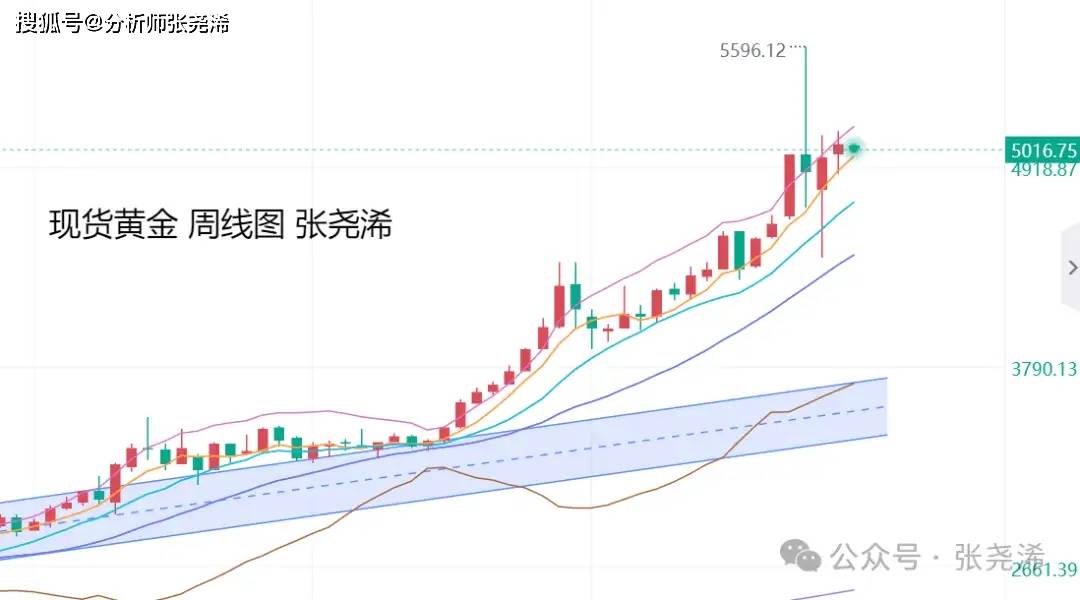
亚市早盘金价下跌,受可能的头寸调整影响
Sou Hu Cai Jing· 2026-02-15 23:52
Core Viewpoint - Gold prices have declined in the Asian morning session due to potential position adjustments, with spot gold down 0.3% at $5,025.48 per ounce. However, weaker-than-expected U.S. CPI data from Friday may limit the decline in gold prices [1] Group 1 - The weaker U.S. CPI data has led to market expectations for a more aggressive interest rate cut cycle by the Federal Reserve [1] - The market currently anticipates that the Federal Reserve will implement at least two rate cuts by 2026, with the first cut expected around June to July [1] - Increased expectations for Federal Reserve rate cuts typically enhance the appeal of non-yielding precious metals like gold [1]
美国1月CPI同比增长2.4% 低于市场预期
Zhong Jin Zai Xian· 2026-02-14 11:27
Core Insights - The U.S. Consumer Price Index (CPI) for January increased by 0.2% month-over-month, lower than the expected 0.3% and the previous value of 0.3% [1] - Year-over-year, the January CPI rose by 2.4%, below the forecast of 2.5% and the prior figure of 2.7% [1] - The core CPI, which excludes food and energy, increased by 0.3% month-over-month, matching expectations and up from 0.2% previously [1] - On a year-over-year basis, the core CPI also rose by 2.5%, in line with expectations but slightly down from 2.6% [1] Market Expectations - Following the CPI data release, the market anticipates a 61 basis point rate cut by the Federal Reserve by 2026, an increase from the prior expectation of 58 basis points [1] - Lindsay Rosner, head of multi-sector fixed income investment at Goldman Sachs Asset Management, indicated that the CPI data did not show the feared strength, making the Fed's "normalization" rate cut path clearer [1] - The Fed's decision will heavily depend on the labor market's performance, as the Federal Open Market Committee (FOMC) is highly sensitive to signs of weakness in the job market [1] - The expectation remains that the Fed will implement two rate cuts this year, with the next anticipated in June [1]
金价重返5000美元,但暴跌暴涨把人整不会了!假期如何布局黄金?
Sou Hu Cai Jing· 2026-02-14 10:29
Group 1 - The core viewpoint of the articles indicates that gold prices are experiencing volatility influenced by U.S. CPI data, with a notable recovery after a dip from historical highs [1][2] - As of February 13, gold prices rebounded to over $5000 per ounce, following a significant drop from around $5600, with a cumulative increase of over 3% in February [1][2] - The U.S. CPI for January showed a year-on-year increase of 2.4%, the lowest since May 2025, leading to heightened expectations for a potential interest rate cut by the Federal Reserve [2][3] Group 2 - The market consensus is forming around the expectation of the Federal Reserve cutting interest rates within the year, with a projected cut of 50-75 basis points [2][3] - Historical trends indicate that gold prices tend to exhibit mild fluctuations during the Chinese New Year, with a slightly higher probability of increases compared to decreases [4] - Factors such as geopolitical risks, U.S. dollar fluctuations, and Federal Reserve policies are expected to continue influencing gold prices and supporting upward trends [4][5] Group 3 - The domestic futures exchanges have raised margin requirements for gold and silver futures during the holiday period, indicating a cautious approach to trading amid market volatility [6] - The potential appointment of Kevin Warsh as the new Federal Reserve Chair could introduce uncertainties regarding future monetary policy, impacting market sentiment and gold prices [5]
美联储降息概率预期上升,黄金、白银大涨
Xin Lang Cai Jing· 2026-02-14 01:56
Core Viewpoint - The release of US CPI data has led to an increased market expectation for a Federal Reserve interest rate cut, resulting in a decline in the US dollar index and enhancing the attractiveness of precious metal assets [1][1]. Group 1: Market Reactions - COMEX gold futures rose by 2.33%, reaching $5063.80 per ounce [1]. - COMEX silver futures increased by 2.10%, reaching $77.27 per ounce [1].
今晚CPI会再爆冷?纸黄金踌躇
Jin Tou Wang· 2026-02-13 08:34
Group 1 - The current trading price of paper gold is around 1104.34 CNY per gram, with a decline of 1.83% from the previous session, and it has fluctuated between a high of 1124.88 CNY and a low of 1082.57 CNY [1] - The market for paper gold is showing a short-term sideways trend, indicating a lack of strong momentum despite being in a bullish trend [3] - Key support levels for paper gold are identified between 1100-1105 CNY per gram, with a potential test of the 1080 CNY support line if these levels are breached [3] Group 2 - The Consumer Price Index (CPI) for January is expected to show a year-on-year increase of 2.5%, which would align with pre-pandemic average price levels from 2017 to 2019 [2] - Recent CPI data has consistently fallen below Wall Street expectations, which may influence the Federal Reserve's decision to lower benchmark borrowing rates if January's data is weak [2] - The market is closely monitoring the upcoming CPI data release, as it will significantly impact economic trends and Federal Reserve monetary policy adjustments [2]