
美的中央空调

Search documents
从攻克“心脏”到引领标准:美的中央空调以“舒适黄金三角”创新引领行业向上突破
Sou Hu Cai Jing· 2025-12-31 03:51
Core Insights - The Chinese home appliance industry has developed a large-scale and complete industrial system, yet it faces challenges in high-end core components, particularly in the air conditioning sector where reliance on imports remains significant [1][4] - Midea's central air conditioning division has adopted a unique path of "independent innovation + system leadership," providing a model for high-quality development in Chinese manufacturing [1][4] Group 1: Industry Challenges - Despite being the largest market globally, China's air conditioning industry struggles with a lack of self-sufficiency in high-end compressor technology, which affects profit margins and innovation [1] - In 2021, China exported 159 million compressors worth 26.93 billion yuan but imported 16.71 million units valued at 7-9 billion yuan, highlighting the gap in high-end production capabilities [1] Group 2: Midea's Innovation Strategy - Midea has shifted its strategic focus from optimizing external technologies to reconstructing core technologies internally, leading to a significant transformation in its research and development logic [4][5] - Over the past five years, Midea has invested over 18 billion yuan in R&D, concentrating on foundational areas like compressors and control systems, establishing a localized R&D framework [4][5] Group 3: Breakthroughs in Technology - Midea achieved a historic breakthrough in compressor technology, enabling self-research and production, which enhances supply chain security and performance [5] - By 2025, Midea's self-developed ultra-low frequency steady-state technology is expected to receive international recognition, significantly improving energy efficiency and comfort in central air conditioning systems [5][10] Group 4: New Standards in the Industry - The introduction of the "Comfort Golden Triangle" redefines the standards in the central air conditioning industry, shifting focus from technical parameters to user experience [6][12] - This new evaluation system emphasizes "temperature balance, noise balance, and comfort," marking a transition from performance metrics to comprehensive user experience [6][12] Group 5: Market Recognition and Impact - Midea's technological advancements have led to a significant market share in central air conditioning, with recognition from industry awards validating its innovative approaches [10][15] - The "Comfort Golden Triangle" is becoming a benchmark for the industry, indicating a shift where Chinese innovation is not just a participant but a trendsetter [12][15] Group 6: Broader Implications for Chinese Manufacturing - Midea's journey illustrates how Chinese manufacturing can overcome core technological bottlenecks and transition from being "large but weak" to "large and strong" [17] - The company's focus on independent innovation and understanding user needs positions it as a leader in defining future standards and experiences in the global market [17]


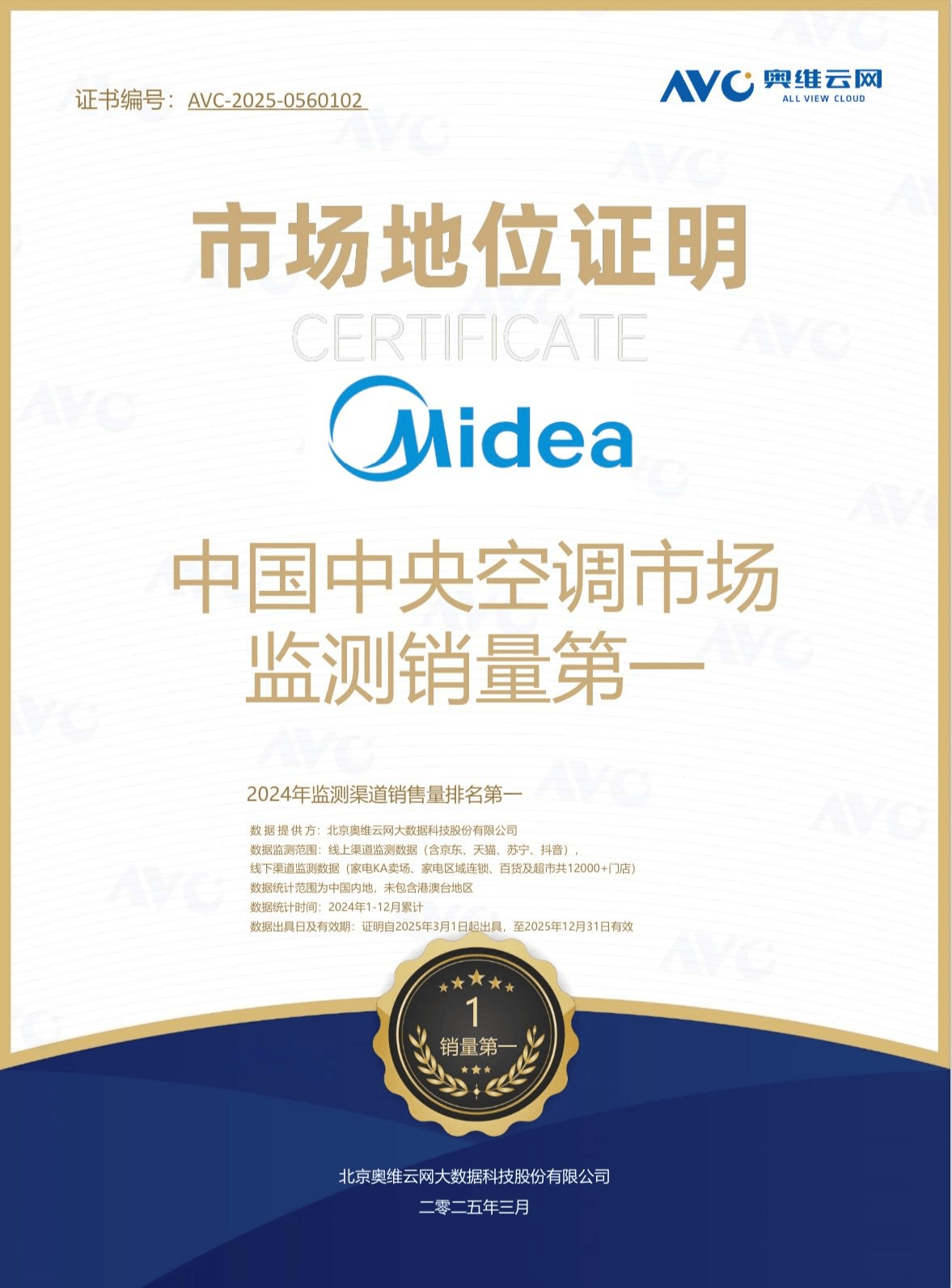
180亿研发铸就双十一霸榜:千亿中央空调产业,迎来“美的”加速度
Di Yi Cai Jing· 2025-10-31 01:15
Core Insights - The article emphasizes that core technology is essential for breakthroughs, while user experience is the source of value for companies like Midea in the HVAC industry [1][11][17] Industry Overview - The Chinese central air conditioning industry has faced significant challenges and has a history marked by struggles and obstacles [3] - Historically, the market was dominated by foreign brands, with domestic companies relying on "market for technology" strategies, leading to a long-term dependency on outdated technologies [4][5] Midea's Strategic Approach - Midea has adopted a dual strategy of "guarding the right and innovating" to navigate industry cycles and achieve global advancement [6] - The company has invested 18 billion yuan over five years in R&D, resulting in over 25,000 authorized patents and 71 core technologies recognized as internationally leading [7][9] Technological Advancements - Midea has made significant breakthroughs in core components, such as compressors, and has established a rigorous quality control system with over 17,000 tests for reliability [9] - The company has achieved a wide operational temperature range of -35°C to 65°C and maintains 100% capacity without degradation, showcasing its technological leadership [12] User-Centric Innovations - Midea focuses on user scenarios to drive technological innovation, addressing common pain points in air conditioning usage [10] - The introduction of features like dual airflow technology enhances user comfort by preventing direct cold air exposure [10] Market Positioning and Global Expansion - Midea's success represents a significant shift for Chinese high-end manufacturing, breaking through technological barriers and establishing a strong national brand image [12] - The company has transitioned from merely exporting products to exporting technology and standards, with over 40% of its revenue coming from overseas since 2016 [13] Competitive Edge - Midea's competitive strength lies in its comprehensive technical capabilities and customized solutions, allowing it to adapt to extreme climates globally [14][16] - The company has built a robust service network with 35,000 professional engineers, ensuring high-quality installation and after-sales service [16] Conclusion - Midea's journey reflects a commitment to technology and user-centric solutions, positioning it as a trusted brand in the global market [17]

1亿人口大市场,全球关税洼地,中国车企涌向埃及
3 6 Ke· 2025-06-16 05:20
Group 1 - The core viewpoint of the articles highlights Egypt's emerging role as a new destination for Chinese manufacturing and investment, driven by its large population and strategic location for trade [1][5][10] - Egypt's GDP is projected to reach $403 billion in 2024, with a low per capita GDP of $3,748, indicating a market with significant demand for affordable daily goods [3][4] - The Egyptian government is actively encouraging foreign investment through incentives such as tax refunds, land returns, and hiring subsidies to boost employment and industrial levels [4][5] Group 2 - The demographic profile of Egypt shows that 60% of its population is under 30 years old, with high smartphone and internet penetration, creating favorable conditions for e-commerce growth [3][4] - Egypt has established numerous free trade agreements over the past 30 years, making it an attractive hub for re-exporting goods to other regions [5][9] - The automotive industry is shifting towards local production, with the government favoring companies that can establish local manufacturing capabilities [8][10] Group 3 - The infrastructure sector has seen significant Chinese investment, with over 2,800 Chinese companies operating in Egypt, totaling more than $8 billion in investments [7][10] - The Egyptian government has launched initiatives to localize electric vehicle production as part of its 2030 Vision, aiming for electric vehicles to comprise 10% of total vehicles by 2030 [8][10] - Challenges for foreign companies include land scarcity, high land prices, and limited port capacity, which may affect logistics and operational efficiency [10]