航班座位选座服务

Search documents
新规能否击穿航班锁座“黑箱”
Xin Lang Cai Jing· 2026-02-24 06:58
Core Viewpoint - The demand for air travel in China is increasing around the Spring Festival, prompting the China Air Transport Association to release a draft regulation on flight seat reservation rules, aiming to address the controversial issue of seat locking during check-in [1][9]. Group 1: New Regulations - The draft regulation categorizes reserved seats into operational guarantee seats and value-added service seats, with specific requirements for free seat selection percentages for domestic and international flights [9]. - For domestic flights, the minimum percentage of free selectable seats is set at 70%, while for international and regional flights, it is set at 65% [9]. - The regulation aims to standardize the seat reservation process and improve transparency, addressing issues of information asymmetry and inconsistent standards that have left passengers feeling powerless [8][10]. Group 2: Passenger Experiences - Many passengers have reported frustration with the inability to select available seats, often finding popular seats locked and only being offered less desirable options [7][8]. - Complaints have surfaced regarding the lack of clear communication from airlines about seat availability and the reasons for seat locking, leading to a perception of a "black box" in the seat reservation mechanism [8][11]. - Instances of passengers being forced to contact customer service multiple times or visit the airport to resolve seat selection issues have been highlighted, indicating a systemic problem in the current process [7][11]. Group 3: Market Reactions - While some travelers support the new regulations, believing they will enhance the travel experience, others argue that the market should allow for paid seat selection as long as it is transparent [10]. - The existence of intermediaries offering paid seat selection services has been noted, indicating a gray market that exploits the lack of clarity in current regulations [11][12]. - Concerns have been raised about the potential for airlines to circumvent the new rules through practices like requiring passengers to purchase points for seat selection, which could undermine the intended benefits of the regulations [13][14]. Group 4: Industry Implications - The new regulations are seen as a response to long-standing issues in the industry, aiming to balance consumer rights with operational needs [13][14]. - Legal experts emphasize the importance of enforcing these regulations and ensuring that airlines do not exploit loopholes, which could damage consumer trust and the industry's reputation [12][14]. - The draft regulation reflects a commitment to public service principles within the aviation sector, aiming to protect consumer rights and promote fair practices [13][14].

至少65%座位要放开免费选!中航协征求意见稿来了
第一财经· 2026-01-29 12:53
Core Viewpoint - The article discusses the new draft regulations from the China Air Transport Association regarding the rules for reserving seats on flights, aiming to enhance passenger rights and clarify the rules around seat locking and selection [3][4]. Group 1: Seat Reservation Rules - The draft specifies that at least 70% of economy class seats on domestic flights must be available for free selection, with higher percentages for larger aircraft [4][6]. - For international and regional flights, the minimum percentage for free seat selection is set at 65% of the total economy class seats [6][7]. - Prior investigations revealed that the seat locking ratio among ten airlines ranged from 19.9% to 62.1%, with an average of 38.7% [6][7]. Group 2: Paid Seat Selection - The draft prohibits cash payments for seat selection on domestic flights, allowing only members to use points or miles for certain reserved seats [10][11]. - The regulations aim to balance consumer choice and airline operations, ensuring that a significant number of seats remain available for selection, especially for families and groups [9][10]. Group 3: Release of Reserved Seats - The draft outlines rules for releasing reserved seats at check-in counters, mandating that domestic flight reserved seats be made available for free during check-in hours [10][11]. - For international flights, reserved seats must be released no later than six hours before departure [10].

航班“锁座”多少合适?选座能收费吗?中航协征求意见稿来了
Di Yi Cai Jing· 2026-01-29 11:01
Core Viewpoint - The China Air Transport Association has released a draft for public consultation regarding the rules for "seat locking" on flights, aiming to clarify the number, acquisition, and release rules for locked seats, with feedback due by February 2 [1] Group 1: Seat Locking Rules - The draft specifies that at least 70% of economy class seats on domestic flights must be available for free selection, with higher percentages for larger aircraft [2][4] - For international and regional flights, the minimum percentage of free selectable seats is set at 65% of the total economy class seats [2][4] - Prior investigations indicated that the seat locking ratio among ten airlines ranged from 19.9% to 62.1%, with an average of 38.7% [2][5] Group 2: Payment and Selection Mechanisms - The draft prohibits cash payments for seat selection on domestic flights, allowing only members to redeem seats through points or mileage [6][8] - The concept of "value-added reserved seats" is introduced, which requires passengers to pay or use points to select certain seats, with a growing trend of airlines marking seats for additional fees [7][8] Group 3: Release Rules - The draft outlines rules for releasing reserved seats at check-in counters, stating that domestic flight reserved seats must be made available for free during check-in, while international flights must release certain reserved seats no later than six hours before departure [9][10]
国内航班免费可选座位最低要求占七成!曾有航司因锁座被约谈
Nan Fang Du Shi Bao· 2026-01-29 10:40
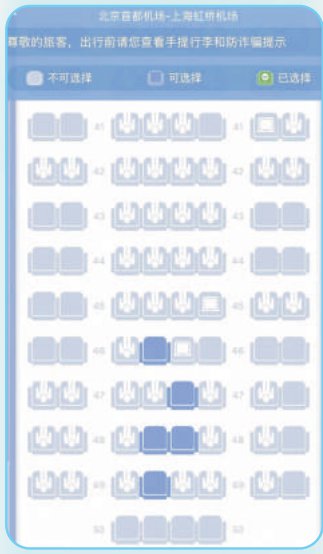
Core Viewpoint - The China Air Transport Association has released a draft standard for public consultation regarding the reservation of seats on flights, aiming to regulate the classification and information disclosure of economy class seats by airlines [1][2]. Group 1: Seat Classification and Regulations - Airlines are required to categorize economy class seats into "free selectable seats" and "reserved seats" [2]. - Reserved seats are further divided into operationally necessary reserved seats (for safety and service needs) and value-added reserved seats (including reward points/miles redemption and paid reservations for international and regional flights) [2]. - Domestic flights must ensure that at least 70% of economy class seats are free selectable, while international and regional flights must have a minimum of 65% [2]. Group 2: Information Disclosure and Transparency - Airlines must clearly inform passengers about the categories of free and reserved seats, redemption standards, paid selection prices (for international and regional flights), and the release time of reserved seats [2]. - A clear seat map must be provided to distinguish between "free selectable," "member selectable," "not selectable online," and "selected seats" to avoid ambiguity and misleading information [2]. Group 3: Consumer Complaints and Industry Response - Several airlines have faced scrutiny for locking certain desirable seats, leading to consumer complaints about unfair practices [3]. - The Jiangsu Consumer Protection Committee has conducted investigations and engaged with multiple airlines regarding the locking of seats that should be part of standard services [3]. - Airlines such as 吉祥航空 and 四川航空 have acknowledged the issues and are undertaking internal evaluations and corrective actions in response to the consumer protection committee's findings [3].



航班预留座位规则征求意见:国内航班不得付费选座,免费可选座位比例不低于70%
Xin Lang Cai Jing· 2026-01-29 10:24
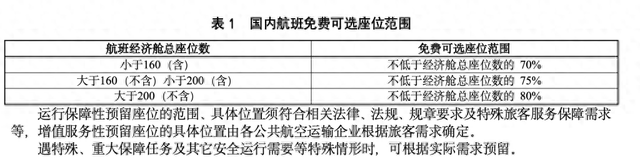
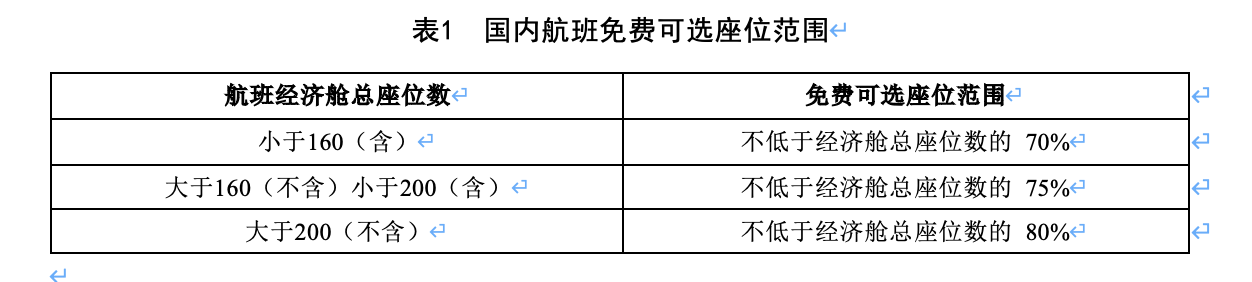
Core Viewpoint - The "Flight Seat Reservation" rules have been further clarified, establishing a framework for the classification and management of economy class seat reservations by airlines in China [1][5]. Group 1: Overview of the Draft Rules - The draft rules categorize economy class seats into "free selectable seats" and "reserved seats," with operational reserved seats mandated for safety and special passenger needs [1][2]. - The draft aims to standardize the types, scope, proportions, and information disclosure of seat reservations for domestic, international, and regional flights [1][6]. Group 2: Domestic Flight Seat Reservation Standards - For domestic flights, value-added reserved seats are limited to rights-based reservations, prohibiting paid seat selection [2][7]. - Free selectable seats must constitute at least 70% of the total economy class seats for flights with 160 or fewer seats, 75% for flights with 161 to 200 seats, and 80% for flights with more than 200 seats [2][3]. - Rights-based reserved seats must be available for online selection no later than three hours before the scheduled departure time [2][3]. Group 3: International and Regional Flight Seat Reservation Standards - International and regional flights must provide at least 65% of economy class seats for free selection [3][4]. - Reserved seats must be released at least six hours before departure for manual check-in and gradually released online starting 48 hours before departure [3][4]. - The draft specifies that seat maps must clearly indicate seat categories, including free selectable seats and paid options [4][6]. Group 4: Industry Context and Implications - The current paid seat selection service is prevalent in international flights, while domestic flights primarily offer free seats in the rear [4][5]. - The draft aims to address discrepancies in seat selection services among airlines, ensuring better protection of passenger rights and enhancing service experiences [5][6]. - The standard is designed to align domestic practices with international norms, reflecting a commitment to improving passenger service and transparency [6][7].