
节能建材

Search documents
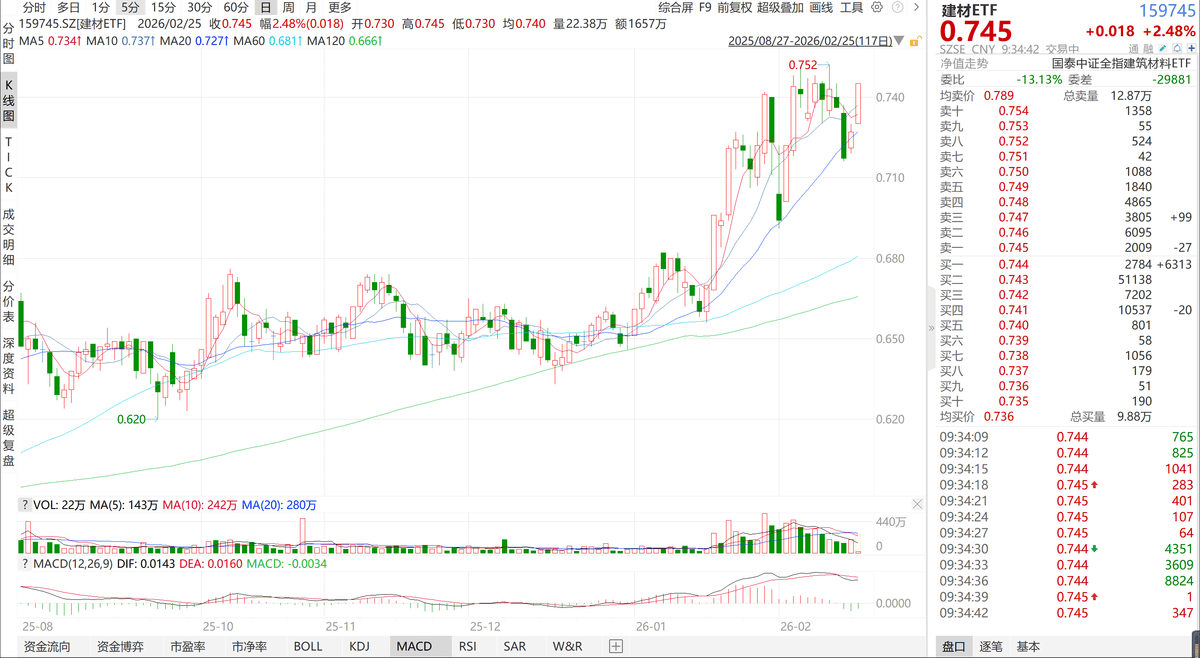
建材ETF(159745)强势领涨超2% 政策驱动+需求回暖 建材板块迎来布局良机
Sou Hu Cai Jing· 2026-02-25 01:49
Core Viewpoint - The recent strong performance of the building materials sector in the A-share market is attributed to multiple favorable factors, including macroeconomic policies, gradual improvement in industry fundamentals, and consensus on low-level capital allocation [1][3]. Policy Support - The real estate sector is experiencing a combination of policies aimed at stabilizing expectations, sales, and construction, which have led to increased demand for construction materials such as waterproofing, coatings, pipes, and tiles [3]. - Infrastructure investment continues to support the economy, with local governments accelerating the issuance of special bonds and major projects commencing, leading to a steady recovery in demand for traditional cyclical building materials like cement, glass, and fiberglass [3]. Cost and Profitability - Prices of core raw materials for building materials, such as coal, soda ash, and natural gas, have decreased, effectively lowering production costs and enhancing profit margins for companies [3]. - Ongoing supply-side reforms, including staggered production and capacity regulation, are clearing out outdated capacities, leading to increased industry concentration and improved profitability for leading companies [3]. Future Outlook - The investment opportunities in the building materials sector are clear, driven by both cyclical recovery and growth upgrades, with short-term benefits expected from accelerated construction and demand recovery [4]. - Long-term demand will be supported by urban renewal and the promotion of green and energy-efficient materials, while new materials like fiberglass and advanced composites are expected to grow due to high demand in new energy and AI sectors [4]. - The building materials sector is characterized by low valuations and high dividends, providing room for continued valuation recovery, supported by favorable policies, improving demand, and rising profitability [4]. Investment Strategy - For investors, the building materials ETF (159745) is recommended as an efficient tool for exposure to the sector, tracking the CSI All Share Construction Materials Index and covering a full industry chain [4]. - The ETF allows for easy trading, low fees, and risk diversification, making it suitable for both trend-following and value-oriented investors [4][5].

生态社区是什么样的社区?
Zhong Guo Huan Jing Bao· 2025-05-16 00:19
Core Viewpoint - The construction of high-quality ecological communities is elevated to a new level, transitioning from "environmental improvement" to "value creation" as part of the "Beautiful China" initiative [1] Group 1: Definition and Importance of Ecological Communities - Ecological community construction is a micro-practice and important carrier for achieving the goals of "Beautiful China" [1] - High-quality ecological communities are essential components for realizing the "Beautiful China" construction goals [1] - The concept of ecological communities has evolved from traditional green communities to a more comprehensive focus on ecological culture and harmonious coexistence with nature [1] Group 2: Characteristics of High-Quality Ecological Communities - Low-carbon: Represents a green lifestyle and aims to create low-carbon living experiences through green products and technologies [1] - Livable: Emphasizes complete community functions, providing a comfortable and aesthetically pleasing environment for residents [2] - Clean: Focuses on external beauty with effective sanitation, waste management, and community infrastructure [2] - Quiet: Ensures a peaceful living environment free from noise disturbances [2] - Harmonious: Highlights the harmony between people, objects, and nature [2] Group 3: Strategies for Building High-Quality Ecological Communities - Promote low-carbon living by developing zero or near-zero carbon communities and enhancing energy self-sufficiency through renewable energy sources [3] - Create warm spaces with humanistic care by designing community green spaces and ensuring accessibility for all residents [3] - Advance "waste-free communities" by establishing recycling stations and improving waste management efficiency [4] - Enhance tranquility through noise reduction measures and creating natural soundscapes [5] - Foster a sense of community and shared responsibility by involving residents in ecological culture initiatives and community governance [5]