衍生周边

Search documents
年营收超6亿,52TOYS赴港上市复制“下一个泡泡玛特”?
Sou Hu Cai Jing· 2025-05-27 14:42
Core Viewpoint - The Chinese collectible toy company 52TOYS has submitted its IPO application to the Hong Kong Stock Exchange, aiming to capitalize on the booming market for IP-based toys and collectibles [1][3]. Group 1: Company Overview - 52TOYS, founded in 2015, has established itself as the third-largest player in the domestic collectible toy market, with a revenue of approximately 6 billion RMB [6][11]. - The company has undergone several funding rounds, raising 1 billion RMB in 2018 and 4 billion RMB in 2021, demonstrating steady growth despite challenges such as the pandemic [6][7]. Group 2: Financial Performance - 52TOYS reported revenues of approximately 4.6 billion RMB, 4.8 billion RMB, and 6.3 billion RMB for the years 2022, 2023, and 2024, respectively, reflecting a compound annual growth rate of about 16.7% [7][8]. - The company has faced losses for three consecutive years, with a projected loss exceeding 1 billion RMB in 2024, but expects adjusted profits of 19.1 million RMB and 32.1 million RMB in 2023 and 2024, respectively [8][25]. Group 3: Market Position and Competition - As of May 27, 2023, 52TOYS has an estimated valuation of approximately 1.87 billion RMB based on a recent investment from Wanda Film, which holds a 7% stake in the company [5][3]. - The market capitalization of leading competitors, such as Pop Mart and Blok, is significantly higher, with Pop Mart valued at 313.17 billion HKD and Blok at 38.46 billion HKD [5][25]. Group 4: IP Strategy - 52TOYS generates a substantial portion of its revenue from licensed IPs, with the proportion of revenue from licensed IPs increasing from 50.2% in 2022 to 64.5% in 2024 [14][11]. - The company has developed over 30 proprietary IPs and collaborates with 85 experienced designers and 40 artists to enhance its product offerings [16][11]. Group 5: Future Plans - 52TOYS aims to expand its retail presence significantly, planning to establish over 100 self-operated stores in China and internationally within the next three to five years [26][25]. - The company is also focusing on increasing its overseas market revenue, which has grown from 7.6% in 2022 to 23.4% in 2024 [26][25].


情绪消费成品牌增长核心动力!叠纸心意等4家“谷子店”跻身中外大牌
Huan Qiu Wang Zi Xun· 2025-05-27 04:20
Core Insights - Emotional consumption is experiencing significant growth, with new brands like "谷子经济" leading the way in capturing the youth market [1][4] - The "China Online Consumption Brand Index" (CBI) and "Global Brand China Online 500" (CBI500) highlight the performance of brands based on real consumer data, focusing on high-quality development [1][2] Brand Performance - Four brands, namely 叠纸心意, 米哈游, 光与夜之恋, and 卡游, have emerged as strong representatives of emotional consumption among young consumers, characterized by low average transaction prices and rapid product updates [2][4] - 卡游 has a customer price index of 1.34, below 85% of brands on the list, yet its transaction amount growth index is 0.56, surpassing well-known international brands like LEGO [2] Youth Engagement - The four brands show exceptional performance in the 18-24 age group, with transaction growth rates exceeding those of established toy brands like 万代 and 迪士尼 [2] - 光与夜之恋's transaction amount growth index can reach over four times that of other brands, indicating strong market traction among younger consumers [2] Market Trends - During last year's Double 11 shopping festival, 米哈游 and 叠纸心意 both surpassed 100 million RMB in sales, marking their entry into the "billion club" [3] - The total transaction volume for derivative products on the Taobao platform exceeded 10 billion RMB, with over 30% of transactions coming from consumers aged 18-24 [3] Industry Implications - The success of these domestic IP brands serves as a strong reference for similar brands, demonstrating the potential of original IP content to disrupt the dominance of foreign IPs [4] - The rise of emotional consumption is becoming a core driver of growth for many brands, indicating a shift from manufacturing to creative development in the Chinese toy market [4]
去年淘宝上衍生周边成交量超百亿元 潮玩行业可能出现下一个泡泡玛特吗?
Mei Ri Jing Ji Xin Wen· 2025-04-19 13:03
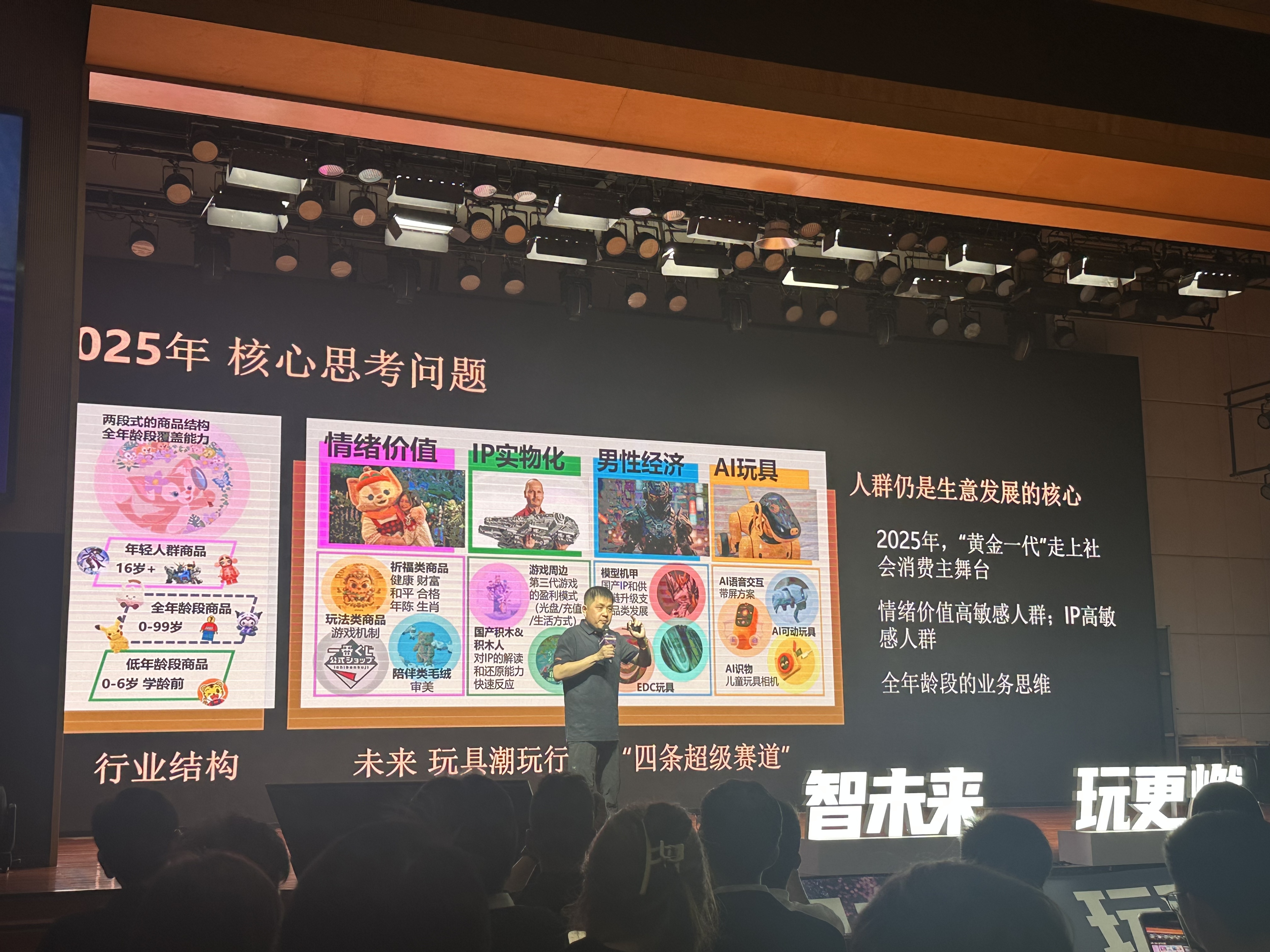
Core Insights - The toy industry is predicted to evolve towards four major trends in the next five years: emotional value, IP (Intellectual Property) materialization, male economy, and AI (Artificial Intelligence) toys [1] - The market size of China's toy and trendy toy industry is approximately 153.6 billion yuan, indicating significant growth potential [1] - The rise of derivative products related to popular IPs is creating a substantial market, with the example of "Nezha 2" generating over 300 million yuan in sales within a month [5] Group 1: Industry Trends - The toy industry is transitioning from niche to mainstream, with significant sales figures reported on platforms like Taobao, including over 1 billion yuan in derivative product sales in 2024 [1] - The focus of Taobao's toy offerings has shifted over the years, from maternal and infant toys to blind boxes, and now to plush toys, which have become the leading category [4] - The EDC (Every Day Carry) toy segment has seen a remarkable increase, with search volume up 532% and transaction volume up 345% year-on-year in 2024 [4] Group 2: Brand Development - The toy industry is moving towards brand-oriented development, with many manufacturers transitioning from OEM to brand marketing strategies [5][6] - The success of brands like Bubble Mart has demonstrated that high-value toys can be marketed effectively, influencing the industry's approach to pricing and value [10] - The concept of "brand equals category" is emphasized, suggesting that successful brands can dominate their respective markets, as seen with Lego and Bubble Mart [9] Group 3: Market Opportunities - The potential for new companies to emerge in the toy industry is significant, with the possibility of 3 to 10 new publicly listed companies in the future [13] - The industry's evolution from practicality to emotional value reflects changing consumer preferences for personalized and high-value toys [13] - The success of Bubble Mart has shown that Chinese toy companies can achieve substantial market valuations, although replicating its success may be challenging [13]