
认股权贷款

Search documents
民企科创债发行家数和规模均居全国第3,四川“交卷”2025科技金融大文章
Sou Hu Cai Jing· 2026-01-28 06:42
Core Viewpoint - The People's Bank of China Sichuan Branch is prioritizing technology finance as a key task, implementing the "Star Plan" to enhance financial support for technological development in the province [1] Group 1: Policy Framework and Ecosystem - The Sichuan Branch has led the development of a comprehensive policy framework to support technology finance, including measures like the "Five Major Articles of Finance" and the "Star Plan" for 2025 [2] - A tiered financial interaction policy has been established, rewarding banks that provide loans to technology SMEs and issue innovation bonds, with over 45 million yuan distributed to 62 banks by 2025 [2] - The branch is promoting a coordinated approach to technology finance, focusing on eight national high-tech zones and two regions with strong technology finance foundations [2] Group 2: Support for Technological Innovation - The Sichuan Branch has set up re-loans for technological innovation and equipment upgrades, with extensive policy promotion and collaboration with local departments [3] - A monthly monitoring and quarterly reporting system has been established to evaluate the implementation of policies, with underperforming banks subject to discussions and on-site supervision [3] - By the end of 2025, banks in the province had granted 106.3 billion yuan in credit to technology enterprises and projects, a 2.6-fold increase from the end of 2024 [3] Group 3: Financial Product Innovation - Financial institutions are innovating products and services to better support technological innovation, with major banks establishing independent management mechanisms for technology finance [4] - New financial products such as innovation credit loans and intellectual property loans have been launched, with collaborative models between banks and other financial institutions [4] - By the end of November 2025, the balance of technology loans in the province reached 1.35 trillion yuan, a year-on-year increase of 13.5%, surpassing the national average by 2 percentage points [5] Group 4: Diversified Financing Channels - The Sichuan Branch is leveraging the bond market to support technological innovation, facilitating the issuance of 23.1 billion yuan in technology innovation bonds [6] - A pilot program for cross-border financing has been initiated, allowing 44 companies to sign foreign debt agreements totaling 6.59 million USD under a new policy framework [6]
去年亦庄小微企业贷款贴息力度创新高
Sou Hu Cai Jing· 2026-01-12 19:48
Core Insights - The Beijing Economic-Technological Development Area (BDA) has reported a total of 84.3645 million yuan in loan interest subsidies for small and micro enterprises by 2025, marking a 54% year-on-year increase [1] - A total of 1,365 enterprises have benefited from this policy, representing a 42% year-on-year growth, indicating a significant expansion in the coverage and financial support of the loan interest subsidy policy [1] Group 1: Loan Interest Subsidy Policy - The loan interest subsidy policy has reached a historical high in terms of coverage and financial support, effectively reducing financing costs for enterprises and stimulating market vitality [1] - Since its implementation in 2020, the policy has been continuously optimized, allowing small and micro enterprises in the BDA to enjoy a 50% interest subsidy on loans, with a maximum of 500,000 yuan [1] - Among the 1,365 enterprises that received support, 873 are technology-based companies, highlighting the policy's focus on supporting technological innovation [1] Group 2: Financial Services for Technology Innovation - In April 2025, the BDA established a Technology Financial Service Center, attracting 22 financial institutions to provide innovative business consulting and services such as "Technology R&D Loans" and "Equity Rights Loans" [2] - The BDA has implemented a "no application required" model for the loan interest subsidy policy, allowing enterprises to receive funding support without actively seeking out policies, thus enhancing the efficiency of policy implementation [2] - The loan interest subsidy policy is being integrated with loan risk compensation funds to lower financing costs for enterprises and boost banks' confidence in lending, contributing to a healthier financing ecosystem for small and micro enterprises [2]
激活金融赋能新质生产力内生动力
Zhong Guo Jing Ying Bao· 2025-12-10 11:14
Core Viewpoint - Financial institutions must adapt deeply and effectively to drive technological innovation, which is crucial for promoting high-quality economic development in the context of the "14th Five-Year Plan" [1] Group 1: Construction of "Patient Capital" New Paradigm - The cultivation of new productive forces has long cycles and high uncertainty, differing from traditional finance's focus on safety, liquidity, and profitability [2] - To build "patient capital," banks should implement five major transformations: 1. Shift in operational philosophy to become a supportive financial service provider [2] 2. Transformation of product services to cover the entire lifecycle of technology enterprises [2] 3. Change in target clientele to include potential high-tech companies beyond established firms [2] 4. Transition in revenue models towards diversified structures [2] 5. Collaboration shift from isolated efforts to multi-party cooperation [2] Group 2: Internal Mechanism Adjustments - The bank has established a technology finance task force led by the president to strategically position itself in key areas [3] - Key measures include incorporating technology finance credit indicators into the assessment system and creating a supportive environment for lending [3] - Long-term assessment cycles for technology finance business are emphasized to encourage internal motivation [3] Group 3: Innovative Products and Service Ecosystem - The introduction of the "New Quality Loan" product signifies a fundamental shift in evaluation logic, focusing on future potential rather than traditional financial metrics [4] - The bank is exploring innovative products like "Equity Option Loans" to align with the characteristics of technology enterprises [4] - A comprehensive service ecosystem is being developed to support companies throughout their lifecycle, including risk-sharing loans for startups and one-stop financing services for growing firms [4] Group 4: Early Identification of Core Clients - The bank has created a proactive "scout" mechanism to identify future core clients early [5] - Establishing specialized industry teams and technology finance centers in key regions enhances early engagement with potential clients [5] - Collaboration with local government initiatives and industry funds is aimed at building a supportive ecosystem for early-stage technology enterprises [5] Group 5: Risk Management Enhancements - The bank is leveraging technology to enhance risk identification and pricing capabilities through a multi-dimensional assessment approach [6] - The risk management philosophy has evolved from traditional financial analysis to a dynamic evaluation model incorporating technology, industry, and policy factors [6] - The bank aims to integrate various financial services into its development strategy to support the growth of new productive forces [6]
破局科创融资难 多方合议“轻资产”企业成长密码
2 1 Shi Ji Jing Ji Bao Dao· 2025-12-03 23:08
Group 1 - The core theme of the discussion at the 21st Century Financial Annual Conference focused on the integration of technology and finance, emphasizing that innovation requires deep financial participation alongside technological breakthroughs and industrial development [1] - The emergence of new industries such as intelligent manufacturing, commercial aerospace, and biomedicine necessitates not only technological advancements but also financial capital to support growth [1] - Hebei Bank proposed a solution to the challenges faced by technology-based enterprises, particularly startups, by moving away from a single product service model to a comprehensive credit product matrix that includes both online and offline services, with loans disbursed in as fast as 30 minutes [1] Group 2 - Zhongguancun Bank has developed a full-cycle product system addressing the financing difficulties faced by startups, particularly those with light assets, by offering a "1+N" product service model that spans from seed to mature stages [2] - The concept of "patient capital" is becoming increasingly important in the full-cycle service ecosystem for technology enterprises, with a shift from financial investment to industrial capital involvement [2] - Galaxy Aerospace shared insights on financing paths for hard technology companies, highlighting the reliance on venture capital in the initial stages and the gradual adoption of diversified financial tools, including equity financing and local industry funds, as the company matures [2]
破局科创融资难!多方合议 “轻资产” 企业成长密码
2 1 Shi Ji Jing Ji Bao Dao· 2025-12-03 07:04
Group 1 - The strategic importance of technology finance is increasingly highlighted, with the central financial work conference in 2023 emphasizing it as a key driver for high-level technological self-reliance and strength [1] - Experts agree that technology finance has evolved beyond simple capital supply to become a core hub for resource integration, risk diversification, and the transformation of technological achievements [2] - The characteristics of technology enterprises, such as being "light asset, lack of collateral, and high risk," present challenges to traditional credit evaluation systems, necessitating the development of financial service models tailored to their needs [3] Group 2 - Financial institutions need to adapt to the development patterns of technology industries to achieve a win-win situation between financial value and industrial value [2] - The discussion highlighted the need for a full-cycle, accompanying financial service ecosystem to address the significant differences in funding and resource demands at various stages of technology enterprise development [3][4] - The concept of "patient capital" is becoming an essential part of the full-cycle service ecosystem, with financial institutions expected to deeply engage in industry scenarios to match the evolving needs of enterprises [4] Group 3 - The integration of financial and technological innovation is driven by the high investment, long cycle, and high-risk characteristics of hard technology industries, necessitating collaborative support from various types of capital [4] - The financing paths for hard technology enterprises often begin with venture capital in the initial stages and evolve to include diversified financial tools, with equity financing remaining a crucial support [5] - Continuous funding, particularly from patient capital, is essential for strategic emerging industries like commercial aerospace and satellite internet, which require sustained investment due to high technical barriers and long infrastructure development cycles [5]
中关村银行:打造科技金融生态圈“中关村样本”
Sou Hu Cai Jing· 2025-12-02 23:56
Core Viewpoint - The article discusses how Beijing Zhongguancun Bank, as the first private bank focused on serving technological innovation, has effectively supported early-stage tech companies lacking collateral over the past eight years [3][4]. Group 1: Strategic Positioning - Beijing Zhongguancun Bank has upgraded its strategic positioning from being a "provider of financial services" to a "builder of a technology financial ecosystem and a companion for innovative enterprises throughout their lifecycle" [3][4]. - The bank aims to contribute a "Zhongguancun sample" to the construction of the technology financial system [3][4]. Group 2: Key Focus Areas - The bank's service focus is summarized in eight characters: "grasp early, grasp small, grasp hard technology" [4]. - "Grasp early" refers to the ability to support emerging and future industries by providing financial assistance at the early stages of enterprise development [4]. - "Grasp small" indicates a focus on small and micro tech enterprises in their initial and growth stages, offering flexible and customized financial solutions [4]. - "Grasp hard technology" emphasizes investment in fields such as artificial intelligence, biomedicine, integrated circuits, new energy, new materials, and aerospace [4]. Group 3: Innovative Mechanisms - The bank has established a working mechanism that allows it to understand technology and entrepreneurship, ensuring effective matching of funds with projects [6]. - The bank has developed innovative financial products tailored to the unique needs of emerging industries, such as "Talent Benefit Plans," "Equity Rights Loans," and "Technology R&D Loans" [6]. - A case study illustrates how the bank provided crucial funding to a drone company during its early R&D phase, leading to significant growth and a valuation increase of 135% [7]. Group 4: Ecosystem Development - Beijing Zhongguancun Bank is building a more open innovation ecosystem by collaborating with venture capital institutions, industrial parks, incubators, accelerators, government funds, and research institutes [8]. - The bank has established partnerships with over 400 venture capital and industrial partners, facilitating shared customer resources, risk assessments, and project promotions [8]. - The bank is focusing on strategic emerging industries and aims to expand its ecosystem to promote collaborative development of technology finance across regions [8].


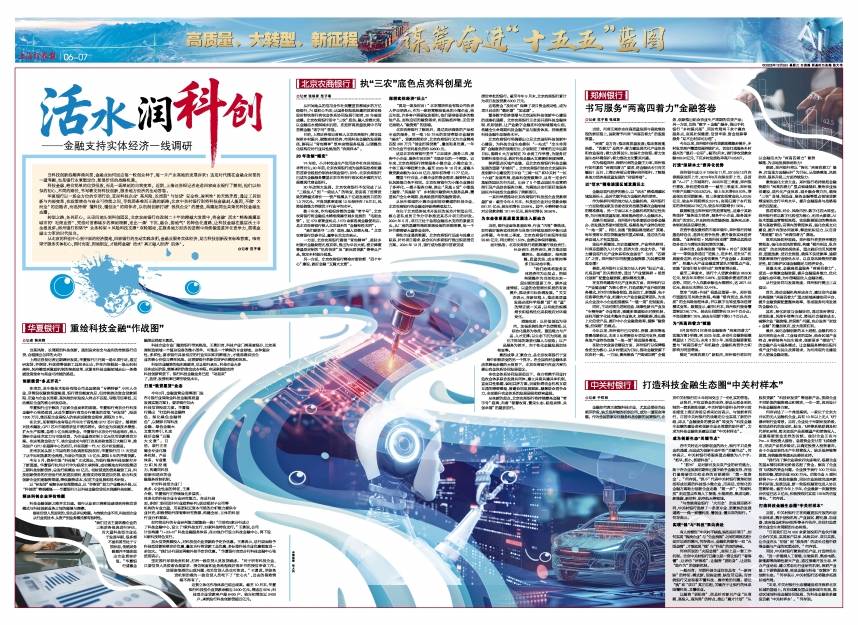
活水润科创——金融支持实体经济一线调研
Shang Hai Zheng Quan Bao· 2025-12-02 18:09
Core Insights - The financial industry is facing a transformative opportunity to support technological innovation and local economic development, moving beyond traditional credit models to embrace a more integrated approach to financing [1][2][3] Group 1: 华夏银行 (Huaxia Bank) - Huaxia Bank is implementing a comprehensive initiative to address the inherent conflict between high-risk, long-cycle technology innovation and traditional banking's focus on safety and profitability, utilizing innovative financial tools and internal reforms [3][4] - The bank has successfully launched various financial products, such as "研发贷" (R&D loans) and "并购贷" (merger loans), to meet the specific needs of technology companies, including a notable 13 million yuan R&D loan for a biotechnology firm [4][6] - As of October, Huaxia Bank's loans to technology enterprises reached nearly 240 billion yuan, with a growth rate of approximately 50%, indicating a strong commitment to supporting the tech sector [9] Group 2: 北京农商银行 (Beijing Rural Commercial Bank) - Beijing Rural Commercial Bank has evolved from a local credit cooperative to a major financial institution, with assets growing to 1.3 trillion yuan and maintaining a non-performing loan rate of around 1% [11][12] - The bank focuses on rural revitalization and small and micro enterprises, offering tailored financial products like "优农快贷" (Fast Agricultural Loans) to support local agricultural initiatives [12][14] - As of October, the bank's inclusive small and micro loans reached 20.048 billion yuan, reflecting its commitment to serving diverse customer needs [14] Group 3: 郑州银行 (Zhengzhou Bank) - Zhengzhou Bank is strategically aligned with the national goals of high-quality development and efficient governance, focusing on providing financial support to key industries and local economies [21][23] - The bank has established a "产业链金融" (industry chain finance) model to support local industries, particularly in manufacturing and agriculture, and has signed strategic agreements to provide targeted credit support [24][25] - As of June, the bank's agricultural loan balance was 48.094 billion yuan, demonstrating its commitment to rural financial services [25] Group 4: 中关村银行 (Zhongguancun Bank) - Zhongguancun Bank, as the first private bank focused on technology innovation, aims to build a comprehensive ecosystem for tech enterprises, shifting from merely providing financial services to becoming a key player in the tech finance ecosystem [32][33] - The bank emphasizes early-stage support for startups, particularly in hard technology sectors, and has developed customized financial solutions to meet the unique needs of these companies [34][35] - By collaborating with over 400 venture capital and industry partners, Zhongguancun Bank is creating a robust network to support tech companies throughout their lifecycle [36][37]

北京初步打造形成全国领先的科技金融发展环境
Xin Jing Bao· 2025-11-27 10:13
Core Insights - Beijing is enhancing its technology finance service system, focusing on policy innovation, venture capital, credit financing, and other specialized work to support technology enterprises [1][6] Group 1: Investment and Funding - In the first three quarters of this year, equity investment in Beijing reached 112 billion yuan, a year-on-year increase of 47.9% [2] - The government has established 8 municipal investment funds, making investment decisions for 255 enterprises with a total investment amount of 29.8 billion yuan, which has attracted social investment of 104 billion yuan [2] - The total scale of national-level funds established in Beijing exceeds 500 billion yuan, including the third phase of the National Integrated Circuit Fund and the second phase of the Military-Civilian Integration Fund [2] Group 2: Credit and Loan Mechanisms - As of the end of August, the balance of technology loans in Beijing reached 4.2 trillion yuan, reflecting a year-on-year growth of 8.8% [3] - Over 1,400 enterprises have received nearly 70 billion yuan in loans through enhanced bank-enterprise connections and monitoring [3] - The introduction of innovative loan products such as "merger loans" and "technology R&D loans" has led to over 30 billion yuan in applications [3] Group 3: Capital Market and Insurance - More than 60% of listed companies in Beijing are high-tech enterprises, with 475 companies listed [4] - The city has issued over 230 technology innovation bonds, raising more than 520 billion yuan [4] - Beijing has established the first commercial aerospace insurance consortium in the country, providing nearly 5 billion yuan in risk coverage for private aerospace launch projects [4][7] Group 4: Future Plans - Beijing aims to accelerate the establishment of national-level funds and enhance investment in key and emerging industries [6] - The city plans to support banks in exploring innovative loan products with longer terms and optimize the evaluation standards for technology enterprises [6] - Future initiatives include forming a major technology attack insurance community in fields like intelligent driving and biomedicine [7]
中关村银行:以产业逻辑赋能科创 打造陪伴式科技金融生态
2 1 Shi Ji Jing Ji Bao Dao· 2025-11-26 07:29
Core Viewpoint - The article discusses the role of Zhongguancun Bank in supporting high-level technological self-reliance and innovation in Beijing, focusing on its unique practices in serving early-stage tech enterprises and addressing their financing challenges [1][8]. Group 1: Bank's Positioning and Strategy - Zhongguancun Bank, established in 2017, positions itself as an "innovation and entrepreneurship bank," dedicated to serving cutting-edge tech companies in Beijing [1][8]. - The bank identifies two core pain points for startups: "light assets" and "long-term financing difficulties," which serve as both challenges and opportunities for differentiation in its services [1][3]. Group 2: Core Approaches - The bank has developed three core strategies based on in-depth research of Beijing's tech market: 1. Focus on six key sectors, including biomedicine and high-end equipment manufacturing, to build a precise industry service system [3]. 2. Establish an "innovation and entrepreneurship ecosystem service system" that collaborates with over 400 investment institutions to provide integrated services [3]. 3. Utilize deep industry research as a foundational capability, incorporating technical assessments and trend analysis into its decision-making process [3]. Group 3: Comprehensive Product System - Zhongguancun Bank has created a full-cycle product system covering seed, startup, growth, and maturity stages of enterprises [4][5]. - The bank's "1+N" product service system includes "equity rights loans" and the "Hui Chuang" series, catering to the entire lifecycle of tech enterprises [5]. - For seed-stage companies, the bank emphasizes talent evaluation and has launched the "Hui Cai Su Dai" product for quick approvals based on talent assessment [5]. - For early-stage companies, the bank offers customized products like the "Hui Cai Plan" and "Technology R&D Loan" to support those in the critical funding gap [5][6]. - Growth-stage companies benefit from "equity rights loans" and "innovation credit loans," which incentivize continuous innovation [6]. - Mature companies can access "merger loans" and "investment-linked loans" to enhance their competitive positioning [6]. Group 4: Talent Development in Tech Finance - The bank has established five specialized departments focused on key industries and technologies, creating a professional service system [7]. - It continuously updates its industry database and credit policies to reflect the latest trends and risks in six priority sectors [7]. - The bank aims to attract professionals who understand technology and industry, enhancing its capacity to serve tech enterprises [7]. Group 5: Commitment to Innovation - Zhongguancun Bank is committed to its role as an "innovation and entrepreneurship bank," aiming to efficiently empower tech innovation through specialized, ecological, and full-cycle service models [8].

北京开启量子路演 最高奖励潜力企业百万元
Bei Jing Shang Bao· 2025-11-26 00:30
Core Insights - The event on November 24, 2025, in Beijing focused on quantum technology, featuring eight innovative companies and facilitating deep exchanges with investment institutions to explore new trends in industry development [1][2] - The Beijing Economic and Information Technology Bureau aims to select potential enterprises through this public roadshow and provide rewards of up to 1 million yuan to promote rapid development in future industries [1][4] Group 1: Event Overview - The public roadshow is part of the "Winning the Future" project series, aimed at creating a long-term communication mechanism for government-enterprise connections and industry-academia-research integration [1][4] - The event gathered eight potential companies in the quantum field to bridge social capital with early-stage investments in hard technology, addressing financing bottlenecks for innovative enterprises [2][4] Group 2: Financial Support and Policies - The People's Bank of China introduced various financial support tools for technology innovation, including equity-linked loans and technology enterprise acquisition loans, to assist quantum technology companies [2] - The equity-linked loan allows banks to mitigate credit risk through future equity gains, addressing the financing challenges faced by asset-light technology firms [2] Group 3: Market Trends and Projections - According to a report shared at the event, global quantum technology financing reached $4.8 billion in the first three quarters of 2025, indicating a booming investment climate in the sector [3] - The report suggests that confidence among quantum investment institutions is gradually recovering, marking a significant increase compared to previous years [3] Group 4: Future Industry Development - The Beijing Economic and Information Technology Bureau plans to support the Haidian District in establishing a national-level future industry pilot zone, enhancing Beijing's influence in frontier technology innovation [5] - The city has implemented over 40 municipal policies to promote future industries, with a focus on artificial intelligence and 6G, aiming to lead in national competitiveness [4][5]