财政贴息

Search documents
中国人民银行曲靖市分行:融资对接“暖服务” 赋能实体经济加速度
Sou Hu Cai Jing· 2026-01-21 10:48
Core Insights - The People's Bank of China (PBOC) in Qujing has implemented a comprehensive approach to address financing difficulties under information barriers, resulting in a total financing of 29 billion yuan for various market entities by the end of November 2023, with a loan balance of 290.27 billion yuan, reflecting a year-on-year growth of 7.17% [1] Group 1: Financing Mechanisms - The PBOC has established a long-term financing coordination mechanism to alleviate bottlenecks in financing and information barriers, promoting policies such as the "Implementation Opinions on Financial and Fiscal Linkage to Support High-Quality Development" [1] - A "government-bank-enterprise guarantee" financing coordination mechanism has been set up, utilizing multiple policy tools to lower financing thresholds and costs for market entities [1] Group 2: Demand Response Mechanism - A financing demand response mechanism has been developed, focusing on local industrial characteristics and updating financing demand lists for various sectors, including technology and agriculture [2] - A full-process closed-loop management model has been established to ensure precise matching between supply and demand in financing [2] Group 3: Financing Events and Activities - The PBOC has organized 62 financing matching events since 2025, facilitating financing intentions of 290 enterprises amounting to 4.582 billion yuan, enhancing the coverage and effectiveness of financing connections [2] - Specialized financing matching events have been conducted in areas such as technology, green finance, and digital finance, resulting in 69 enterprises signing agreements for a total of 6.132 billion yuan [3] Group 4: Targeted Financial Support - The PBOC has focused on providing targeted financial services to address specific challenges faced by enterprises, coordinating over 30 financing issues through various initiatives [3] - Financial resources have been directed to county-level economies, with 39 financing agreements amounting to 1.522 billion yuan facilitated through direct engagement with local market entities [4]


企业融资不用愁!找对方法,让资金活水精准灌溉发展之路
Sou Hu Cai Jing· 2025-12-25 07:13
Core Insights - The article highlights the challenges faced by small and medium-sized enterprises (SMEs) in securing financing, emphasizing that the root causes are information asymmetry and inadequate preparation [1] Group 1: Understanding Financing Challenges - Many SMEs struggle with financing due to a lack of understanding of suitable financial products and banks' inability to assess their true operational status, leading to a deadlock where businesses cannot find funds and banks are hesitant to lend [1] - A case study of a new materials company in Guangxi illustrates that with the right financial solutions, such as long-term loans and flexible working capital, businesses can overcome funding pressures and achieve significant production value [1] Group 2: Recommended Financing Channels for SMEs - Three financing directions are recommended for SMEs, which have relatively low thresholds and strong adaptability: 1. Policy-based financing, which includes favorable government policies like small loan re-lending and financial subsidies, often with lower interest rates and reduced collateral requirements [2] 2. Supply chain finance, allowing businesses to leverage the credit of core enterprises for financing, such as using accounts receivable for factoring, which can alleviate cash flow pressures [2] 3. Digital financing platforms that offer a "one-stop" service, integrating various bank products and providing tailored solutions based on individual business needs [2] Group 3: Common Misconceptions to Avoid - Four common misconceptions that SMEs should avoid include: 1. Waiting until funds are needed to seek financing, as this requires advance planning of 3-6 months [3] 2. Focusing solely on bank loans, while other non-bank channels like equity financing and microloans can also provide necessary funds [3] 3. Neglecting financial norms, as clear financial records can enhance credit scores and increase the likelihood of successful financing [3] 4. Trusting high-interest private loans, which can lead to significant financial risks and potential debt crises [3] Group 4: Preparation Tips for Successful Financing - Two key preparations that can double the success rate of financing include: 1. Organizing essential documents such as financial statements, business licenses, tax certificates, and trade contracts, which serve as the "key" to financing [4] 2. Clearly defining financing needs, including the amount required, duration, and purpose, to facilitate the identification of suitable financial products [4] Group 5: The Importance of Matching Funding Sources with Needs - The core of enterprise financing is the precise matching of funding sources with demand, with many service models evolving to simplify processes and lower barriers, enhancing financing efficiency [5]
7月财政数据的四大特征
Sou Hu Cai Jing· 2025-08-22 03:28
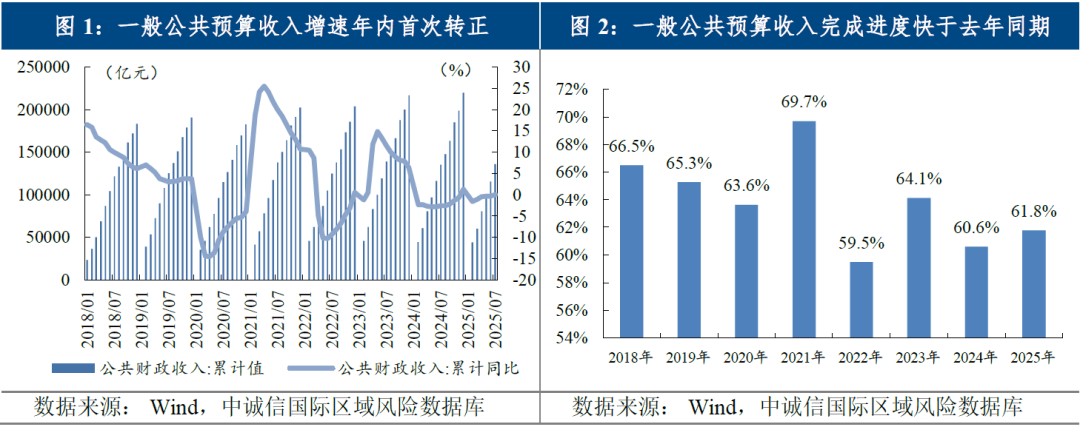
Core Insights - The general public budget revenue has shown significant recovery, with a year-on-year growth of 0.1% from January to July, marking the first positive growth this year, indicating economic resilience [2][4][14] - The land market remains sluggish, with government fund budget revenue growth weak, reflecting ongoing challenges in the real estate sector [2][8] - Fiscal expenditure has ramped up, with a broad fiscal expenditure growth rate of 9.3%, the highest level in recent years, driven primarily by central government spending [3][10][14] - The structure of fiscal expenditure is optimizing, with a focus on social welfare and education, alongside new policies aimed at supporting families and boosting consumption [3][12] Revenue Analysis - From January to July, the general public budget revenue growth rate turned positive for the first time this year, with July showing a 2.6% increase, the highest monthly growth rate [2][4] - Tax revenue recovery is a key driver, with personal income tax, domestic VAT, and domestic consumption tax showing year-on-year growth rates of 8.8%, 3.0%, and 2.1% respectively [6][8] Land Market Insights - The government fund budget revenue saw a year-on-year decline of 0.7% from January to July, with July's growth rate slowing significantly to 8.9% [2][8] - Real estate investment continues to decline, with a 12% year-on-year drop in property development investment from January to July [8][10] Expenditure Insights - Broad fiscal expenditure growth reached 9.3%, significantly higher than the previous year's decline of 2.0%, with central government expenditure growing by 33.9% [3][10] - The issuance of government bonds is at a rapid pace, with a total of 9.11 trillion yuan issued from January to July, a 33.8% increase year-on-year [10][12] Policy and Structural Changes - Recent fiscal policies have focused on social welfare, with expenditures in social security, education, and health exceeding 6 trillion yuan, reflecting a commitment to improving living standards [12][14] - New initiatives such as childcare subsidies and free preschool education have been introduced to stimulate consumption and support families [12][14]