
超级大黄蜂

Search documents
海内外催化不断,大飞机、军贸成新风口?军工ETF华宝(512810)马年开门红!机构高呼“加大军工板块配置”
Xin Lang Cai Jing· 2026-02-24 11:46
Group 1 - The military industry sector in A-shares showed a quick recovery after a brief dip on the first trading day of the Year of the Horse, with the popular military ETF Huabao (512810) reaching a high of 1.98% and closing up 1.16%, marking three consecutive days of gains [1][5] - Among the constituent stocks, 57 rose while 23 fell, with AVIC Heavy Machinery and Philihua both rising over 8%, and China Power increasing by 6.17%. Major stocks like China Shipbuilding, Aero Engine Corporation of China, and Guangqi Technology all rose over 2% [1][5] - The report from Dongfang Securities suggests increasing allocation in the military sector, particularly focusing on large aircraft and military trade, as the acceleration in domestic aircraft production and military trade in new markets is expected to strengthen due to recent geopolitical events [3][7] Group 2 - During the Spring Festival travel period, 14 domestically produced C919 aircraft operated nearly 50 flights daily, representing a year-on-year increase of 52.6%, indicating an acceleration in the domestic production process expected by 2026 [3][7] - Internationally, tensions between the U.S. and Iran have heightened, with Raytheon Technologies announcing that the U.S. Navy has approved the use of its "Stormbreaker" smart weapon on the Super Hornet fleet, emphasizing the urgency of national defense construction in China [3][7] - The Huabao military ETF (512810) covers various popular themes such as large aircraft, commercial aerospace, low-altitude economy, satellite navigation, military informationization, and controllable nuclear fusion, serving as an efficient tool for investing in core military assets [3][7]

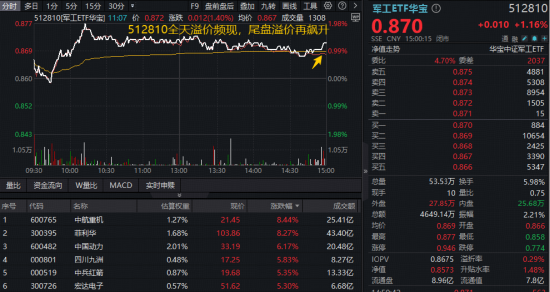
海内外催化不断,大飞机、军贸成新风口?军工ETF华宝马年开门红!机构高呼“加大军工板块配置”
Xin Lang Ji Jin· 2026-02-24 11:44
Core Viewpoint - The military industry sector in A-shares shows strong performance on the first trading day of the Year of the Horse, with significant interest in military ETFs, particularly the Huabao ETF, which has seen a price increase and active buying [1][3]. Group 1: Market Performance - The military sector experienced a quick recovery after a brief dip, with the Huabao ETF reaching a high of 1.98% and closing up 1.16%, marking three consecutive days of gains [1]. - Among the constituent stocks, 57 increased while 23 decreased, with notable gains from Zhonghang Heavy Machinery and Feiliwa, both rising over 8%, and China Power increasing by 6.17% [1]. - Major stocks such as China Shipbuilding, Aero Engine Corporation of China, and Guangqi Technology all rose by over 2% [1]. Group 2: Industry Catalysts - The military industry is experiencing multiple catalysts, including a significant increase in domestic flight operations of the C919 aircraft, which averaged nearly 50 flights per day during the Spring Festival, representing a year-on-year growth of 52.6% [3]. - The commercial aerospace sector is expected to see intensive testing of recoverable rocket experiments from March to June [3]. - Internationally, heightened tensions between the U.S. and Iran have led to increased urgency in China's defense construction, as evidenced by the U.S. Navy's approval of Raytheon Technologies' smart weapon for use on the Super Hornet fleet [3]. Group 3: Investment Recommendations - Dongfang Securities recommends increasing allocation to the military sector, particularly focusing on large aircraft and military trade, anticipating accelerated progress in large aircraft production and increased market share in military trade in new markets like the Middle East [3]. - The Huabao ETF, which covers various popular themes such as large aircraft, commercial aerospace, low-altitude economy, satellite navigation, military informationization, and controllable nuclear fusion, is highlighted as an efficient tool for investing in core military assets [3].



波音(BA.N)获得了美国海军价值9.3亿美元的“超级大黄蜂”合同。
Jin Rong Jie· 2025-12-16 23:18
Group 1 - Boeing has secured a $930 million contract from the U.S. Navy for the "Super Hornet" [1]
专栏丨美国最大航母战斗群剿毒,谁信?
Xin Hua She· 2025-11-13 00:54
Group 1 - The deployment of the USS Gerald R. Ford aircraft carrier in the Caribbean, under the pretext of combating drug trafficking, raises questions about the underlying geopolitical motives of the U.S. government [1][2] - Historical context shows that the U.S. has a long history of military interventions in Latin America, with nearly 400 interventions globally since 1776, 34% of which targeted Latin America and the Caribbean [2] - The USS Ford's presence is perceived as a demonstration of U.S. military power, signaling that the U.S. can still enforce its will in its "backyard" [2][3] Group 2 - The U.S. military buildup in the Caribbean is viewed as a significant threat to peace and stability in the Western Hemisphere, suggesting that non-compliant regimes may face military consequences [3] - The narrative of "fighting drugs" is seen as a facade for U.S. interventionism, with the real intent being the protection of U.S. interests and hegemony in the region [2][3] - The changing dynamics in Latin America, characterized by greater sovereignty and diverse development, challenge the effectiveness of traditional U.S. interventionist strategies [3]