跨国公司本外币一体化资金池业务

Search documents
资金“高速路”贯通,如何利好跨国公司?(环球热点)
Ren Min Ri Bao Hai Wai Ban· 2026-01-28 22:49
Core Viewpoint - The People's Bank of China and the State Administration of Foreign Exchange have announced the nationwide promotion of the integrated currency pool business for multinational companies, which aims to streamline cross-border fund management and enhance operational efficiency for these companies in China [1][3]. Group 1: Policy Changes and Impacts - The integrated currency pool business allows multinational companies to manage both domestic and foreign currency funds under a unified regulatory framework, moving from a model of separate currency management to a more efficient, centralized approach [3][5]. - This policy shift enables companies to autonomously allocate funds within approved limits, significantly reducing the time and complexity involved in cross-border fund transfers [9][10]. - Over 1,100 multinational companies have already benefited from this policy, which has facilitated cross-border transactions amounting to $2.1 trillion [5]. Group 2: Operational Efficiency - The new system allows for faster fund transfers, with many transactions now completed within hours instead of days, thus enhancing the predictability and management of cash flows [9][10]. - Financial teams within multinational companies can transition from operational roles to strategic planning, focusing on risk management and financial forecasting rather than routine transaction processing [10][11]. - The reduction in redundant foreign exchange and cross-border remittance procedures leads to significant cost savings for companies, enhancing their overall financial efficiency [10]. Group 3: Strategic Implications - The integrated currency pool is expected to change the operational dynamics of multinational companies in China, allowing them to establish regional financial centers within the country rather than relying on locations like Singapore or Hong Kong [7][8]. - This policy is anticipated to attract more regional headquarters and financial centers to China, thereby improving the country's position in the global financial network [8][12]. - As multinational companies increasingly utilize the currency pool for RMB transactions, there will be a growing demand for RMB-denominated investment and financing tools, furthering the internationalization of the RMB [12].


外汇领域高水平制度型开放稳步推进
Jin Rong Shi Bao· 2026-01-09 00:46
Core Viewpoint - The article discusses the ongoing reforms in the foreign exchange (FX) sector in China, highlighting the expansion and improvement of bank FX operations, capital account opening, and support for key regional developments, aiming for a more efficient and open FX market by 2026 [1][2][3]. Group 1: Bank FX Operations Reform - The State Administration of Foreign Exchange (SAFE) is promoting reforms to enhance the quality and scope of bank FX operations, with a focus on efficient processing of FX transactions [2][3]. - By the end of 2025, banks processed FX transactions worth $440 billion based on client instructions, with 30 banks participating and covering 32,000 clients [3]. - The SAFE has established a regulatory framework for bank FX operations, including the release of the "Bank FX Operations Management Measures (Trial)" to standardize procedures and enhance operational capabilities [2][3]. Group 2: Capital Account Opening - The promotion of the integrated currency pool for multinational corporations has been expanded nationwide, facilitating centralized fund management for large companies [4]. - As of the third quarter of 2025, 98 multinational companies participated in the currency pool pilot, benefiting nearly 5,000 domestic and foreign member enterprises, with cross-border transactions amounting to approximately $150 billion from January to September 2025 [4]. - The SAFE is also working on policies to streamline the management of funds for domestic companies listed overseas, simplifying processes and enhancing efficiency [5]. Group 3: Support for Key Regional Developments - The SAFE is implementing a series of facilitation policies to support the construction of free trade pilot zones and enhance cross-border financial services in major financial centers like Shanghai and Hainan [1][5]. - The issuance of $30.8 billion in Qualified Domestic Institutional Investor (QDII) investment quotas aims to meet reasonable investment demands in a stable foreign exchange market [5].
跨国公司本外币一体化资金池业务全国铺开!三大利好→
Sou Hu Cai Jing· 2025-12-27 13:00
Core Viewpoint - The People's Bank of China and the State Administration of Foreign Exchange have announced the nationwide promotion of the integrated currency pool business for multinational companies, effective immediately, building on previous pilot experiences [1][3]. Group 1: Overview of the Integrated Currency Pool Business - The integrated currency pool business allows multinational companies to manage both domestic and foreign currency funds centrally, facilitating fund collection and allocation based on operational needs [3]. - Since the pilot program began in 2021 in Beijing and Shenzhen, the scope and content of the business have been expanded multiple times [3]. Group 2: Benefits of Nationwide Implementation - The transition from "local pilot" to "full coverage" offers three main advantages: 1. It leverages the scale effect of centralized funds, allowing companies to manage domestic and foreign currency funds of their subsidiaries in a unified manner [5]. 2. It significantly reduces financial costs and enhances fund utilization efficiency [5]. 3. It simplifies business procedures by shifting more operations from pre-approval to management during and after the process, thereby lowering institutional transaction costs [5]. Group 3: Impact on Multinational Companies - The policy enhances the autonomy and flexibility of cross-border fund allocation for enterprises, contributing to a unified, predictable, and transparent regulatory environment, which boosts multinational companies' confidence in China's cross-border financial management system [7]. - By centralizing management and unified scheduling, corporate groups can reduce idle funds, improve overall fund turnover rates, and enhance responsiveness to market changes [9]. - The policy also aids companies in building a global treasury management system, improving cross-border fund allocation and risk management capabilities, thereby enhancing international competitiveness [9]. Group 4: Requirements for Participation - The notification specifies that multinational companies wishing to engage in the currency pool business must meet nine criteria, including having genuine business needs and a robust cross-border fund management framework [11]. - As of the end of September, 98 multinational companies and over 5,000 of their domestic and foreign subsidiaries have participated in the pilot program, with a cross-border payment scale of approximately $150 billion in the first nine months of this year [11].
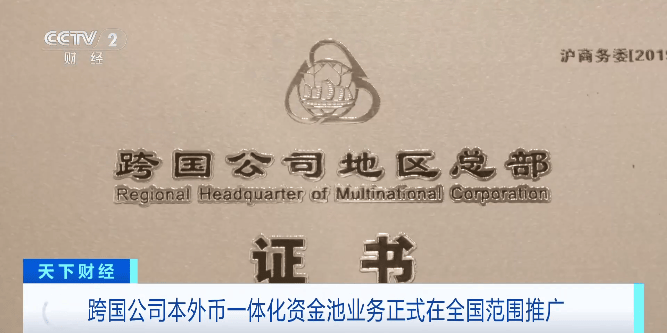
跨国公司本外币一体化资金池业务在全国范围推广带来多重利好
Yang Shi Wang· 2025-12-27 12:37
Core Viewpoint - The People's Bank of China and the State Administration of Foreign Exchange have announced the nationwide promotion of the integrated currency pool business for multinational companies, effective immediately, following successful pilot programs in select regions [1][3]. Group 1: Overview of the Integrated Currency Pool Business - The integrated currency pool business allows multinational companies to centrally manage both domestic and foreign currency funds, facilitating fund collection and allocation based on operational needs [1]. - This initiative transitions from a "local pilot" to "full coverage," providing three main benefits: scale effect from centralized funds, significant cost savings in financial management, and simplified business procedures [1]. Group 2: Conditions and Participation - Multinational companies must meet nine specific conditions to engage in the currency pool business, including having genuine business needs and a robust cross-border fund management framework [3]. - As of the end of September, 98 multinational companies and over 5,000 of their domestic and foreign member enterprises have participated in the pilot, with a cross-border transaction volume of approximately 150 billion USD in the first nine months of the year [3].
跨国公司本外币一体化资金池业务推广至全国
Zhong Guo Zheng Quan Bao· 2025-12-26 21:05
Core Viewpoint - The People's Bank of China and the State Administration of Foreign Exchange have announced the nationwide promotion of the integrated currency pool business for multinational corporations, aimed at facilitating cross-border fund collection and usage [1][2]. Group 1: Policy Framework - The integrated currency pool policy framework will unify the management of domestic and foreign currency pool businesses, encouraging enterprises to conduct operations in local currency [1]. - Local foreign exchange bureau branches will serve as a "one-stop" window for enterprises to handle registration and other procedures, reducing operational costs [1]. Group 2: Cross-Border Fund Management - The policy allows multinational corporations to manage both domestic and foreign currency funds centrally, enabling unified scheduling and usage [2]. - The external debt and overseas lending limits can be flexibly adjusted, allowing corporations to borrow up to 3.5 times and 0.8 times their equity in the currency pool [2]. - The policy facilitates the handling of current account transactions, allowing corporations to manage concentrated receipts and payments or net settlements through the main enterprise [2]. Group 3: Supervision and Management - The policy includes enhanced supervision and management of the currency pool business, with local branches of the People's Bank and foreign exchange bureau required to strengthen statistical monitoring and conduct inspections [1]. - The integrated currency pool policy is seen as a significant step in financial supply-side structural reform, aimed at reducing costs and improving efficiency for enterprises [2]. Group 4: Market Reception and Future Steps - The policy has been well-received by businesses, with reports of smoother cross-border settlements and reduced exchange costs, supporting international business expansion [2]. - Approximately 300 multinational corporations meet the application requirements for the integrated currency pool, with 98 already implementing related business through pilot programs [2]. - Future efforts will focus on optimizing cross-border fund management policies and enhancing the convenience of cross-border trade and investment [3].
跨国公司本外币一体化资金池业务向全国推广
Shang Hai Zheng Quan Bao· 2025-12-26 18:58
Core Viewpoint - The People's Bank of China and the State Administration of Foreign Exchange have announced the nationwide promotion of the integrated currency pool business for multinational companies, aimed at facilitating cross-border fund management and usage [1][2]. Group 1: Policy Framework - The new policy framework for the integrated currency pool business encourages enterprises to conduct operations in local currency and establishes a unified management system for both domestic and foreign currency funds [2]. - Local branches of the State Administration of Foreign Exchange will serve as a "one-stop" window for enterprises to handle registration and filing for the currency pool business, thereby reducing operational costs for companies [2]. Group 2: Cross-Border Fund Management - The policy allows for the establishment of external debt and overseas loan concentration limits linked to the equity of member enterprises within the currency pool, enabling efficient and autonomous fund allocation for multinational companies [2]. - The initiative aims to streamline the cross-border collection and transfer of funds for multinational corporations [2]. Group 3: Supervision and Management - The new regulations outline the norms for multinational companies and cooperating banks in managing the currency pool business, emphasizing the need for enhanced statistical monitoring and both non-site and on-site inspections by local branches of the People's Bank of China and the State Administration of Foreign Exchange [2]. - The currency pool business has undergone several upgrades since its initial pilot in 2021, with the scope gradually expanding to include more regions such as Shanghai, Guangdong, Zhejiang, and Shaanxi [2].
新华鲜报|利好跨国公司!这项跨境资金管理政策全国推广
Xin Hua She· 2025-12-26 14:14
Core Viewpoint - The People's Bank of China and the State Administration of Foreign Exchange have announced the nationwide promotion of the integrated currency pool business for multinational companies, which aims to enhance the management and operation of funds in cross-border investments and trade [1][2]. Group 1: Benefits of Nationwide Implementation - The transition from "local pilot" to "full coverage" is expected to leverage the scale effect of centralized funds, improving the onshore collection of global funds and the security of fund settlements [2]. - The policy allows host enterprises to centrally manage both domestic and foreign currency funds of their member companies, enabling unified scheduling and utilization [2]. - Companies like CATL have reported significant improvements in fund transfer efficiency, with over $3 billion in cross-border fund allocation achieved within six months of implementing the new fund pool [2]. Group 2: Cost Efficiency and Simplification - The policy is anticipated to significantly reduce financial costs and enhance fund utilization efficiency by adjusting the external debt and overseas lending limits for multinational companies [2]. - Multinational companies can manage regular fund collections and net settlement through the host enterprise based on operational needs [2]. - The implementation of the integrated currency pool has simplified business procedures, shifting more operations from pre-approval to post-management, thereby lowering institutional transaction costs [2][3]. Group 3: Operational Efficiency - Companies like Guangdong Haida Group have reported that the time for cross-border fund allocation has been reduced from several days to real-time, greatly enhancing fund utilization efficiency [3]. - The transition to nationwide promotion is seen as a result of institutional innovation based on previous pilot experiences, reflecting a commitment to institutional openness [3].
重磅,央行、外汇局联合发布!全国范围推广→
Jin Rong Shi Bao· 2025-12-26 12:43
Core Viewpoint - The People's Bank of China and the State Administration of Foreign Exchange have announced the nationwide promotion of the integrated currency pool policy for multinational companies, aimed at enhancing cross-border fund management efficiency and reducing operational costs for enterprises [1][2]. Group 1: Policy Implementation - The integrated currency pool policy will be implemented nationwide starting December 26, 2025, following successful pilot programs in various cities [1]. - The policy aims to transition from localized trials to a comprehensive framework, enhancing the predictability and transparency of cross-border financial management [1][2]. Group 2: Background and Development - The increasing number of multinational companies in China has led to a higher demand for efficient cross-border fund management due to diverse currency structures and frequent fund flows [2]. - Initial pilot programs began in 2021, with subsequent expansions in 2022 and 2024, optimizing management policies and simplifying application processes [2][3]. Group 3: Benefits of the Policy - The integrated currency pool allows for centralized management of both domestic and foreign currency funds, improving fund utilization efficiency and reducing management costs [4][5]. - As of the third quarter of this year, 98 multinational companies have participated in the pilot, benefiting nearly 5,000 domestic and foreign member enterprises, with cross-border transactions amounting to approximately $150 billion from January to September [3][5]. Group 4: Cost Reduction and Efficiency - The policy significantly lowers operational costs by eliminating the need for multiple fund pools and accounts, thus reducing account management fees and cross-border exchange costs [6]. - Banks are expected to provide streamlined services for enterprises, enhancing the efficiency of fund pool operations [6][7]. Group 5: Integration of Policies - The policy integrates various favorable measures for enterprises, allowing eligible companies to directly enjoy benefits from multiple facilitation policies [7]. - The approach aims to shift from pre-approval to post-management, thereby reducing institutional transaction costs for multinational companies [7].


跨国公司迎政策利好!央行、外汇局联合发文→
Jin Rong Shi Bao· 2025-12-26 12:26
Core Viewpoint - The People's Bank of China and the State Administration of Foreign Exchange have announced the nationwide promotion of the integrated currency pool business for multinational companies, effective from December 26, 2025, to enhance high-level opening-up and streamline cross-border fund management [1][2]. Group 1: Policy Highlights - The policy focuses on three main aspects: integrating account systems, simplifying business processes, and strengthening overall management [1]. - It allows multinational companies to centrally manage both domestic and foreign currency funds, enabling unified scheduling and utilization of funds [1]. - The policy permits flexible adjustment of foreign debt and overseas lending limits, allowing companies to borrow up to 3.5 times and 0.8 times their equity in the fund pool [1]. - Multinational companies can conduct centralized collection and payment of current account funds through the main enterprise based on operational needs [2]. - The policy aims to simplify business procedures by shifting more operations from pre-approval to post-management, thereby reducing institutional transaction costs for enterprises [2]. Group 2: Future Directions - The People's Bank of China and the State Administration of Foreign Exchange will continue to optimize cross-border fund management policies to enhance the convenience of cross-border trade and investment [2]. - The initiative is part of a broader effort to support financial services for high-quality development of the real economy [2].
利好跨国公司!这项跨境资金管理政策全国推广
Xin Hua She· 2025-12-26 12:02
Core Viewpoint - The People's Bank of China and the State Administration of Foreign Exchange announced the nationwide promotion of the integrated currency pool business for multinational companies, effective immediately, building on previous pilot experiences [1][4]. Group 1: Business Overview - The integrated currency pool serves as a central cash repository, crucial for multinational companies to manage and operate funds effectively [5]. - Since the pilot program began in 2021 in Beijing and Shenzhen, the scope and content of the business have been expanded multiple times, with 98 multinational companies and over 5,000 member enterprises participating by the end of September [5]. - The cross-border payment scale reached approximately $150 billion in the first nine months of this year [5]. Group 2: Benefits of Nationwide Implementation - The transition from "local pilot" to "full coverage" is expected to enhance the scale effect of fund concentration, improving the onshore collection of global funds and the security of fund settlements [6]. - The policy allows host companies to centrally manage both domestic and foreign currency funds of their member enterprises, facilitating unified scheduling and usage [6]. - Companies like CATL have reported significant improvements in cross-border fund allocation efficiency, with over $3 billion in cross-border fund transfers achieved within six months of using the new currency pool [6]. Group 3: Cost Efficiency and Simplification - The policy is designed to significantly reduce financial costs and enhance fund utilization efficiency by adjusting the external debt and overseas lending limits for multinational companies [6]. - Companies can manage regular fund collections and net settlement through the host enterprise based on operational needs [6]. - The process for business operations has been simplified, shifting more activities from pre-approval to post-management, thereby lowering institutional transaction costs [6]. Group 4: Real-World Impact - Guangdong Haida Group reported that the time for cross-border fund allocation has been reduced from several days to real-time since establishing their integrated currency pool [7]. - The transition to nationwide implementation is seen as a result of institutional innovation based on prior pilot programs, reflecting a commitment to institutional openness [7].