跨境资产证券化

Search documents
瞄准AI,这家银行出手!
Zhong Guo Ji Jin Bao· 2025-11-12 13:04
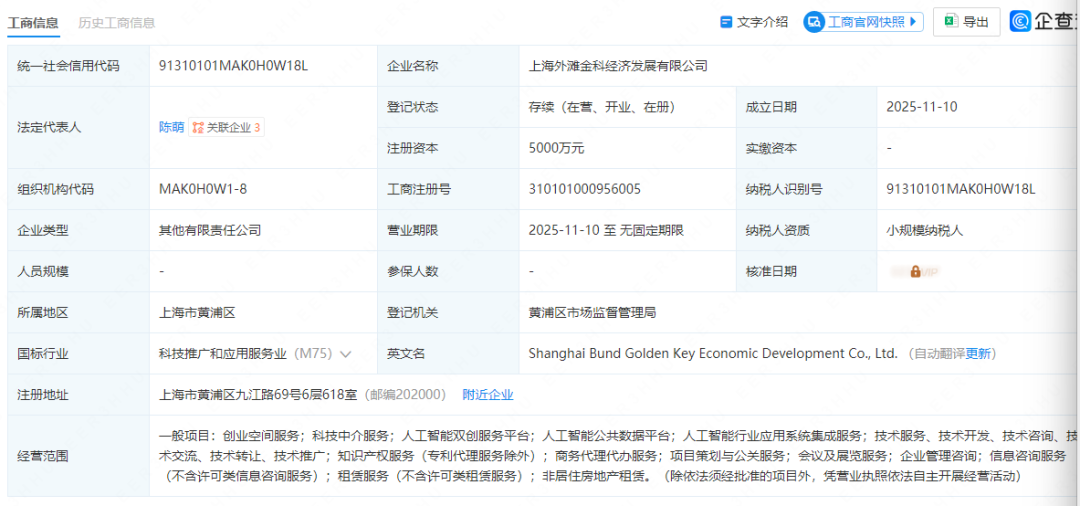
Core Viewpoint - Shanghai International Trust Co., Ltd. has established a new technology company, Shanghai Bund Golden Key Economic Development Co., Ltd., focusing on various artificial intelligence (AI) businesses [1][2]. Company Overview - Shanghai Bund Golden Key was registered on November 10, with a registered capital of 50 million yuan. The legal representative is Chen Meng [2][3]. - The shareholders include Shanghai Huangpu Science and Technology Innovation Group Co., Ltd. and Shanghai Trust [2]. - The company's business scope includes technology intermediary services, AI innovation and entrepreneurship service platforms, AI public data platforms, and AI industry application system integration services, among others [2][3]. Strategic Initiatives - The establishment of Bund Golden Key is part of Shanghai Trust's strategy to enhance its financial technology ecosystem and align with Shanghai's goal of becoming a global financial technology center [4]. - Shanghai Trust has also participated in setting up several other investment funds and companies in the tech sector, indicating a strong commitment to investing in emerging technologies [4][5]. - The total scale of Shanghai Trust's equity investment in technology innovation has approached 40 billion yuan, with its specialized platform managing nearly 3 billion yuan in funds [5]. Industry Context - The focus on AI and technology services aligns with Shanghai Trust's core business of wealth management and cross-border finance, potentially enhancing its family trust and asset securitization services [5]. - The collaboration with the broader strategy of the parent company, Pudong Development Bank, emphasizes a coordinated approach to digital transformation and financial technology [5].


再添新势力!上海信托出资成立外滩金科,瞄准AI赛道
Bei Jing Shang Bao· 2025-11-11 13:29
Core Insights - The establishment of Shanghai Bund Jinke Economic Development Co., Ltd. (referred to as "Bund Jinke") on November 10, 2023, marks a new player in the financial technology sector with a registered capital of 50 million RMB [1][3] - Bund Jinke is jointly owned by Shanghai Huangpu Science and Technology Innovation Group Co., Ltd. and Shanghai International Trust Co., Ltd. Its business scope includes services related to entrepreneurship, technology mediation, artificial intelligence, and intellectual property [1][3] Company Overview - Shanghai International Trust, founded in 1981, is one of the earliest trust companies in China with a registered capital of 5 billion RMB, focusing on asset management and wealth management for high-net-worth clients [3] - The company has a total scale of nearly 40 billion RMB in science and technology equity investments, including significant investments in major Shanghai municipal science and technology funds [3] Strategic Intent - The establishment of Bund Jinke aligns with Shanghai's initiative to enhance its global financial technology center and create a financial technology industry integration demonstration area in Huangpu District [3][4] - The move is seen as a strategic investment to capture opportunities in the financial technology sector, leveraging policy benefits from local government initiatives [4] Business Model and Synergy - Bund Jinke's focus on artificial intelligence and data platforms complements Shanghai International Trust's core business of wealth management and cross-border finance, facilitating a "technology + finance" ecosystem [4][5] - The subsidiary's specialized operations in AI technology are expected to enhance the parent company's capabilities in family trusts and cross-border asset securitization [4][5] Challenges and Considerations - Direct involvement in AI by trust companies faces challenges such as strict regulatory compliance, data security management, and high costs associated with technology development [5] - The establishment of Bund Jinke is anticipated to strengthen Shanghai International Trust's brand influence in the financial technology sector in the short term, while exploring innovative financial models in the long term [5]

【锋行链盟】跨境融资方式及核心要点
Sou Hu Cai Jing· 2025-10-08 16:13
Group 1: Core Views - Cross-border financing is a common method for enterprises or institutions to obtain funds in international financial markets, influenced by domestic and foreign policies and market environments [2] Group 2: Main Financing Methods - Cross-border financing can be categorized based on funding sources, instrument types, and applicable scenarios, including traditional bank-led financing, bond market financing, and equity financing [3][4][5][6] - Traditional financing methods include trade financing, offshore syndicated loans, and domestic guarantees for external loans [4] - Bond market financing includes offshore RMB bonds, Chinese dollar bonds, and Euro/Asian dollar bonds [4] - Equity financing methods involve overseas IPOs and cross-border private equity financing [5][6] Group 3: Key Points of Cross-Border Financing - Cross-border financing is subject to multiple constraints from domestic and foreign policies, markets, and laws, necessitating attention to compliance and regulatory requirements [7] - The introduction of foreign institutional investors for equity investments is common among growth-oriented enterprises [7] - Cross-border asset securitization and REITs are innovative financing tools that leverage quality domestic assets for overseas funding [7] - Strict adherence to foreign exchange management regulations and compliance with international sanctions is essential [8] - Companies must manage currency and interest rate risks effectively, utilizing hedging tools to mitigate potential losses [8] - Comprehensive cost control, including both explicit and implicit costs, is crucial for successful financing [8] - Legal and contractual risks must be understood, particularly regarding governing laws and cross-default clauses [8] - Ensuring the compliance of fund usage and facilitating fund repatriation through legitimate channels is vital [8] - Liquidity management is necessary to match repayment sources with cash flows from assets [8] Group 4: Conclusion - The choice of cross-border financing methods should align with enterprise needs, credit quality, and market conditions, focusing on balancing compliance, costs, and risks [9]