车载信息娱乐系统(IVI)

Search documents
趋势研判!2025年中国车载信息娱乐系统(IVI)行业发展历程、市场规模、重点企业及未来趋势分析:行业发展推动驾乘体验升级,市场规模增长至449亿元[图]
Chan Ye Xin Xi Wang· 2025-09-11 01:27
Core Insights - The development of In-Vehicle Infotainment (IVI) systems is driven by the increasing demand for comfort and entertainment during driving, especially during long trips [1] - The IVI industry in China is experiencing significant growth, with the market size projected to increase from 28.9 billion yuan in 2018 to 44.9 billion yuan in 2024, representing a compound annual growth rate (CAGR) of 7.62% [1][10] - The integration of advanced technologies such as artificial intelligence, 5G communication, and big data will continue to enhance IVI systems, improving user interaction and service ecosystems [1] Industry Overview - IVI systems are comprehensive information processing systems in vehicles, enabling functionalities like navigation, real-time traffic updates, multimedia playback, and vehicle diagnostics [3][4] - The IVI industry has evolved through three stages: initial radio and music playback, the integration of mobile device functionalities, and the current phase characterized by smart and connected features [5] Market Dynamics - The global IVI market is expected to grow from $19.6 billion in 2018 to $25.1 billion in 2024, with a CAGR of 4.21% [9] - In 2023, China's automotive production and sales both surpassed 30 million units, marking a year-on-year growth of 11.6% and 12% respectively [7] Competitive Landscape - The IVI industry in China features a mix of domestic and international players, with foreign companies like Bosch and NXP holding significant positions in the high-end market, while domestic firms like Desay SV and Suoling are gaining traction in the mid-to-high-end segments [10] - Desay SV has reported a revenue of 9.46 billion yuan for its smart cockpit business in the first half of 2025, reflecting a year-on-year growth of 18.76% [11] Development Trends - The IVI industry is moving towards multi-device connectivity and spatial integration, creating a seamless interaction between vehicles and users' smart devices [12] - There is a trend towards larger and multiple screens in vehicles, enhancing visual experiences and allowing for personalized content sharing among passengers [13] - Voice interaction is becoming the core method of interaction within IVI systems, improving safety and convenience through advanced natural language processing capabilities [15]



英伟达财务模型分析--钱都挣在了哪里?
傅里叶的猫· 2025-06-01 15:22
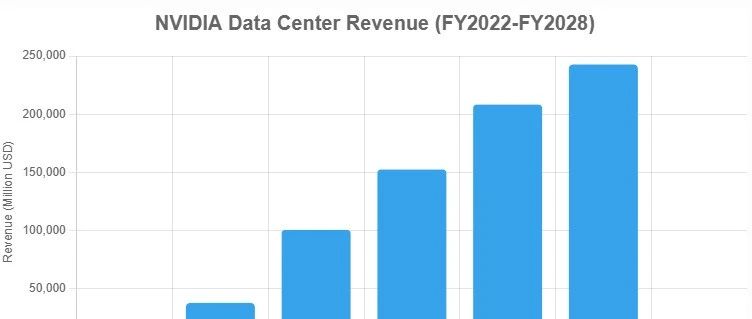
Core Viewpoint - Nvidia's Q1 financial report indicates strong revenue growth driven by data center and gaming segments, despite challenges from inventory write-downs related to the H20 chip [1][22][25] Data Center Business - In Q1, Nvidia's data center revenue reached $39.11 billion, a year-over-year increase of 73.3%, primarily driven by the Blackwell product line [2][4] - The data center segment's revenue is projected to grow significantly, with estimates of $100.69 billion for FY2024 and $152.5 billion for FY2025, reflecting a compound annual growth rate of approximately 208% from FY2022 [4][9] - The product mix is shifting, with the H100/H200 series expected to dominate revenue contributions in the coming years, while the A100's share declines [6][9] Gaming Business - The gaming segment experienced fluctuations, with revenue of $3.375 billion in FY2022, surging to $11.186 billion in FY2023, and slightly declining to $9.781 billion in FY2024 [12][15] - GeForce products remain the core of the gaming business, contributing 80%-85% of revenue, with expectations of $9.536 billion in FY2025 [13][15] - Future forecasts indicate potential revenue of $14.043 billion in FY2026, but with risks from competition and market saturation [15][16] Automotive Business - Nvidia's automotive revenue has grown from $566 million in FY2022 to an expected $2.42 billion in FY2025, driven by demand for autonomous driving and AI applications [18][20] - The DRIVE platform is central to this growth, with significant orders from over 25 automakers, and projections of $3.845 billion in FY2026 [19][20] China Market Impact - Recent U.S. export restrictions on the H20 chip have significantly impacted Nvidia's business in China, leading to a $4.5 billion inventory write-down [22][24] - Despite these challenges, global demand for AI chips remains strong, with Nvidia's infrastructure still in high demand [22][23] Financial Guidance - For Q2 FY2026, Nvidia expects revenue to reach $45 billion, with a GAAP gross margin of 71.8%, despite the anticipated impact of the H20 chip ban [25]