远程手术

Search documents
每经热评丨医疗旅游风口已至 当乘势而上打造新兴产业
Mei Ri Jing Ji Xin Wen· 2026-02-05 15:40
Core Viewpoint - China's healthcare system is gaining international attention due to its efficient treatment processes and cost-effective services, marking a significant opportunity for the medical tourism industry in China [1] Group 1: Competitive Advantages of Chinese Healthcare - The diagnostic and treatment model in China is more efficient compared to countries with universal healthcare, as the referral process is streamlined, significantly reducing waiting times for specialist consultations [1] - Medical costs in China remain affordable, with public hospitals maintaining reasonable pricing. For instance, the cost of CAR-T cell therapy has dropped to over 200,000 RMB, making it more accessible compared to similar treatments in developed countries [1] - Technological advancements in China have positioned its healthcare professionals among the best globally, particularly in complex fields like oncology and cardiology, with leading hospitals offering cutting-edge treatments and remote surgical capabilities [1] Group 2: Challenges in Medical Tourism Development - Despite the strengths of Chinese healthcare, the medical tourism industry in China is underdeveloped, with reports indicating that China is not listed among the top medical tourism destinations, unlike South Korea and Thailand [2] - Many foreign patients seeking medical care in China do so primarily for emergency needs during travel, rather than for planned medical tourism, highlighting a gap in perception and service availability [2] - The industry faces challenges such as entrenched biases against Chinese medical capabilities and a lack of supporting services, which need to be addressed for growth [2] Group 3: Strategic Recommendations for Growth - Medical institutions should proactively promote their capabilities and address global healthcare pain points to attract potential medical tourists, rather than waiting for patients to come [2] - There is a need for collaboration between government and market players to create a long-term plan for medical tourism development while ensuring domestic patient rights are protected [3] - Companies in the tourism and healthcare sectors should work together to create integrated services that combine medical care, accommodation, and recovery, enhancing the overall medical tourism experience [3] Group 4: Future Opportunities - The increasing openness of China presents significant opportunities for the medical tourism sector, although challenges will arise that need to be managed [3] - The influx of foreign patients is not currently overwhelming healthcare resources, indicating that the market has room for growth without compromising domestic healthcare [3] - A collaborative effort among government, enterprises, and medical institutions is essential for China to strengthen its position in the global medical tourism market and to facilitate the export of healthcare services [3]
收费“堵点”打通:手术机器人、远程手术等临床应用将全面提速
Zhong Guo Jing Ying Bao· 2026-01-25 16:01
Core Viewpoint - The National Medical Insurance Administration has released a guideline to standardize pricing for surgical robots and other advanced medical technologies, aiming to facilitate the clinical application of innovative medical technologies and promote a shift towards precision medicine [3][4]. Group 1: Pricing Guidelines - The guideline establishes 37 pricing items, including 5 additional charges and 1 expansion item, covering key technologies such as 3D printing, imaging enhancement, energy devices, intraoperative guidance, surgical robots, and remote surgery [3]. - The pricing framework focuses on the clinical value of new technologies rather than the equipment or surgical site, allowing for a more equitable and transparent pricing model [6][22]. - The guideline introduces a tiered pricing system based on the level of participation and precision of surgical robots, encouraging their use in complex surgeries while preventing misuse in low-value scenarios [6][25]. Group 2: Impact on Remote Surgery - The guideline includes a separate pricing item for remote surgery, facilitating its transition from exploration to practical application [7]. - Remote surgery is particularly significant in emergency situations, such as cardiovascular diseases, where timely intervention is critical [8]. - The establishment of a payment framework for remote surgery is expected to enhance access to quality medical resources across regions, benefiting patients significantly [10][21]. Group 3: Encouragement of Innovation - The release of the guideline signals a clear intent from the government to incentivize continuous innovation in the high-end medical equipment sector [11][12]. - Companies are expected to gain confidence in investing in research and development due to the stable policy environment created by the guideline [12]. - The guideline aims to create a commercial logic loop that supports the sustainable development of innovative medical technologies [11][14]. Group 4: Market Dynamics - The market for surgical robots in China is expected to grow significantly, with domestic market share projected to increase from 32.61% in 2023 to 48.89% in 2024 [17]. - Despite the growth, the overall penetration of robotic surgeries remains low compared to countries like the United States, indicating substantial room for expansion [17]. - The establishment of a unified payment framework is anticipated to activate the existing market for surgical robots, leading to potential growth for companies already holding market share [17]. Group 5: Balancing Costs and Innovation - The guideline aims to balance the need for high-level innovation with the financial burden on patients by establishing pricing boundaries [22][25]. - It specifies that devices with multiple functionalities will be charged based on the highest service price, ensuring fair compensation for advanced capabilities [23][24]. - The National Medical Insurance Administration will guide local agencies in setting reasonable pricing standards, reflecting the value of technical services [26][27].


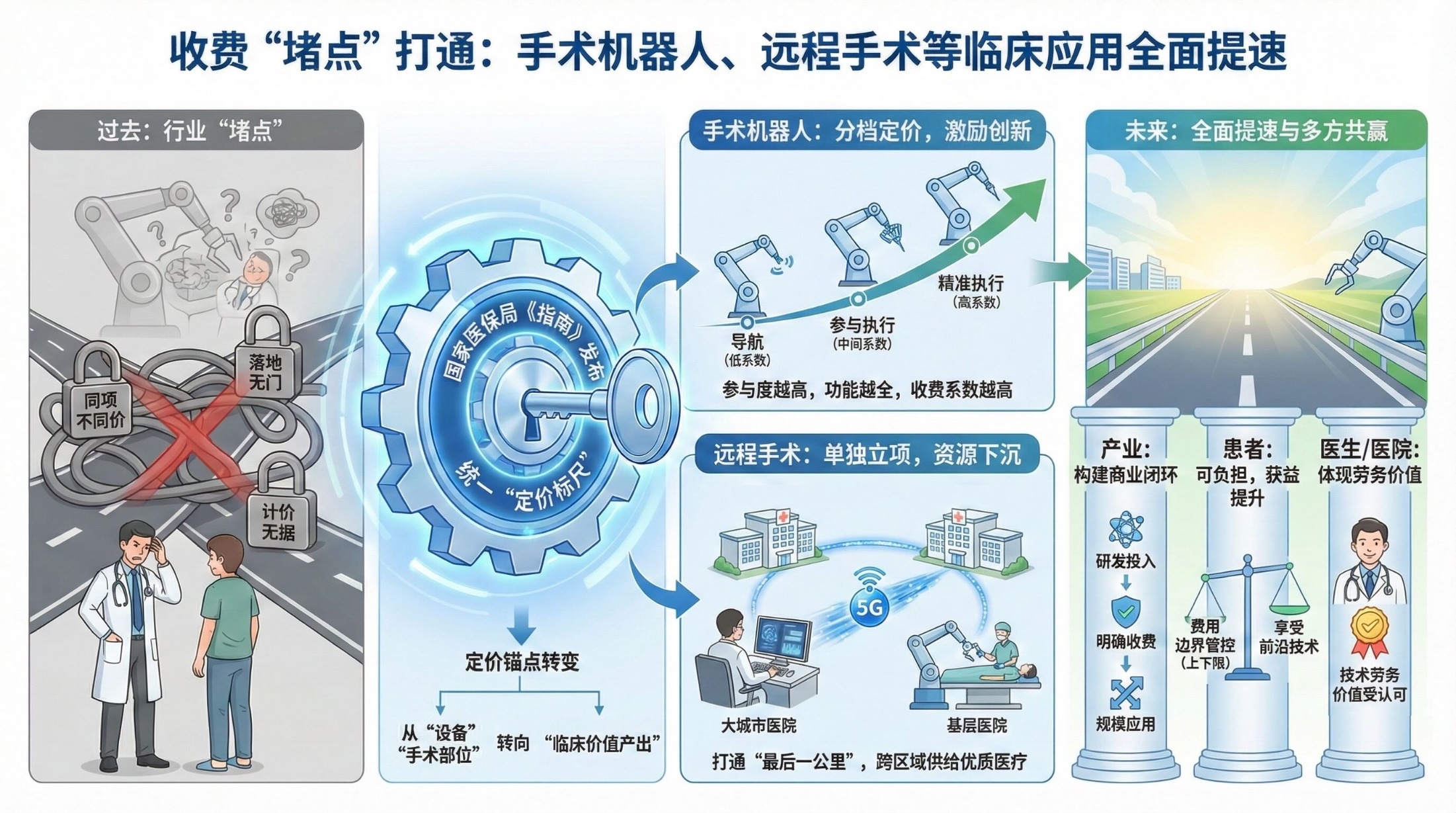
手术机器人等医疗服务有了“明码标价”
Zhong Guo Qing Nian Bao· 2026-01-23 00:07
Core Viewpoint - The National Healthcare Security Administration (NHSA) has released a guideline to standardize pricing for surgical and treatment auxiliary services, establishing 37 pricing items and promoting the clinical application of advanced technologies like 3D printing and surgical robots [1][2]. Group 1: Pricing Guidelines and Impact - The guideline includes a pricing project for 3D bioprinting to facilitate the transition from concept testing to clinical application, which is expected to help companies in the sector [2][3]. - The guideline addresses the pricing for surgical robots, categorizing them based on their involvement in surgeries and clinical value, with a coefficient-based charging model linked to the main surgery [3][4]. - The NHSA will guide local authorities to establish reasonable pricing standards, ensuring a balance between cost-sharing for surgical robots and patient accessibility [5]. Group 2: Industry Development and Innovation - The release of the guideline is anticipated to boost the enthusiasm for research and development among domestic companies, shortening the promotion cycle for new technologies and driving down costs in the domestic supply chain [7]. - The guideline aims to resolve clinical translation issues for innovative technologies like surgical navigation and robots, benefiting both patients and the medical equipment industry [7]. - A new pricing project for remote surgical assistance has been established to facilitate the provision of high-quality medical resources across regions, reducing the burden on patients seeking care away from home [7]. Group 3: Technological Advancements - The first successful remote surgery over a distance of 8,000 kilometers was performed using a domestic surgical robot, showcasing the potential of remote surgical capabilities [9]. - The market share of domestic laparoscopic surgical robots is projected to grow from 32.61% in 2023 to 48.89% in 2024, indicating significant growth potential in the sector [9].
国家医保局出台新规 手术机器人等医疗服务有了“明码标价”
Zhong Guo Qing Nian Bao· 2026-01-21 03:29
Core Viewpoint - The National Healthcare Security Administration (NHSA) has released a guideline to standardize pricing for surgical and treatment auxiliary services, addressing the challenge of charging for advanced medical technologies like surgical robots and 3D bioprinting [1][2]. Group 1: Pricing Guidelines - The guideline establishes 37 pricing items, including 5 additional charges and 1 expansion item, covering key technologies such as 3D printing, surgical robots, and remote surgeries [1]. - A specific pricing project for bioprinting has been created to facilitate the transition from concept testing to clinical application, promoting the use of organ-like technologies [1]. - The guideline introduces a tiered pricing model for surgical robots based on their level of involvement and clinical value, allowing for higher fees for more advanced functionalities [2]. Group 2: Impact on Companies - Companies involved in 3D bioprinting have expressed that the guideline significantly aids their operations, as the lack of standardized pricing previously hindered clinical entry and long-term development [1]. - The guideline is expected to encourage innovation and shorten the promotion cycle for new technologies, benefiting domestic supply chains and reducing costs [2]. - The release of the guideline is anticipated to resolve clinical translation issues for innovative technologies, allowing patients to benefit from advancements while promoting high-quality development in the medical equipment industry [2]. Group 3: Remote Surgery - The guideline includes a pricing project for remote surgical assistance, enabling experts in resource-rich areas to provide services to patients in other regions, thus alleviating the burden of seeking medical care from afar [3]. - A notable achievement in remote surgery was highlighted, where a team successfully performed a prostate cancer surgery over a distance of 8,100 kilometers using a domestic surgical robot [3]. - The market share of domestic laparoscopic surgical robots is projected to grow significantly, from 32.61% in 2023 to 48.89% in 2024, indicating a strong potential for future expansion [3].
未知机构:东北医疗大健康价格立项落地手术机器人迎来收费模式突破事件国家医保-20260121
未知机构· 2026-01-21 02:10
Summary of Conference Call on Northeast Medical Health Industry Industry Overview - The conference call discusses the Northeast Medical Health industry, specifically focusing on the recent developments in surgical robotics and innovative medical technologies. Key Points and Arguments 1. **National Pricing Guidelines**: On January 20, the National Healthcare Security Administration (NHSA) released the "Guidelines for the Establishment of Pricing Projects for Surgical and Treatment Auxiliary Medical Services (Trial)" which establishes a unified pricing framework for surgical robots, energy equipment consumables, and remote surgery technologies across the country [1][3]. 2. **Provincial Implementation Timeline**: Historical data suggests that it typically takes between six months to a year for provinces to implement specific projects and pricing after the NHSA's announcement [2]. 3. **Benefits of Pricing Directory**: The establishment of a clear pricing directory is expected to facilitate the entry of innovative devices into hospitals and increase the sales volume of consumables [4]. 4. **Impact on Clinical Promotion**: Previously, the need for medical institutions to apply for self-pricing or provincial pricing led to reduced enthusiasm for clinical promotion. The new pricing directory aims to streamline the final pricing model across provinces, enhancing the accessibility of advanced medical technologies and promoting a shift from traditional to precision medicine [5]. 5. **Tiered Pricing System for Surgical Robots**: A tiered pricing system based on the clinical value and participation level of surgical robots has been introduced. Prices will be set in three tiers: navigation, participation in execution, and precise execution. The guidelines also include specific consumables in the pricing structure [5]. 6. **Independent Pricing for Remote Surgery**: Remote surgery has been given independent pricing status, which is expected to benefit leading hospitals and increase surgical volumes [6]. 7. **Clarification on Consumable Charges**: The guidelines clarify the charging logic for disposable and reusable consumables, stating that disposable consumables will be sold at zero markup, while reusable consumables will incur an auxiliary operation fee [7]. Key Beneficiaries 1. **MicroPort Robotics**: A leading domestic surgical robot company with over 160 cumulative orders for laparoscopic robots expected by December 2025. The company is positioned to capitalize on the commercialization of surgical robots and expand market share through innovative procedures [8]. 2. **JinFeng Medical**: Among the top two domestic surgical robot manufacturers, it is rapidly increasing the volume of multi-port and single-port laparoscopic robots, leading in domestic procurement bids [8]. 3. **Tianzhihang**: A leader in orthopedic surgical robots, the company has developed a comprehensive business model that includes equipment, consumables, and technical services [8]. 4. **Sanyou Medical**: Focused on developing three-arm spinal surgical robots and ultrasonic bone knives, benefiting from the new pricing regulations for energy equipment consumables [8]. 5. **Aikang Medical**: Set to launch a second-generation knee joint surgical robot in collaboration with Peking University Third Hospital, aiming to provide a complete digital orthopedic solution [8]. 6. **Chunli Medical**: Innovating with handheld robotic technology, the company plans to establish multiple surgical training centers overseas to accelerate international expansion [9].


医疗器械板块盘初活跃 天智航涨超10%
2 1 Shi Ji Jing Ji Bao Dao· 2026-01-21 01:40
Core Viewpoint - The medical device sector is experiencing significant activity, with notable stock increases following the release of new pricing guidelines by the National Healthcare Security Administration, which includes 37 pricing projects for surgical and treatment auxiliary services [1] Group 1: Market Activity - The medical device sector saw a surge in stock prices, with Tianzhihang rising over 10% [1] - Other companies such as Sanyou Medical, Xishan Technology, Kangzhong Medical, and Tianyi Medical also experienced stock increases [1] Group 2: Regulatory Changes - On January 20, the National Healthcare Security Administration issued guidelines for pricing projects related to surgical and treatment auxiliary services [1] - The guidelines include 37 pricing projects, along with 5 additional charge items and 1 expansion item [1] - The new pricing projects cover important auxiliary technologies and products, including 3D printing, intraoperative guidance, surgical robotic arms, and remote surgery [1]
中国国家医保局:前瞻性设立“远程手术辅助操作费”价格项目
Xin Lang Cai Jing· 2026-01-20 14:46
Core Viewpoint - The National Healthcare Security Administration of China is promoting the large-scale application of surgical robotic arms by establishing a new pricing project for "remote surgical assistance" to enhance the integration of advanced medical technologies into healthcare services [1][2]. Group 1: Pricing Guidelines and Projects - The National Healthcare Security Administration has accelerated the compilation and issuance of medical service pricing project guidelines, having released a total of 36 batches, with provinces averaging 30 batches implemented [1]. - The 37th batch of guidelines includes 37 pricing projects specifically for surgical and treatment assistance operations, along with 5 additional charge items and 1 expansion item, covering key technologies such as 3D printing, intraoperative guidance, and surgical robotic arms [1][2]. Group 2: Focus on Surgical Robots - The pricing guidelines focus on the participation level of surgical robots in operations and their clinical value in precision surgery, categorizing pricing into navigation, execution participation, and precision execution [2]. - A coefficient-based charging model is implemented, allowing surgical robots with higher participation, comprehensive functions, and precise execution to receive higher fee coefficients [2]. Group 3: Remote Surgery and Resource Allocation - The establishment of the "remote surgical assistance fee" pricing project aims to facilitate remote surgeries conducted by experts in resource-rich areas for patients in other regions, thereby reducing the burden of travel for patients seeking quality medical care [2]. - The National Healthcare Security Administration is closely monitoring innovations in the medical industry and has unified over a hundred prospective pricing projects related to new technologies and products, paving the way for gradual industrial upgrades and leading healthcare payment innovations [2].
最新医保政策解析:手术和治疗辅助操作,统一收费框架!
思宇MedTech· 2025-12-08 12:20
Core Viewpoint - The article discusses the issuance of the "Guidelines for the Pricing of Surgical and Treatment Auxiliary Operations" by the National Medical Insurance Administration, which aims to standardize and categorize auxiliary surgical operations within the medical insurance system, enhancing transparency and adaptability to new technologies [2][3]. Policy Background - The introduction of a unified pricing guideline addresses structural challenges in China's medical service pricing system, such as regional disparities and the lack of standardized pricing for auxiliary operations [3]. - The guidelines represent the first systematic classification of auxiliary operations in surgery, covering advanced technologies like 3D imaging, navigation systems, and remote surgery [3][4]. Key Components of the Guidelines - The pricing project consists of seven core elements: project name, service output, price composition, additional charges, expansion items, pricing units, and pricing explanations [4]. - The guidelines include 36 auxiliary operations categorized into six systems based on service output attributes, facilitating understanding across disciplines [5][6]. Categories of Auxiliary Operations - **3D Technology Chain**: This category includes operations related to 3D reconstruction, modeling, and printing, which enhance pre-surgical planning and individualization of treatment [6][8]. - **Tracing and Imaging Enhancement**: This category focuses on technologies that improve intraoperative information clarity, such as tracers and advanced imaging techniques [7][9]. - **Energy Instrument Assistance**: This category includes various energy devices used in surgery, emphasizing the separation of technical costs from device usage [10][11]. - **Intraoperative Imaging Guidance**: This category standardizes the pricing of imaging guidance during surgery, enhancing its role in risk management [12][13]. - **Surgical Path Navigation**: This category includes navigation systems that provide real-time tracking and positioning during surgeries [14][15]. - **Surgical Robotics and Remote Surgery**: This category recognizes the role of robotic assistance and remote surgery as significant advancements in surgical capabilities [16][18]. Understanding the Pricing System - The guidelines emphasize that "service output" is the sole basis for establishing pricing projects, allowing for flexibility in technical paths as long as the output remains consistent [20]. - The guidelines allow for existing projects to accommodate technological improvements without the need for new pricing applications, reducing barriers to innovation [21][22]. Implications for Hospitals and Enterprises - The new pricing framework is expected to lead to a comprehensive restructuring of cost management, quality control, and payment mechanisms within hospitals [26][30]. - Hospitals will be better equipped to assess the real costs and values of auxiliary operations, promoting transparency and accountability in surgical practices [30][31]. - Enterprises will need to shift their focus from equipment-centric models to service output-oriented strategies, enhancing their data capabilities to comply with new regulatory requirements [36][38]. Observations on Systemic Evolution - The guidelines represent a significant shift from fragmented technical approaches to a cohesive capability system, facilitating clearer communication of technological value [44][45]. - The formal recognition of independent pricing for capabilities, such as robotic assistance, aligns with international trends towards technology-neutral and capability-oriented regulatory frameworks [46]. - The requirement for data retention and reporting will transform surgical practices from experience-based to data-driven methodologies, supporting future research and clinical improvements [47][48].