
金属有机框架

Search documents
这项创新,将打造完美芯片
半导体行业观察· 2026-02-28 01:14
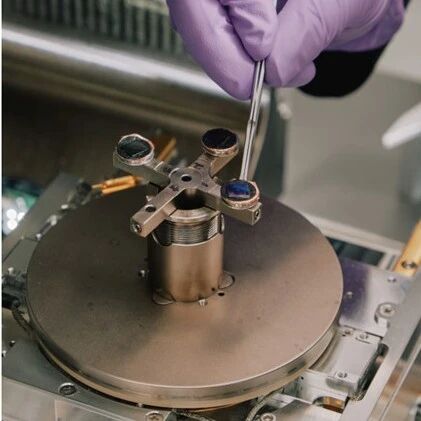
Core Viewpoint - The semiconductor industry faces a multi-trillion dollar challenge to develop the most powerful and dense silicon microchips within the limits of physical laws, marking a significant engineering victory and the final step of Moore's Law, with commercial applications expected no earlier than 2040 [2][4]. Group 1: Moore's Law and Its Implications - Moore's Law states that the number of transistors on a microchip doubles approximately every two years, but this doubling is limited by the physical constraints of silicon wafers [4]. - The current advanced silicon etching technology achieves a precision of 10 nanometers, equivalent to about 60 silicon atoms, with a target of reducing this to around 5 nanometers [6]. Group 2: Photolithography Technology - The technology required to achieve this goal is photolithography, which uses a narrow wavelength light source to etch patterns onto silicon wafers with atomic-level precision [4][6]. - The introduction of metal-organic frameworks (MOFs) as a new type of photoresist material could potentially revolutionize chip manufacturing due to their self-assembling properties and compatibility with various metals and organic molecules [11][12]. Group 3: Challenges and Future Prospects - Integrating MOFs into existing semiconductor manufacturing processes poses significant engineering challenges, with experts suggesting that commercial viability may not be realized until 2040 [14]. - The demand for more powerful and energy-efficient chips is driven by the need for advanced devices like smartphones and AI data centers, which could lead to a shift away from silicon materials in the future [16].

唠科|坚守、勇气与好奇——从2025年诺贝尔自然科学奖看科研之道
Xin Hua She· 2025-10-11 09:58
Core Insights - The 2025 Nobel Prize in Natural Sciences highlights the long-term dedication and perseverance of scientists, with many achieving recognition decades after their initial research [2][5][10] Group 1: Award Recipients - The oldest laureate this year is Richard Robson, born in 1937, while the youngest is Omar M. Yagi, born in 1965, indicating a wide age range among the winners [2] - Robson's research on metal-organic frameworks began in 1974, leading to significant applications such as water collection from desert air and carbon dioxide capture [4][5] - Yoshinori Sakaguchi's work on regulatory T cells took over a decade to gain recognition, with initial ideas emerging in the early 1980s [4][9] Group 2: Research Timeline - The time gap between the publication of significant scientific findings and their recognition with a Nobel Prize has been increasing, with an average delay of 30 years for the Chemistry Prize from 2011 to 2019 [5] - The average delay for the Physiology or Medicine Prize is also substantial, at 26 years, reflecting the lengthy process of validation for groundbreaking research [5] Group 3: Challenges and Perseverance - Many award-winning scientists faced skepticism and challenges during their research, often being labeled as "non-mainstream" [6][9] - Robson and Sakaguchi both encountered doubts from the scientific community regarding their innovative ideas, yet they persisted in their research [9][10] Group 4: Motivation and Curiosity - Curiosity and a desire to explore fundamental principles are key motivators for scientists, driving them to pursue research even in less popular fields [10] - The history of the Nobel Prize shows that many laureates have made significant contributions to humanity through sustained curiosity and dedication [10]
三位科学家因“开发新型分子结构”获2025年诺贝尔化学奖
人民网-国际频道 原创稿· 2025-10-09 05:40
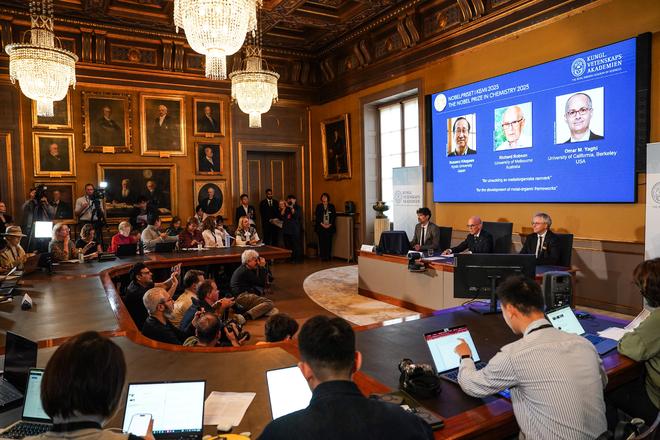
Core Points - The 2025 Nobel Prize in Chemistry has been awarded to Shinsuke Kitagawa from Kyoto University, Richard Robson from the University of Melbourne, and Omar M. Yaghi from the University of California, Berkeley for their contributions to the development of metal-organic frameworks [1] - The Nobel committee highlighted the innovative molecular structure created by the winners, which features large cavities allowing molecules to flow in and out, enabling applications such as water collection from desert air, pollutant extraction from water, CO2 capture, and hydrogen storage [1] - The chairman of the Nobel Chemistry Prize Committee, Heiner Linke, emphasized the significant potential of metal-organic frameworks in customizing materials with previously unforeseen functionalities [1] Summary by Related Categories Award Recipients - Shinsuke Kitagawa, born in 1951 in Kyoto, Japan, is a professor at Kyoto University and obtained his PhD in 1979 [2] - Richard Robson, born in 1937 in Gruesome, UK, is a professor at the University of Melbourne and earned his PhD in 1962 [2] - Omar M. Yaghi, born in 1965 in Amman, Jordan, is a professor at the University of California, Berkeley, with a PhD obtained in 1990 [2] Applications and Impact - The breakthrough discovery has led chemists to construct thousands of different metal-organic framework materials, which may address significant global challenges [1] - Potential applications include separating PFAS from water, decomposing trace pharmaceuticals in the environment, capturing CO2, and extracting moisture from desert air [1]
史上最强打工人:老板布置的杂活,被他干成了诺贝尔奖
Hu Xiu· 2025-10-08 23:41
Core Points - The 2025 Nobel Prize in Chemistry was awarded to Susumu Kitagawa, Richard Robson, and Omar M. Yaghi for their work on metal-organic frameworks (MOFs), which are structures containing large internal cavities that allow molecules to move freely in and out [1] Group 1: Research and Contributions - The research focuses on metal-organic frameworks (MOFs), which are significant for their unique structural properties and potential applications in various fields [1] - Kitagawa's early interest in chemistry was influenced by philosophical ideas from Zhuangzi, leading him to explore the "useless" aspects of organic materials, particularly the tiny pores in these materials [11] - Robson contributed to the development of MOFs while working on a project assigned by his superior, which ultimately led to the discovery of a new type of material with significant internal voids [30][31] - Yaghi, who grew up in a challenging environment, developed MOFs that can capture water vapor from the air, addressing water scarcity issues in arid regions [38][46] Group 2: Personal Backgrounds of the Laureates - Kitagawa is known for his diverse interests, including detective novels and kabuki performances, and emphasizes the importance of public speaking skills among his students [5][6] - Robson has a strong academic background, having studied at prestigious institutions like Oxford and Caltech, and has spent most of his career at the University of Melbourne [13][15] - Yaghi's journey from a refugee background in Jordan to becoming a prominent scientist highlights the transformative power of education and science, as he now supports young scholars in developing countries [35][53]

创造金属有机框架 可捕获二氧化碳
Nan Fang Du Shi Bao· 2025-10-08 23:13
Core Viewpoint - The 2025 Nobel Prize in Chemistry has been awarded to three scientists for their contributions to the development of Metal-Organic Frameworks (MOFs), which have significant potential in various applications, including environmental and medical fields [2][4]. Group 1: Award Details - The Nobel Prize was awarded to Yoshinori Kitagawa, Richard Robson, and Omar M. Yaghi, recognizing their groundbreaking work in creating MOFs [2][4]. - The prize amount is 11 million Swedish Krona, approximately 1.17 million USD, which will be shared among the three laureates [4]. Group 2: Scientific Contributions - The awarded scientists developed MOFs characterized by large cavity structures that allow gases and other chemicals to flow, enabling applications such as water collection from desert air, CO2 capture, and toxic gas storage [2][3]. - MOFs are based on reticular chemistry, creating supermolecular structures with unprecedented chemical and structural strength, leading to innovative materials with high surface area and porosity [5][6]. Group 3: Applications and Impact - MOFs have significant applications in climate change mitigation, particularly in carbon capture technology, where they can reduce the separation cost of CO2 from other gases, which currently accounts for 70% of the total carbon capture cost [3]. - In the biomedical field, MOFs show promise in drug delivery and imaging, acting as "nano-trucks" to transport therapeutic agents directly to targeted areas, such as tumors [6].
科普|为化学创造“新空间”的金属有机框架——2025年诺贝尔化学奖成果解读
Xin Hua She· 2025-10-08 15:58
Group 1 - The 2025 Nobel Prize in Chemistry was awarded to Shin Kitagawa, Richard Robson, and Omar M. Yaghi for their development of Metal-Organic Frameworks (MOFs), which have significant implications for chemistry, energy, environment, and materials science [1] - MOFs are described as intricate "molecular buildings" composed of metal ions and organic molecules, forming a three-dimensional crystalline structure with spacious cavities that allow gas or liquid molecules to enter and exit freely [2][3] - The flexibility and stability of MOFs enable them to be tailored for various applications, including water extraction from desert air, carbon capture, and toxic gas storage, showcasing their potential in clean energy and environmental solutions [2][3] Group 2 - The research on MOFs has rapidly advanced, with thousands of different materials being constructed, many of which are expected to address significant global challenges [3][4] - MOFs can effectively adsorb carbon dioxide, separate harmful substances from water, and decompose antibiotic residues, contributing to environmental protection [4] - In the energy sector, MOFs are utilized for hydrogen and methane storage, enhancing safety and efficiency in new energy transportation, as well as for catalyzing reactions and electrochemical energy conversion [4]