
铁蛋

Search documents
雷军需要第三次All In
3 6 Ke· 2026-01-12 01:54
Core Viewpoint - Lei Jun emphasizes the importance of engineers and technology at Xiaomi, indicating a shift in narrative focus towards technological innovation and foresight in the face of increasing competition and market challenges [1][4][10]. Group 1: Recognition of Engineers - Lei Jun awarded significant technical prizes to engineers, marking it as a key annual event for Xiaomi [1]. - In a recent live stream, Lei Jun reiterated his identity as an engineer rather than a marketing master, expressing disdain for marketing tactics [2][3]. Group 2: Shift in Narrative - The narrative surrounding Xiaomi is changing, with a growing focus on safety incidents, false marketing, and public perception rather than just products [4][5]. - Xiaomi's ability to set the agenda is weakening, attributed to rapid technological changes and the increasing importance of foresight in tech companies [5]. Group 3: Importance of Foresight - Foresight is becoming a core competitive advantage for leading entrepreneurs, with successful figures like Steve Jobs and Elon Musk exemplifying this trait [6]. - Lei Jun is positioned between Tim Cook and Elon Musk, needing to enhance his foresight to maintain relevance and success [7]. Group 4: AI and Future Directions - Xiaomi is at a critical juncture, needing to pivot towards becoming an AI-focused company, marking a third major investment phase after mobile and automotive sectors [10]. - The company has invested over 100 billion in technology R&D over the past five years, with plans to double this to 200 billion in the next five years [24]. Group 5: Competitive Landscape - Xiaomi's AI model development is lagging behind competitors like ByteDance and Alibaba, which have made significant advancements in AI models since 2022 [12]. - The company has faced challenges in the AI hardware market, with initial enthusiasm for products like AI glasses waning quickly [14]. Group 6: Opportunities in AI Integration - The integration of AI with mobile and automotive technologies presents a unique opportunity for Xiaomi, as it can leverage its manufacturing capabilities and existing technology [19][20]. - There is a lack of defined standards for AI integration in mobile and automotive sectors, providing Xiaomi with a chance to establish itself as a leader [23]. Group 7: Financial Considerations - Despite ambitious plans, Xiaomi's budget for AI development may be insufficient compared to competitors who are investing significantly more [25]. - The company may need to consider restructuring its AI division for independent financing to support its technological ambitions [25][26]. Group 8: Future Challenges - To maintain its competitive edge, Xiaomi must enhance its technological narrative and public perception, similar to how Musk has positioned himself in the tech landscape [29]. - The transition from "Lei Busi" to "Lei Musk" requires substantial investment and a shift in strategy to align with emerging technological trends [29].


公开发声、高调挖人、投资150亿,雷军想续上机器人梦
Tai Mei Ti A P P· 2025-12-02 04:16
Group 1 - The core viewpoint of the article is that Xiaomi is making significant strides in the humanoid robot sector, with plans to deploy humanoid robots in its factories over the next five years and a growing focus on the household market for humanoid robots [1][17] - Xiaomi's robot team is actively recruiting talent, including notable figures such as Lu Zeyu, who previously led research on Tesla's Optimus dexterous hand, and Luo Fuli, a key researcher from DeepSeek [2][10] - The company is aiming to bridge the gap in the humanoid robot market by integrating advanced AI capabilities with dexterous robotic hands, showcasing a comprehensive strategy that combines both hardware and software expertise [3][10] Group 2 - Xiaomi's initial foray into the robotics field began in 2019 with the launch of its quadruped robot "Iron Egg," which was priced significantly lower than competitors, leading to initial success [11][12] - However, the market dynamics shifted, and Xiaomi's humanoid robot "Iron Big" faced challenges in gaining traction due to a lack of product upgrades and commercialization efforts [12][13] - In 2024, Xiaomi plans to integrate its robotics business with its automotive division, aiming to leverage shared AI resources and top talent to reduce costs and enhance innovation [14] Group 3 - Since 2015, Xiaomi has invested approximately 15 billion yuan in the robotics sector through various funds, supporting nearly 50 companies across the entire robotics supply chain [18][20] - Investments include key components such as precision transmission parts and sensors, which are crucial for the development of dexterous robotic hands [18][20] - The company is building a comprehensive ecosystem in the robotics field, encompassing hardware, software, and specialized applications, with a focus on advancing dexterous hand technology as part of this broader strategy [20][21]

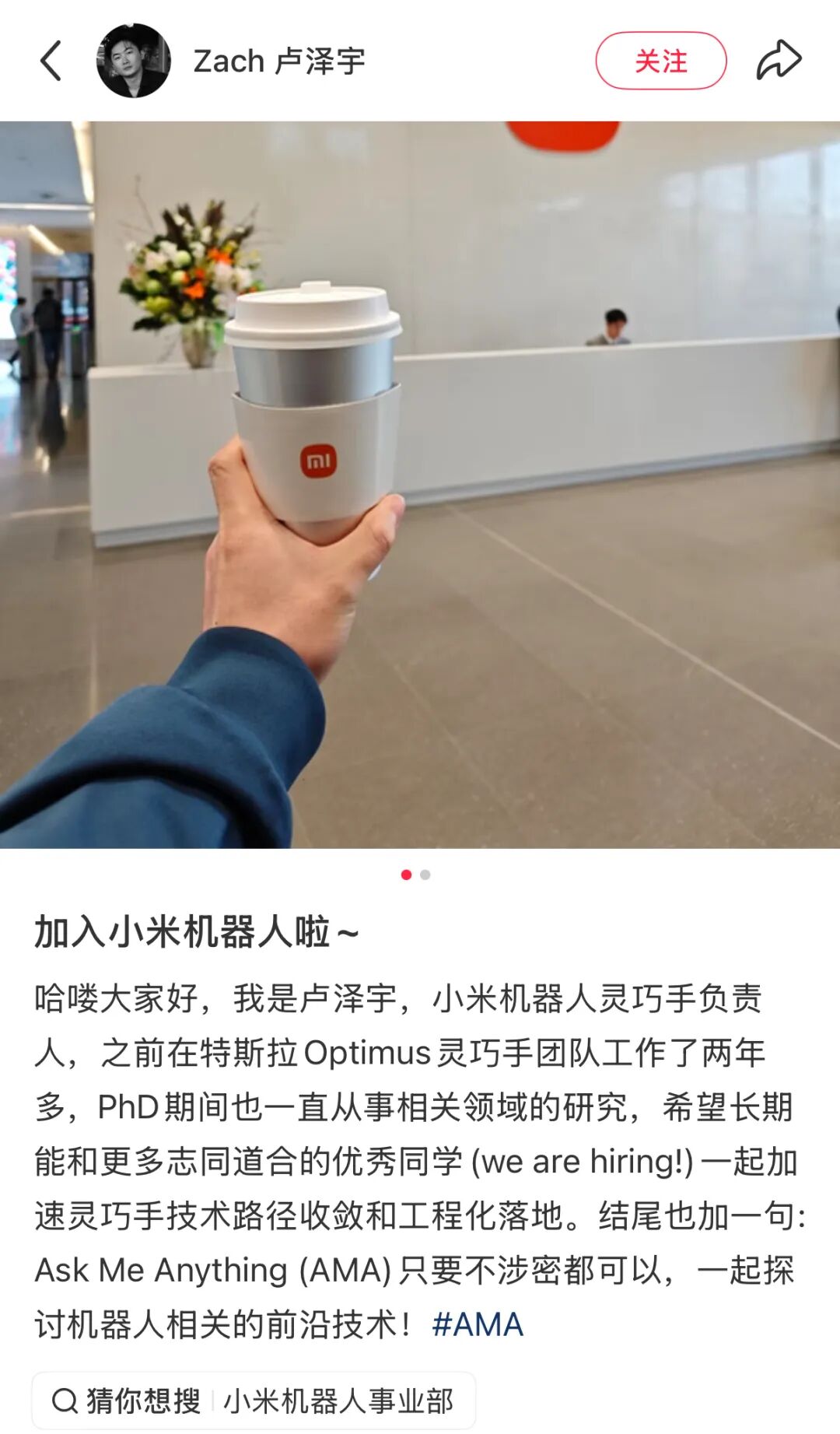
小米狂吸机器人技术大牛,前特斯拉Optimus工程师也来了
3 6 Ke· 2025-11-28 10:14
Core Insights - Xiaomi has successfully recruited top talent from various industries, including Lu Zeyu, a former member of Tesla's Optimus dexterous hand team, to enhance its robotics capabilities [1][17]. Group 1: Recruitment and Talent Acquisition - Lu Zeyu has joined Xiaomi's robotics team as the head of dexterous hand technology, aiming to accelerate the engineering application of advanced control systems [4][17]. - Xiaomi's robotics department is actively expanding, currently offering 257 job openings, including 12 positions focused on dexterous robotics [19]. - The company has also welcomed other notable talents, such as Luo Fuli, a former core researcher at DeepSeek, who is now leading the MiMo team focused on spatial intelligence [19]. Group 2: Technological Development and Strategy - Lu Zeyu's experience at Tesla involved critical aspects of the Optimus robot's hand development, including tactile sensor development and hand structure design, which aligns perfectly with Xiaomi's goals [13][17]. - Xiaomi aims to improve the dexterity of its robots, which is seen as a key capability for the next generation of humanoid robots [17]. - The company has launched the MiMo-Embodied model, which integrates tasks from autonomous driving and embodied AI into a single framework, achieving top performance in 29 benchmark tests [21]. Group 3: Industry Position and Future Plans - Xiaomi's robotics efforts are part of a broader strategy to establish a foothold in the humanoid robotics market, with plans to invest 2 billion yuan over five years in a humanoid robot R&D and manufacturing base [25]. - The integration of Xiaomi's robotics division into its automotive framework is viewed as a pragmatic approach to leverage the synergies between robotics and autonomous driving [25]. - The establishment of the Beijing Humanoid Robot Innovation Center, in collaboration with other companies, marks a significant step towards building a comprehensive ecosystem for embodied intelligence in China [28].
定价继续下探 具身智能敲响人类的家门
Bei Jing Shang Bao· 2025-11-03 16:17
Core Insights - The article discusses the rapid development and commercialization of quadruped robots, particularly focusing on the launch of the Rover X1 by Yuejiang, which targets the consumer market with a price of 7499 yuan [1][2]. Market Overview - The quadruped robot market in China reached 470 million yuan in 2023, showing a year-on-year growth of 42.68%, with projections to expand to approximately 660 million yuan in 2024 and potentially exceed 850 million yuan by 2025 [2]. - The market has transitioned from early technology exploration to practical applications, indicating a growing consumer demand for functional robots [2]. Competitive Landscape - Yushun Technology leads the consumer-grade market with a projected market share of 32.4% in 2024, while Yunshenchu ranks second with an 18.9% share. International competitors like Boston Dynamics maintain significant technological advantages [3]. - The market is not yet monopolized, with several international companies holding shares of 12.2%, 6.6%, and 5.5% respectively [3]. Application Scenarios - The Rover X1 is designed for various household applications, including outdoor adventures, home security, programming education, and daily interactions, enhancing its integration into family life [4]. - Specific use cases include carrying equipment during outdoor activities, conducting night patrols for security, and facilitating programming education through an open system [4]. International Developments - International companies are also exploring the home robotics market, with products like the NEO from Norway and Figure 03 from the USA, although they are still in early stages of development [5]. - These products aim to assist with household chores but face challenges in achieving full autonomy [5]. Challenges and Future Outlook - Current household robots are primarily focused on emotional and companionship value rather than functional capabilities, with expectations for price reductions and improved technology in the coming years [7]. - The market faces a supply-demand mismatch, with high-end products priced out of reach for average consumers and low-end products lacking practical functionality [7]. - The ability to perform complex tasks autonomously remains a significant challenge, with current technology limited to predefined workflows [8]. Conclusion - The future of household robots will depend on advancements in technology and the ability to meet practical consumer needs, with a focus on vertical applications and cost reduction being critical for widespread adoption [8][9].
定价7499元 当具身智能敲响家门
Bei Jing Shang Bao· 2025-11-03 13:44
Core Insights - The article discusses the evolution of quadruped robots, particularly focusing on the recent launch of the Rover X1 by the company Yuejiang, which aims to penetrate the consumer market with a price point of 7499 yuan, comparable to flagship smartphones [1][2]. Market Overview - The quadruped robot market in China reached a scale of 470 million yuan in 2023, showing a year-on-year growth of 42.68%, with projections to expand to approximately 660 million yuan in 2024 and potentially surpass 850 million yuan by 2025 [2]. - The market has transitioned from early technology exploration to practical applications, indicating a growing consumer demand for functional robots [2]. Competitive Landscape - Yujing Technology holds a leading position in the consumer-grade robot market with a projected market share of 32.4% in 2024, while Yunshenchu ranks second with an 18.9% share. International competitors like Boston Dynamics maintain significant technological advantages but do not dominate the market [3]. Product Applications - The Rover X1 is designed for various household applications, including outdoor exploration, home security, programming education, and daily interactions, enhancing its integration into family life [4]. International Developments - International companies are also exploring the home robotics market, with products like the NEO from Norway's 1X and Figure 03 from the US, although they are still in early stages of development and have higher price points [5]. Future Outlook - The current focus for home robots is on emotional and companionship value rather than complex task execution, with expectations that prices will decrease as technology advances, making robots more accessible to average households [8]. - The industry faces a supply-demand mismatch, with high-end products priced out of reach for most consumers and low-end products lacking practical functionality [8]. - The ability of robots to perform specific tasks autonomously is improving, but challenges remain in their adaptability to varied household tasks [9].