银丹心脑通软胶囊

Search documents
贵州百灵:锚定长期价值,全产业链布局穿越行业周期
Guo Ji Jin Rong Bao· 2026-01-30 14:26
Core Viewpoint - Guizhou Bailing (ST Bailing) expects a negative net profit for the fiscal year 2025 due to various factors including a slowdown in product market demand, adjustments in medical insurance payment policies, and intensified market competition [1] Group 1: Company Performance and Challenges - The overall business of Guizhou Bailing remains stable, but the company faces pressure on profits due to changes in supply and demand across the industry chain, inventory pressures, and increased fixed costs from expanded fixed asset scale and depreciation expenses [1] - In 2025, the pharmaceutical manufacturing industry in China reported a revenue of 2.49 trillion yuan, a year-on-year decline of 1.2% [1] - Over half of the more than 20 listed traditional Chinese medicine companies that have disclosed their 2025 performance forecasts are expected to incur losses [1] Group 2: Product and Market Strategy - Guizhou Bailing has ranked among the top non-prescription drug companies in China for ten consecutive years, with 14 products making it to various product rankings, achieving a historical high in the number of products listed [2] - The core product, Yindan Xinnaotong soft capsules, has maintained positive sales growth since 2019 and is expected to benefit from the expanding "silver economy" [2] - The company has completed direct sales reform in 15 provinces and is exploring diverse international market paths, with six products registered in countries like Turkmenistan, Brazil, and Singapore [2] Group 3: Future Outlook and Strategic Initiatives - For 2026, the company plans to expand market sales of its leading products and optimize product structure to increase market share, while also investing in R&D to enrich its product pipeline and accelerate the pace of project launches [3] - The management expresses confidence in improving operational quality and product competitiveness through cost reduction and efficiency enhancement efforts [3] - Industry experts note that Guizhou Bailing is currently in a phase of "valuation bottom + performance inflection point + long-term growth," with potential for long-term value consolidation as industry recovery signals emerge [3]

ST百灵披露2025年度业绩预告 以全产业链布局穿越行业周期
Zheng Quan Ri Bao Wang· 2026-01-30 13:44
Core Viewpoint - ST Bailin (002424) is expected to report a negative net profit for the fiscal year 2025 due to factors such as a slowdown in product market demand, adjustments in medical insurance payment policies, and intensified market competition, alongside increased fixed asset scale and depreciation expenses [1] Company Performance - The overall business of the company remains stable, but the net profit is projected to decline year-on-year due to various pressures including inventory and supply-demand changes in the industry [1] - The company has been recognized as one of the top non-prescription drug companies in China for ten consecutive years, with 14 products ranking among the top in their respective categories, achieving a historical high in the number of products listed [2] Product Development - The core product, Yindan Xinnao Tong soft capsules, has maintained positive sales growth since 2019 and is expected to benefit from the expanding "silver economy" [2] - The company is actively exploring diversified international markets, with six products registered in countries such as Turkmenistan, Brazil, and Singapore [2] Capacity and Innovation - ST Bailin is advancing its "capacity upgrade + innovative R&D" strategy, with the completion of a project that will enable the annual production of 900 million bags of granules [2] - The company has received approval for clinical trials of a new traditional Chinese medicine for type 2 diabetes, marking a significant milestone in its R&D efforts [2] Future Outlook - For the fiscal year 2026, the company plans to expand market sales of its leading products and optimize its product structure while investing in R&D to enrich its product pipeline [3] - The management expresses confidence in improving operational quality and product competitiveness to enhance overall business performance and promote sustainable development [3] - Industry experts note that ST Bailin is currently in a favorable position characterized by valuation bottoming, performance turning points, and long-term growth opportunities, suggesting potential for valuation recovery as the industry signals recovery [3]
从“数量扩张”向“质量优先”,院士专家回应中成药产业升级
2 1 Shi Ji Jing Ji Bao Dao· 2026-01-29 08:20
Core Viewpoint - The Chinese traditional medicine industry is undergoing significant regulatory and market changes, leading to a rapid phase of industry reshuffling and upgrading as the deadline for new registration regulations approaches [1][2][4]. Regulatory Changes - The new regulations set to take effect on July 1, 2026, will require clear safety information on drug labels, pushing the industry towards higher quality standards and potentially leading to the delisting of products with ambiguous safety data [2][6]. - Current data indicates that over 40,000 of the 57,000 approved traditional Chinese medicine (TCM) products have unclear safety information, which will impact products with unclear clinical value and high safety risks [3][4]. Industry Dynamics - The dual pressures of funding and technology are intensifying the differentiation among companies, with larger firms able to invest in data compliance and mergers, while smaller firms struggle with funding and may abandon low-value licenses [4][5]. - The market share is expected to concentrate among high-quality enterprises, leading to a significant increase in industry concentration and a shift towards innovative and improved traditional medicines [4][5]. Market Performance - Recent earnings forecasts indicate a recovery in the TCM sector, with leading companies like Jiangzhong Pharmaceutical and Yiling Pharmaceutical showing significant profit growth, with Yiling expected to turn a loss of 7.25 billion yuan in 2024 into a profit of 1.2 to 1.3 billion yuan in 2025, marking a profit increase of up to 279.43% [7]. Quality and Pricing Trends - The upcoming centralized procurement and adjustments to the basic drug catalog are expected to accelerate industry upgrades, with a focus on quality over price, as the market will likely see a reduction in low-quality products [8][9]. - The new procurement process will include a comprehensive quality evaluation system to ensure that different manufacturers produce equivalent therapeutic effects and quality, addressing the challenges posed by the complexity of TCM ingredients [9].

中成药出清将主要影响两类药品
2 1 Shi Ji Jing Ji Bao Dao· 2026-01-29 08:03
Core Viewpoint - The Chinese traditional medicine (CTM) industry is undergoing significant regulatory and market changes, leading to a phase of "low-quality" product elimination and industry upgrading as the deadline for new registration regulations approaches [1][2]. Regulatory Changes - The new regulations, effective from July 1, 2026, will require clear safety information on CTM product labels, with products marked as "unclear" facing delisting [1]. - The regulations aim to address the lack of safety information in CTM product labels, which has been a significant issue, with over 40,000 product approvals marked as "unclear" in critical safety areas [3]. Industry Impact - The regulatory countdown is causing a notable impact on the industry, with many companies voluntarily canceling or transferring low-value approvals due to increasing compliance costs [1][4]. - The industry is expected to see a fundamental shift in market dynamics, with a concentration of market share among high-quality enterprises as low-efficiency approvals are eliminated [4][5]. Financial Performance - Recent earnings forecasts indicate a recovery in the CTM sector, with leading companies like Jiangzhong Pharmaceutical and Yiling Pharmaceutical showing significant profit growth due to improved cost management and marketing reforms [7]. - Yiling Pharmaceutical is projected to turn a profit of 1.2 to 1.3 billion yuan in 2025, marking a substantial turnaround from a loss in 2024 [7]. Market Dynamics - The upcoming fourth batch of centralized procurement for CTM is set to further accelerate industry upgrades, with a focus on quality and compliance [8]. - The procurement process will involve a comprehensive evaluation of quality, with strict penalties for non-compliance, ensuring that only high-quality products remain in the market [9]. Future Outlook - The industry is expected to continue moving towards high-quality development over the next 3-5 years, with a focus on modernizing classic formulations and innovating new products [5][6]. - The establishment of a comprehensive quality evaluation system for CTM is crucial for ensuring product efficacy and safety, which will be essential for the industry's global competitiveness [9].


中成药出清将主要影响两类药品
21世纪经济报道· 2026-01-29 08:01
Core Viewpoint - The Chinese traditional medicine (CTM) industry is undergoing significant regulatory and market changes, leading to a phase of "low-quality" product elimination and industry upgrade as the deadline for new registration regulations approaches [1][2][4]. Regulatory Changes - The new regulations, effective from July 1, 2026, will require clear safety information on CTM product labels, with products marked as "unclear" facing delisting [1][4]. - A significant number of CTM approvals, approximately 40,000, currently lack essential safety information, which will impact products with unclear clinical value and high safety risks [4]. Industry Dynamics - The dual pressure of funding and technology is intensifying the differentiation among industry players, with leading companies able to enhance their core products and acquire quality approvals, while smaller firms struggle with funding and research capabilities [5]. - The industry landscape is expected to fundamentally change post-regulation, with a reduction in ineffective approvals and a concentration of market share among high-quality enterprises [5][6]. Market Trends - The market for CTM is anticipated to shift towards high-quality development, focusing on classic formulations and innovative products, while the concentration of market share will increase as low-market-share products exit [8][9]. - Recent performance reports indicate a recovery in the CTM sector, with leading companies like Jiangzhong Pharmaceutical and Yiling Pharmaceutical showing significant profit growth due to cost improvements and marketing reforms [9][10]. Pricing and Competition - The upcoming centralized procurement process is expected to enhance market competition, leading to potential cost reductions for high-quality products as low-quality options are phased out [8][11]. - The new procurement regulations will include a comprehensive quality evaluation system to ensure that different manufacturers' products meet consistent efficacy and quality standards [12].


第四批中成药集采或迎新进展 独家与OTC品种成焦点
2 1 Shi Ji Jing Ji Bao Dao· 2026-01-21 08:01
Core Viewpoint - The ongoing development of the fourth batch of traditional Chinese medicine (TCM) centralized procurement is expected to significantly reshape the industry competition landscape, with a major breakthrough in product coverage including exclusive products and OTC (over-the-counter) drugs [1][3]. Group 1: Centralized Procurement Details - The fourth batch of TCM centralized procurement officially started on November 5, 2025, with a total of 28 procurement groups covering 90 products, expected to reach a market scale of over 450 billion [3]. - The product structure of the fourth batch shows significant changes, with 40 exclusive formulations and 6 exclusive products included, featuring high-revenue items such as Yindan Xinnaotong soft capsules and Ginkgo biloba extract injections [3]. - The inclusion of exclusive TCM products in the procurement process breaks the previous high-margin model reliant on "patent protection + administrative barriers," forcing similar products to compete directly [3][4]. Group 2: Industry Transformation - Centralized procurement is pushing companies to focus on clinical data collection, evidence-based medicine research, and foundational technology investment, emphasizing the need for substantial R&D investment to demonstrate product value [4]. - The large-scale inclusion of OTC products marks a significant trend, with popular retail products like Jianwei Xiaoshi tablets and Qiangli Pipa syrup appearing in the procurement list, indicating a shift from hospital markets to retail [4][5]. - Post-procurement, OTC product profit margins may shrink to 1%-3%, prompting companies to seek new profit growth points through chronic disease management services and expanding product categories [5]. Group 3: Price Dynamics - The price reduction in TCM centralized procurement has escalated from 42.27% in the first batch to 68.98% in the third batch, with some products experiencing price drops exceeding 97% [6]. - Predictions suggest that the price reduction for exclusive products in the fourth batch may remain between 50%-55%, while OTC products could see terminal price reductions exceeding 50% [6]. - The centralized procurement is expected to eliminate unreasonable costs in the distribution chain, leading to long-term healthy competition in the industry, although short-term profits may be under pressure [7]. Group 4: Industry Restructuring - The industry is approaching a phase of restructuring, where larger companies can absorb price reduction pressures through optimized production processes, while smaller companies may face severe challenges and potential exit from the market [7]. - Companies are adjusting product and sales channel structures to enhance terminal coverage in response to changes brought by centralized procurement [7]. - The fourth batch of TCM centralized procurement is entering an "unrestricted" era, covering all aspects from prescription drugs to OTC, domestic to imported products, and exclusive to non-exclusive, accelerating the high-quality development of the TCM industry [7].
刚摘帽,又戴帽:ST百灵 “帽子戏法”背后的11亿造假!
Xin Lang Cai Jing· 2025-12-26 09:48
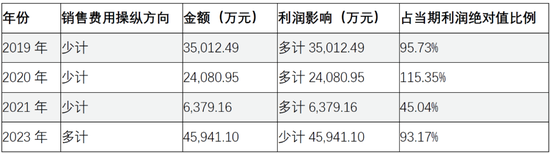
Core Viewpoint - Guizhou Bailing (002424.SZ) has once again been classified as ST (Special Treatment) due to financial misconduct, marking a continuous cycle of financial fraud, penalties, and regulatory scrutiny, with a total of 11.14 billion yuan manipulated over four years [1][4][28]. Financial Manipulation - The company has been involved in financial manipulation by underreporting and overreporting sales expenses to inflate and deflate profits, respectively, with a total adjustment amounting to 11.14 billion yuan over four years [6][28]. - The financial manipulation details include: - 2019: Underreported sales expenses by 350.12 million yuan, inflating profits by 350.12 million yuan (95.73% of that year's profit) - 2020: Underreported sales expenses by 240.81 million yuan, inflating profits by 240.81 million yuan (115.35% of that year's profit) - 2021: Underreported sales expenses by 63.79 million yuan, inflating profits by 63.79 million yuan (45.04% of that year's profit) - 2023: Overreported sales expenses by 459.41 million yuan, deflating profits by 459.41 million yuan (93.17% of that year's profit) [8][29]. Regulatory Actions - The company faced a historic penalty of 25.6 million yuan from the China Securities Regulatory Commission (CSRC), and its internal control reforms were deemed superficial [9]. - The actual controller, Jiang Wei, has been banned from the market for ten years, significantly impacting the company's strategic stability [9]. Legal Issues - Jiang Wei is embroiled in a legal dispute with Huachuang Securities, which is seeking repayment of 1.7 billion yuan due to unpaid debts related to financial support provided in 2019 [10][32]. - The relationship between Jiang Wei and Huachuang Securities has deteriorated from a supportive partnership to a contentious legal battle [11][32]. Financial Performance - Guizhou Bailing has experienced significant financial decline, with a revenue drop of 10.26% in 2024 to 3.825 billion yuan and a negative net profit of 82.44 million yuan [13][34]. - In the first three quarters of 2025, revenue continued to decline by 24.28%, with a net profit of only 21.21 million yuan, indicating ongoing financial challenges [13][34]. R&D and Sales Issues - The company's R&D investment is significantly below industry standards, with R&D expenses as a percentage of revenue at 0.82%, 1.95%, and 1.59% from 2022 to 2024, compared to an average of 4.17% to 4.86% among peers [35]. - Sales expenses are alarmingly high, with a sales expense ratio of 48.46% in 2024, nearly four times that of a competitor [15][35]. Dependency Risks - Guizhou Bailing has a high dependency on a limited number of customers and suppliers, with the top five customers accounting for nearly 40% of revenue and the top five suppliers for over 45% of purchases [37].
刚摘帽,又戴帽:ST百灵 “帽子戏法”背后的11亿造假!
Quan Jing Wang· 2025-12-26 09:37
Core Viewpoint - Guizhou BaiLing has been repeatedly penalized and labeled as ST (special treatment) due to ongoing financial misconduct, leading to significant management and operational instability [2][3][7]. Financial Misconduct - The company has been involved in a cycle of financial manipulation, with a total of 1.114 billion yuan adjusted over four years, showcasing a pattern of inflating and deflating profits [5][6]. - The China Securities Regulatory Commission (CSRC) issued a record fine of 25.6 million yuan, indicating severe regulatory scrutiny and the ineffectiveness of the company's internal control reforms [7]. Management Issues - The company's actual controller, Jiang Wei, has been banned from the market for ten years, which poses a significant threat to the company's strategic stability [2][7]. - Jiang Wei is embroiled in a legal dispute with Huachuang Securities, which is seeking repayment of 1.7 billion yuan, further complicating the company's financial situation [10][11]. Financial Performance - Guizhou BaiLing's revenue for 2024 was 3.825 billion yuan, a decline of 10.26% year-on-year, with a net loss of 82.44 million yuan, primarily relying on government subsidies to mitigate losses [13]. - In the first three quarters of 2025, revenue continued to decline by 24.28%, with a net profit of only 21.21 million yuan, indicating ongoing financial challenges [13]. Research and Development - The company's R&D expenditure has been significantly lower than industry peers, with R&D expenses as a percentage of revenue at 0.82%, 1.95%, and 1.59% from 2022 to 2024, compared to an average of 4.17% to 4.86% among 69 listed traditional Chinese medicine companies [14]. - The core R&D project, "Tang Ning Tong Luo," has not yet completed its Phase III clinical trials, raising concerns about its future revenue potential [14]. Sales and Market Dependency - Guizhou BaiLing's sales expenses are alarmingly high, with a sales expense ratio of 48.46% in 2024, nearly four times that of Yunnan Baiyao [14]. - The company relies heavily on a concentrated customer and supplier base, with the top five customers accounting for nearly 40% of revenue and the top five suppliers for over 45% of purchases, which could jeopardize its operational stability [16].

“苗药第一股”翻车:贵州百灵四年造假6.5亿,昔日贵州首富被禁入市场十年
Guan Cha Zhe Wang· 2025-12-22 15:10
Core Viewpoint - Guizhou Bailing, once hailed as the "first stock of Miao medicine," has been exposed for financial fraud spanning four years, leading to a fine of 10 million yuan and a change in stock designation to "ST Bailing" [1][2]. Financial Fraud Details - From 2019 to 2021, Guizhou Bailing inflated profits by a total of 655 million yuan through improper accounting of sales expenses, with 2020's inflated profit accounting for 115.35% of the reported total profit for that year [2][4]. - In 2023, the company reversed its approach, overstating sales expenses by 459 million yuan, resulting in a net loss of 415 million yuan, marking the first annual loss since its listing [4][10]. - The fraudulent activities involved delaying the recognition of sales expenses, thereby artificially inflating profits, which misled investors regarding the company's financial health [2][4]. Management and Regulatory Actions - The actual controller and chairman, Jiang Wei, faces a fine of 5 million yuan and a 10-year ban from the securities market due to his knowledge of the fraudulent activities and failure to act [6][10]. - Other executives, including the general manager, were fined a total of 15.6 million yuan for their roles in the financial misconduct [1][10]. - The company's stock was suspended for one day and will be subject to risk warnings, with a new trading limit of 5% following its relisting [10]. Company Background - Jiang Wei, who transformed Guizhou Bailing from a struggling company to a market leader, saw his wealth peak at 16.5 billion yuan in 2017 before facing financial difficulties due to high stock pledges [6][9]. - The company went public in 2010, raising approximately 1.381 billion yuan, but has since faced significant challenges leading to its current situation [7][9].
8万股民踩雷!“苗药第一股”财务造假多年,监管拟罚2560万元,公司致歉
Hua Xia Shi Bao· 2025-12-20 08:09
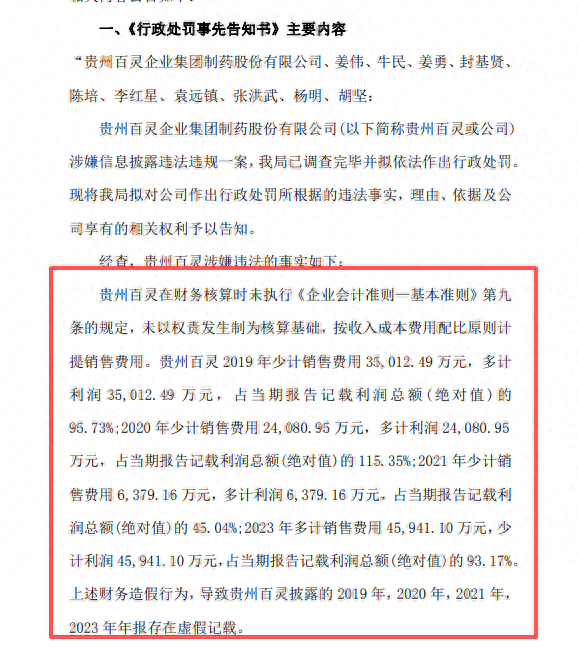
Core Viewpoint - Guizhou BaiLing Pharmaceutical Group Co., Ltd. faces severe regulatory penalties for financial fraud involving false records in multiple annual reports from 2019 to 2021 and 2023, marking it as a significant case of financial misconduct in the A-share market [2][3]. Group 1: Regulatory Actions - On December 19, Guizhou BaiLing received an administrative penalty notice from the Guizhou Securities Regulatory Bureau, proposing a total fine of 25.6 million yuan, including 10 million yuan for the company and 5 million yuan for its chairman, Jiang Wei [2][5]. - The company is required to correct its violations and has been warned, with penalties also proposed for 10 responsible individuals totaling approximately 15.6 million yuan [5][6]. - Jiang Wei, as the chairman, is subject to a 10-year ban from the securities market due to his knowledge of the financial misconduct and failure to act [5]. Group 2: Financial Misconduct Details - Guizhou BaiLing's financial misconduct involved underreporting sales expenses by 350.12 million yuan, 240.81 million yuan, and 63.79 million yuan for the years 2019, 2020, and 2021 respectively, leading to inflated profits of the same amounts, which represented 95.73%, 115.35%, and 45.04% of the reported profit totals for those years [4]. - In 2023, the company also overstated sales expenses by 459.41 million yuan, which accounted for 93.17% of the reported profit total for that year [4]. Group 3: Investor Implications - Investors who suffered losses due to Guizhou BaiLing's financial fraud may pursue legal action for compensation, particularly those who bought shares between April 30, 2020, and November 8, 2024, and sold or held shares thereafter [7][9]. - The company's stock will be suspended for one day on December 22 and will resume trading on December 23 under a new designation "ST BaiLing," indicating financial distress [9].