
锂离子电池储能

Search documents
代表呼吁储能行业“反内卷”:招标应转向价值与安全导向
第一财经· 2026-03-11 00:59
Core Viewpoint - The focus of the new energy storage industry is shifting from large-scale expansion of production and installed capacity to high-quality development, standard guidance, and sustainable commercial operation of projects [2]. Group 1: Industry Growth and Projections - New energy storage, excluding pumped storage, includes various forms such as lithium-ion battery storage, compressed air storage, and flow battery storage. By the end of 2025, the domestic new energy storage installed capacity is expected to grow by 84% year-on-year, reaching 136 million kilowatts, accounting for over 40% of the global installed capacity, with lithium battery storage contributing approximately 96% of the installed capacity [2]. - The National Development and Reform Commission and other departments have outlined a plan stating that by the end of 2027, the national new energy storage installed capacity will exceed 180 million kilowatts, with lithium-ion battery storage remaining the primary technology route [3]. Group 2: Challenges in the Industry - Despite rapid expansion and a promising outlook, the new energy storage market faces challenges such as a single and unstable revenue model and intensified irrational price competition [4]. - The "involution" competition is squeezing the reasonable profit margins in the energy storage industry, with key equipment prices dropping by approximately 80% over the past three years, leading to some bidding prices being consistently below the average production cost [5]. Group 3: Recommendations for Improvement - To address the "involution" dilemma, it is suggested that the national energy regulatory authorities collaborate with relevant departments to improve the bidding standards for energy storage projects. This includes incorporating core value indicators such as the levelized cost of energy (LCOE), long-term reliability commitments, and safety redundancy configurations into the evaluation criteria [5]. - The government work report emphasizes the need to strengthen antitrust measures and fair competition reviews, utilizing various methods such as capacity regulation, standard guidance, price enforcement, and quality supervision to mitigate "involution" competition and foster a healthy market ecosystem [5].


国家能源局:截至去年底我国新型储能装机较2024年底增长84%
Xin Lang Cai Jing· 2026-01-30 03:09
Core Insights - By the end of 2025, China's new energy storage capacity is expected to grow by 84% compared to the end of 2024, achieving over 40 times the capacity compared to the end of the 13th Five-Year Plan, indicating significant development in the sector [1] Capacity Growth - As of the end of 2025, the average energy storage duration is projected to be 2.58 hours, an increase of 0.30 hours from the end of 2024 [1] - The North China region holds the largest share of installed capacity, accounting for 32.5% of the national total [1] - In the past year, North and Northwest China have been the main growth areas for new energy storage, with newly installed capacities of 21.88 million kilowatts and 19.66 million kilowatts, respectively, representing 35.2% and 31.6% of the national new installations [1] Project Scale - There is a clear trend towards larger-scale projects, with installations of 100,000 kilowatts and above making up 72% of the total by the end of 2025, an increase of approximately 10 percentage points from the end of 2024 [1] - Projects with a storage duration of 4 hours or more are gradually increasing, with their share reaching 27.6%, up by about 12 percentage points from the end of 2024 [1] Technology Dominance - Lithium-ion battery storage remains the dominant technology, accounting for 96.1% of the installed capacity, while compressed air storage, flow battery storage, and flywheel storage make up 3.9% [1]
截至去年底我国新型储能装机较2024年底增长84%
Yang Shi Xin Wen· 2026-01-30 02:54
Core Insights - By the end of 2025, China's new energy storage capacity is expected to grow by 84% compared to the end of 2024, achieving over 40 times the capacity compared to the end of the 13th Five-Year Plan, indicating significant development in the sector [1] - The average energy storage duration has increased by 0.30 hours to 2.58 hours compared to the end of 2024 [1] Group 1: Capacity and Utilization - The equivalent utilization hours of new energy storage nationwide are projected to reach 1195 hours in 2025, an increase of nearly 300 hours from 2024 [2] - The State Grid and Southern Power Grid have equivalent utilization hours of 1175 hours and 1294 hours, respectively [2] Group 2: Regional and Technical Developments - The North China region accounts for the largest share of installed capacity, with 32.5% of the national total, and has seen significant growth in new installations [3] - New installations in North and Northwest China were 21.88 million kW and 19.66 million kW, representing 35.2% and 31.6% of the national total, respectively [3] - Projects with a capacity of over 100,000 kW now account for 72% of total installations, an increase of about 10 percentage points from 2024 [3] - Lithium-ion battery storage remains dominant, comprising 96.1% of installed capacity, while other technologies like compressed air and flow batteries account for 3.9% [3]
南方电网PPT:南方电网新型储能运营模式及调度运用情况
Sou Hu Cai Jing· 2026-01-15 02:19
Core Insights - The report discusses the new energy storage operation and scheduling model of China Southern Power Grid, highlighting its integration and operational rules across five provinces, with a focus on market mechanisms and development strategies [1][2]. Group 1: Energy Storage Capacity and Technology - As of now, the installed capacity of new energy storage in Southern Power Grid has reached 8.878 million kW / 17 million kWh, with 166 energy storage stations, including 7.718 million kW / 14.48 million kWh from grid-side and power-side storage [1][12]. - The technology primarily involves lithium-ion battery storage, with emerging projects in compressed air, flow batteries, and other new technologies, indicating a diversification trend [1][11]. - The expected installed capacity by the end of 2025 is projected to exceed 15 million kW [1][11]. Group 2: Operational Efficiency and Utilization - In 2024, the average daily cycle of new energy storage in the Southern region is 0.76 times, with an average utilization hour of 2.87 hours, where Guangdong shows the highest efficiency with 1.14 cycles and 4.3 hours [1][13]. - During the 2025 Spring Festival, the maximum discharge power of grid-side storage reached 3.39 million kW, with a maximum discharge rate of 67.6% [1][13]. Group 3: Scheduling and Market Mechanisms - New energy storage is categorized into five types: grid-side, power-side, user-side, independent shared storage, and joint storage, with specific operational rules for each type [2][19]. - The operational models across the five provinces are distinct, with Guangdong focusing on capacity leasing and market participation, while Guangxi and Yunnan are exploring various market modes for profitability [2][34][35]. - To promote new energy storage development, it is essential to establish a capacity pricing mechanism, optimize the operation of the spot market, and expand the frequency regulation market [2][2].

报告:我国新型储能平稳较快发展 技术路线多元协同
Xin Hua Cai Jing· 2026-01-08 08:03
Core Insights - The report by State Grid Energy Research Institute indicates that by September 2025, China's new energy storage capacity will reach 103 million kilowatts, representing a growth of over 30 times compared to the end of the 13th Five-Year Plan [1] - The utilization level of energy storage stations is continuously improving, with the equivalent utilization hours for new energy storage nationwide increasing by approximately 120 hours year-on-year to about 770 hours from January to September 2025 [1] - The report forecasts that by 2030, the cumulative demand for new energy storage in China will exceed 300 million kilowatts, with lithium battery storage remaining the primary technology during the 14th Five-Year Plan [3] Group 1: Current Status - As of September 2025, the total installed capacity of new energy storage in the State Grid operating area is 83.146 million kilowatts, with an average charge and discharge duration of 2.43 hours [1] - The maximum adjustable power of new energy storage in the State Grid operating area is 64.23 million kilowatts, with an average discharge duration of 2.4 hours during peak summer evenings [1] - In regions like Jiangsu, Shandong, and Zhejiang, the maximum simultaneous utilization rate of new energy storage has reached over 95%, playing a crucial role in peak supply [1] Group 2: Technological Development - The report highlights a "diverse collaboration and multiple breakthroughs" in new energy storage technology, with rapid iterations and declining costs across various technology routes [2] - The construction cost for lithium-ion battery storage is projected to be between 900-1100 RMB/kWh by 2025, while sodium-ion battery storage costs are expected to range from 2500-3500 RMB/kWh [2] - New compressed air storage has achieved key indicators, entering an accelerated industrialization phase with construction costs dropping to 5000-6000 RMB/kWh [2] Group 3: Future Outlook - The report anticipates steady growth in new energy storage, with a projected cumulative demand exceeding 300 million kilowatts by 2030 [3] - The diversification of technology routes will include both short-term and long-term energy storage solutions, with new energy storage playing an increasingly significant role in peak shaving, load following, and long-cycle regulation [3]
国内外需求共振 储能产业迎全球爆发期
Zheng Quan Ri Bao Wang· 2025-11-11 13:21
Core Insights - The energy storage industry in China is experiencing a global boom, with domestic battery manufacturers facing high demand and full production capacity [1][2] - The capital market is actively pursuing energy storage concepts, with many related stocks seeing significant price increases this year [1] - The growth in demand for energy storage is driven by a combination of policy subsidies, technological cost reductions, and energy structure transformations [1][2] Industry Development - China's new energy storage installed capacity is rapidly increasing, with projections indicating it will exceed 100 million kilowatts by September 2025, accounting for over 40% of the global total [1] - By 2027, the installed capacity is expected to reach over 180 million kilowatts, with direct project investments estimated at approximately 250 billion yuan [2] - The primary technology for new energy storage remains lithium-ion batteries, with a diversification of technology routes and application scenarios anticipated [2] Market Trends - The energy storage sector is expected to drive lithium battery demand growth exceeding 30% next year, presenting investment opportunities across materials, batteries, and integration [4] - The recent "Guiding Opinions" issued by the National Development and Reform Commission and the National Energy Administration emphasizes the need for advanced and efficient energy storage technologies [5] International Expansion - Chinese energy storage companies are increasingly securing large overseas orders, with 199 new overseas storage orders totaling over 160 GWh in the first half of the year, marking a year-on-year increase of 220.28% [6] - The surge in overseas demand is attributed to the construction of AI data centers and aging power grid infrastructure in some regions, where energy storage serves as a backup power source [6] - Chinese companies are transitioning from merely supplying products to establishing a significant presence in the global energy market, focusing on high-end technology standards and local supply chain development [7]


5年30倍!从中国 向世界 新型储能撬动万亿市场
Zhong Guo Dian Li Bao· 2025-11-10 01:56
Core Insights - China's new energy storage capacity reached 103 million kilowatts by the end of September 2023, marking a more than 30-fold increase since the end of the 13th Five-Year Plan, accounting for over 40% of the global total and positioning China as the world leader in this sector [1][2][5] Industry Development - New energy storage is a key technology for establishing a new energy system and supporting global energy transition, with significant investments expected to exceed 1 trillion yuan [2][5] - By September 2023, the installed capacity of new energy storage in Inner Mongolia and Xinjiang exceeded 10 million kilowatts, with North China operating 31.18 million kilowatts, representing 30.4% of the national total [2] - The average bidding price for EPC projects has decreased by approximately 40%, and battery cell prices have dropped by about 60% compared to 2022, indicating a trend towards cost reduction [4] Market Dynamics - The utilization hours of new energy storage systems increased by about 120 hours year-on-year to approximately 770 hours in the first three quarters of 2023, demonstrating enhanced operational efficiency [2] - As of June 2023, there were 194 new energy storage stations participating in market transactions within the State Grid's operating area, with a total installed capacity of 20.59 million kilowatts, accounting for 27% of the total new energy storage capacity [7] Technological Innovation - Various new energy storage technologies are being developed, including compressed air storage, liquid flow batteries, and solid-state batteries, with liquid flow battery capacity increasing to 1.15 million kilowatts, a 30-fold increase since the end of the 13th Five-Year Plan [6] - The "136 Document" issued in January 2023 aims to clarify the market value of energy storage, promoting its integration into market trading systems [6] Future Outlook - The new energy storage market in China is expected to accelerate further, with projections indicating that by 2030, the installed capacity could reach between 236.1 GW and 291.2 GW, with a compound annual growth rate of 20.2% to 24.5% from 2025 to 2030 [10] - The shift from price competition to value competition in the energy storage market is anticipated to drive high-quality development and innovation in business models [11]


媒体报道︱5年30倍!从中国 向世界 新型储能撬动万亿市场
国家能源局· 2025-11-06 08:09
Core Viewpoint - The article emphasizes the rapid growth and significance of new energy storage in China, highlighting its role in the global energy transition and the potential for a trillion-dollar market [3][4][5]. Summary by Sections New Energy Storage Development - As of September 2023, China's new energy storage installed capacity reached 103 million kilowatts, growing over 30 times since the end of the 13th Five-Year Plan, accounting for over 40% of the global total [3][5]. - The National Energy Administration reported that the installed capacity of new energy storage has become a crucial part of the new power system [5]. Market Dynamics and Investment - New energy storage has directly driven project investments exceeding 200 billion yuan and has stimulated over 1 trillion yuan in the upstream and downstream industries [7]. - The average bidding price for EPC contracts has decreased by approximately 40%, and battery cell prices have dropped by about 60% compared to 2022, indicating a trend of cost reduction and accelerated international expansion [6]. Technological Innovations - Lithium-ion battery storage dominates the market with over 98.1 million kilowatts, representing 96.1% of the total installed capacity [6]. - New energy storage technologies, including compressed air and liquid flow batteries, are being implemented, with liquid flow battery capacity increasing to 1.15 million kilowatts, a 30-fold increase since the end of the 13th Five-Year Plan [10]. Policy and Market Mechanisms - The introduction of the "136 Document" aims to clarify the market value of energy storage, promoting its integration into market trading systems [10]. - There is a need for a capacity compensation mechanism for new energy storage to ensure stable market returns, as current policies do not adequately reflect the value of storage's flexible regulation capabilities [11]. Future Outlook - By 2030, China's new energy storage capacity is projected to reach between 236.1 GW and 291.2 GW, with a compound annual growth rate of 20.2% to 24.5% from 2025 to 2030 [14]. - The shift in business models towards high-quality, cost-effective storage products is expected to enhance market competitiveness and drive the industry towards high-quality development [15].

气候目标驱动新型储能发展规模化
Guo Ji Jin Rong Bao· 2025-11-06 02:51
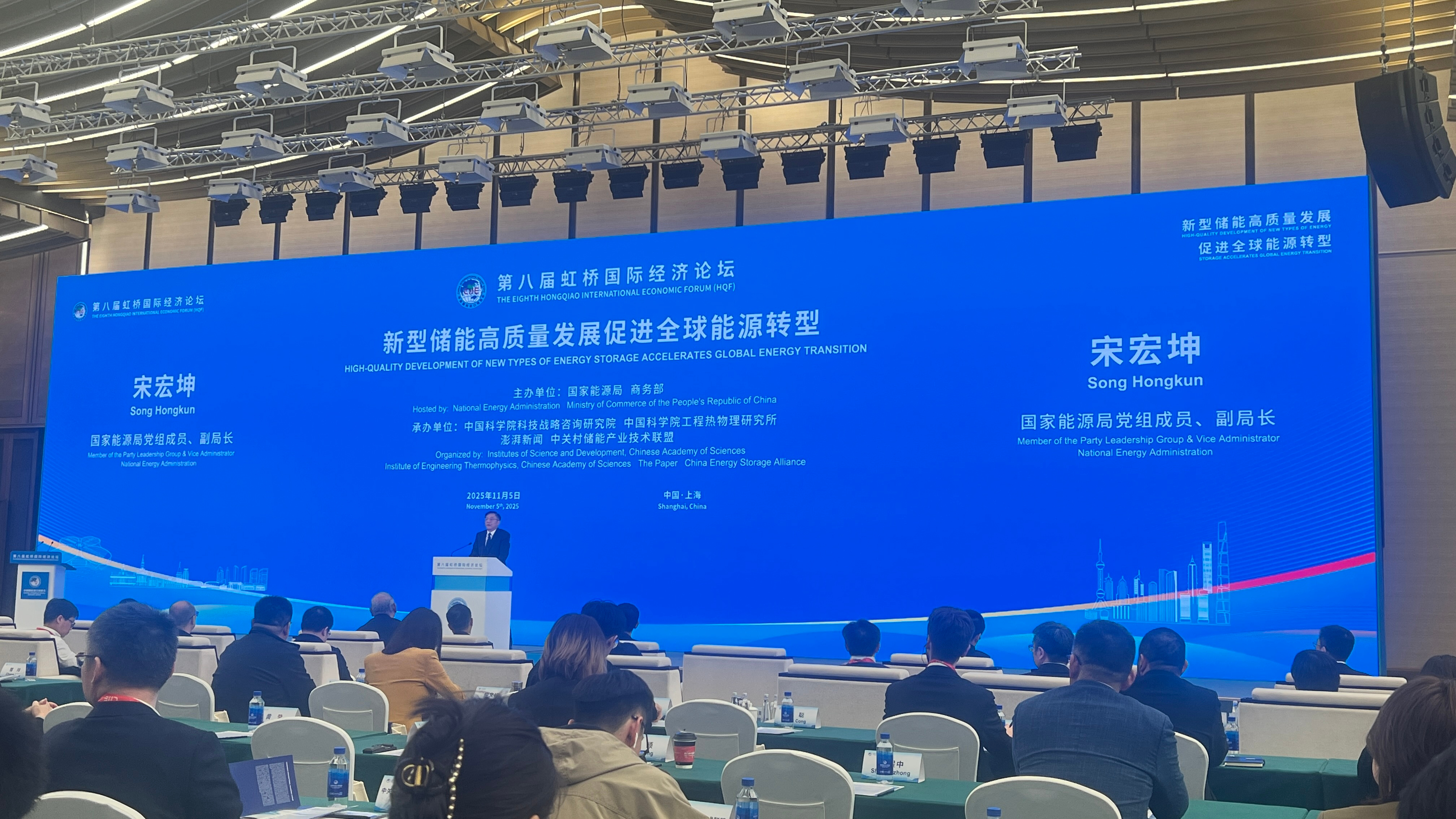
Group 1 - The eighth Hongqiao International Economic Forum focused on "Promoting High-Quality Development of New Energy Storage for Global Energy Transition" [1] - This year marks the tenth anniversary of the Paris Agreement, highlighting a critical phase in global climate governance, with China committed to green and low-carbon transformation [4] - New energy storage is recognized as a key technology for supporting the construction of a new energy system and new power system, characterized by flexibility, rapid response, and short construction cycles [6] Group 2 - As of September 2023, China's new energy storage installed capacity has surpassed 100 million kilowatts, becoming an essential part of the new power system [6] - The National Energy Administration reported that by September 2025, China's renewable energy installed capacity is expected to exceed 1.7 billion kilowatts, contributing significantly to green and low-carbon energy transition [6] - Nicaragua's government expressed its intention to deepen partnerships with Chinese companies in solar, hydropower, and energy storage sectors, leveraging its natural conditions for renewable energy development [7] Group 3 - Chinese energy storage companies are seizing market opportunities, expanding trade scale, and enhancing their position in the global energy storage supply chain [9] - The National Energy Administration emphasizes the importance of innovation and comprehensive policies to create a favorable environment for the development of new energy storage technologies and industries [9] - Nobel laureate Steven Chu highlighted the necessity of diverse technologies for deep decarbonization, praising China's leadership in cost control for large wind turbines, battery storage, and nuclear reactors [10]
跃居世界第一!我国新型储能装机规模超1亿千瓦
Xin Hua Cai Jing· 2025-11-05 16:50
Core Viewpoint - By the end of September 2025, China's new energy storage installed capacity is expected to exceed 100 million kilowatts, representing a growth of over 30 times compared to the end of the 13th Five-Year Plan, and accounting for over 40% of the global total installed capacity, making China the world leader in this sector [1][2]. Group 1: Industry Growth and Development - The rapid increase in new energy storage installed capacity is attributed to technological innovation, industrial development, and the gradual improvement of business models, transitioning from the initial commercialization phase to large-scale development [1][2]. - In the first three quarters of 2025, the equivalent utilization hours of new energy storage nationwide reached approximately 770 hours, an increase of about 120 hours year-on-year, with several provinces demonstrating effective utilization [1]. Group 2: Technological Advancements - As of September 2025, lithium-ion battery storage dominates the new energy storage technology landscape, with an installed capacity exceeding 98 million kilowatts, accounting for 96.1% of the total; flow battery storage has grown approximately 30 times since the end of the 13th Five-Year Plan, reaching 1.15 million kilowatts [2]. - Emerging technologies such as solid-state batteries and hydrogen storage are accelerating development, providing robust support for future energy storage needs in new power systems [2]. Group 3: Policy and Market Mechanisms - The National Energy Administration plans to focus on several key areas during the 14th Five-Year Plan, including coordinated planning of new energy storage and other regulatory resources, enhancing market mechanisms for new energy storage, and promoting a shift from policy-driven to market-driven development [3]. - Efforts will be made to improve the utilization levels of new energy storage, support technological innovation, and deepen international cooperation in the field of new energy storage [3].