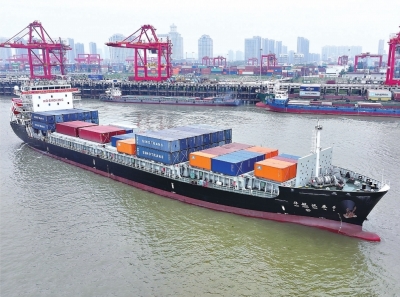
长江荣耀号

Search documents
“长江星耀”号明年春天入列武汉游轮母港
Chang Jiang Ri Bao· 2025-12-20 00:41
Core Insights - The "Changjiang Xingyao" immersive smart cruise ship will officially join Wuhan's cruise port in spring 2026, reshaping the night tourism industry in Wuhan and enhancing the theme of "Yangtze River tourism starting from Wuhan" [1] - The cruise ship combines smart technology, green energy, immersive cultural theater, and avant-garde art design, aiming to provide travelers with a poetic journey that encapsulates the essence of the Yangtze River's 5,000-year civilization [1] - The introduction of the "Changjiang Xingyao" has attracted significant interest from domestic and international travel agencies, with many expressing intentions to collaborate and expand the market in Wuhan [1] Group 1 - The "Changjiang Erhao" luxury cruise ship will relocate its starting point to Wuhan in 2026, allowing direct boarding for travelers from both Wuhan to Chongqing and vice versa [2] - The "Changjiang Rongyao" cruise ship is set to host a temple fair event during the 2026 Spring Festival, enhancing the immersive experience of traditional culture for tourists during night cruises [2] - As of now, the "Changjiang Rongyao" has received 250,000 visitors in 2025, marking a 10% year-on-year increase [2] Group 2 - The introduction of new cultural tourism products, including the "Guanggu Air Rail" educational products, aims to enrich Wuhan's tourism offerings and provide deeper experiences for visitors [2]
依托长江独特禀赋 武汉打造“一船一特色”的夜航IP集群
Zhong Guo Xin Wen Wang· 2025-09-25 07:09
Core Insights - Wuhan is leveraging its unique geographical advantages along the Yangtze River and its largest tributary, the Han River, to develop a distinctive night cruise IP cluster featuring themed boats [1] Group 1: Industry Development - The construction of the "Two Rivers and Four Banks" core area of the Yangtze International Golden Tourism Belt is accelerating, enhancing the cultural and scenic tourism experience [1] - The Wuhan Cultural Tourism Group's Two Rivers Tour Company is continuously innovating services such as Yangtze River educational tours and robot-guided tours to refresh the "river cruise" experience [1] Group 2: Unique Offerings - The "Zhiyin" cruise has pioneered a "mobile theater + city museum" model, attracting global tourists to experience the charm of Wuhan [1] - Night cruises on the Yangtze River have become a popular choice for visitors to appreciate the beauty of "Great Rivers, Great Lakes, Great Wuhan" [1]
武汉持续位列全国十大热门旅游目的地
Chang Jiang Ri Bao· 2025-09-25 00:29
Group 1: Cultural and Tourism Development - During the 14th Five-Year Plan period, Wuhan's cultural industry added value accounted for 5.5% of the city's GDP in 2023, with expectations for a 12% and 16% year-on-year growth in tourist reception and total tourism revenue respectively by the first half of 2025 [1] - Wuhan's cultural and tourism market is thriving, with the number of newly registered cultural and entertainment enterprises increasing by 387% year-on-year in the first half of 2025, leading all industries in new registrations [1] - The Wuhan Mei Flower Award has recognized 12 winners, the highest among sub-provincial cities, and the city's cultural venues are attracting over 10 million visitors annually [1] Group 2: Sports Infrastructure and Industry Growth - Wuhan has constructed or renovated 30 urban sports parks and 208 community sports centers, increasing per capita sports facility area from 2.17 square meters to 3.21 square meters, creating a "12-minute sports fitness circle" for citizens [2] - The total output value of Wuhan's sports industry is projected to reach 95.8 billion yuan in 2024, with an annual growth rate of 12%, while the added value of the sports industry is expected to be 43.3 billion yuan, growing at 11% annually [2] - Sports consumption in Wuhan is anticipated to exceed 53.1 billion yuan, representing nearly a 50% increase compared to the beginning of the 14th Five-Year Plan [2] Group 3: Tourism and Cultural Integration - The Jiang'an District has become the province's leader in national-level tourism and leisure districts, with the historical area of Hankou expected to receive 39 million visitors in 2024 [3] - The Wuhan Cultural Tourism Group is focusing on enhancing visitor experiences through diverse cultural and commercial integrations, such as the "Zhiyin Guose" aesthetic life museum and the Zhaowu bookstore, which blend traditional culture with modern trends [3] - The cultural and creative industries in Optics Valley are rapidly developing, with over 500 companies served in the creative industry park, of which more than 85% are cultural enterprises, fostering significant IP creations [3]
武汉港九大港区激活“黄金水道”
Chang Jiang Ri Bao· 2025-05-09 08:40
Core Insights - Wuhan Port is a significant inland port that connects the Yangtze River to the sea, enhancing China's openness and vitality [2][5] - The port consists of nine districts, with Yangluo Port being the core, and is projected to handle over 3.5 million TEUs by 2024, maintaining its leading position in the Yangtze River region [3][6] Group 1: Port Infrastructure and Operations - Yangluo Port is known for its busy operations, accommodating large vessels and facilitating extensive cargo transport [3][4] - The port has achieved a record by successfully docking the Panama-flagged vessel "Kangshun 99," which carried 7,324.41 tons of cargo, marking the largest foreign operational vessel to dock at Wuhan Port [5] - Wuhan Port has established 30 direct shipping routes across the country and five international routes connecting to Japan, South Korea, Russia, Vietnam, and Indonesia [5] Group 2: Intermodal Transportation - Yangluo Port has developed over 60 intermodal transport channels, solidifying its position as a key hub in the middle reaches of the Yangtze River [6] - In 2024, the port's intermodal transport volume reached 231,600 TEUs, a year-on-year increase of 44.5%, leading all inland ports in China [6] - The integration of rail and water transport has significantly reduced logistics costs for various industries in the region [6] Group 3: Regional Economic Impact - Wuhan Port plays a crucial role in activating new economic dynamics in the central Yangtze River urban cluster, serving as a strategic point for regional development [8][9] - The port has established a "one port connects three provinces" model, enhancing inter-provincial cooperation and logistics efficiency [9] - By 2024, Wuhan Port is expected to become the largest foreign trade container hub in the upper and middle reaches of the Yangtze River, with a 22% increase in foreign trade container throughput [9] Group 4: Future Development Plans - By 2035, Wuhan Port aims to transition from an inland port to an international comprehensive hub, enhancing its strategic significance [9] - The completion of the Han River channel upgrade is anticipated to extend the port's influence, increasing the share of cargo flow in the central and western regions from 35% to 50% by 2030 [9]