非洲芝麻

Search documents
前11月广东外贸进出口同比增4.2% 占全国总值的20.9% 对全国增长的贡献度达23.8%
Nan Fang Ri Bao Wang Luo Ban· 2025-12-11 01:17
Core Insights - Guangdong's foreign trade has shown steady progress this year, with growth rates surpassing the national average, highlighting its significant role in the national economy [1][2] - In the first 11 months, Guangdong's total foreign trade reached 8.61 trillion yuan, a 4.2% increase year-on-year, setting a historical record for the same period [1] - The province accounted for 20.9% of the national total trade value, contributing 23.8% to the overall national growth [1] Trade Performance - In November, Guangdong's imports and exports reached 813.24 billion yuan, an 8.9% increase, leading the nation in growth [2] - Exports for November were 515.14 billion yuan, up 6.7%, while imports rose to 298.1 billion yuan, a 12.8% increase [2] - General trade accounted for 58.2% of Guangdong's total trade, with a 3.9% increase, while processing trade saw a modest growth of 0.5% [2] Export Dynamics - Guangdong's exports of electromechanical products reached 3.77 trillion yuan, a 7% increase, making up 68.5% of total exports [3] - Key export items such as electronic components and computers saw significant growth, with increases of 19.3% and 10.1% respectively [3] - Traditional products like motorcycles and game consoles also experienced notable growth rates of 34.6% and 27.2% [3] Import Trends - The demand for imports has continued to expand, with integrated circuits imported at 1.17 trillion yuan, a 15.6% increase [3] - Imports of computers and their components grew by 20.3%, while semiconductor manufacturing equipment saw a remarkable increase of 43.8% [3] Market Expansion - ASEAN, Hong Kong, and the EU are Guangdong's top three trading partners, each surpassing 1 trillion yuan in trade volume [4] - Trade with emerging markets such as the Middle East and Africa has shown strong growth, with increases of 7.8% and 10.4% respectively [4] - The "Belt and Road" initiative countries accounted for 38.5% of Guangdong's trade, totaling 3.32 trillion yuan, with a growth rate of 4.9% [4] Consumer Goods Import - Driven by domestic consumption, imports of essential goods like grains and dairy products have seen double-digit growth, with increases of 18.6% and 19.7% respectively [4] - The implementation of zero-tariff policies for certain products from least developed countries is expected to further enhance import volumes [4][5]
零关税,让更多非洲产品丰富中国市场
Huan Qiu Wang· 2025-12-03 02:43
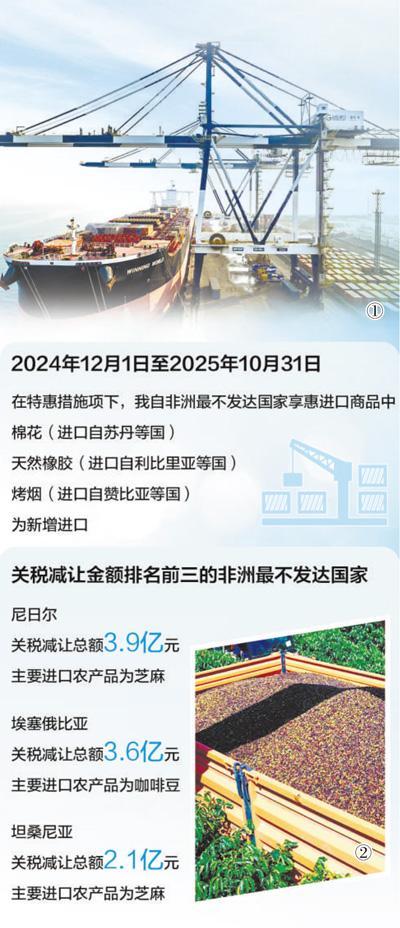
Group 1: Trade Policy Impact - From December 1, 2024, China will implement a zero tariff policy on 100% of products from least developed countries that have diplomatic relations with China, aiming to enhance mutual development [6] - The zero tariff policy is expected to boost trade vitality between China and Africa, particularly benefiting African industries and enriching consumer choices in China [6] Group 2: Coffee Industry Growth - Ethiopia's coffee exports to China have been growing at an annual rate of 27%, with over 34,000 tons exported in the 2024/2025 fiscal year, generating over $218 million in revenue [7] - The zero tariff policy has significantly increased the competitiveness of Ethiopian coffee in the Chinese market, leading to a substantial rise in export volumes [7][8] - The Ethiopian Coffee and Tea Authority noted that China has become Ethiopia's fourth-largest coffee export market [7] Group 3: Supply Chain Efficiency - The import of sesame from Mozambique to China has become more efficient, with direct sourcing channels allowing for better quality control and smoother market entry [9][10] - The logistics process for sesame includes modern transportation methods and a streamlined customs clearance process, reducing costs and improving delivery times [10][11] Group 4: Rubber Industry Developments - The implementation of the zero tariff policy has reduced the tariff on natural rubber from Liberia from 20% to zero, saving approximately 300,000 yuan on the first batch of imports [12] - The reduction in tariff costs allows companies to invest more in research and development, leading to the creation of new products such as energy-saving tires for electric vehicles [13] - In the first ten months of the year, Shandong province's imports from Africa reached 87.645 billion yuan, a year-on-year increase of 50.3%, with natural and synthetic rubber imports growing by 50.7% [13]