骁龙X系列PC处理器

Search documents
高通暗示将减少对台积电依赖
半导体芯闻· 2026-03-23 10:24
Core Viewpoint - Qualcomm signals a shift to reduce reliance on TSMC for semiconductor supply, emphasizing a continued partnership with Samsung Foundry [1][3]. Group 1: Partnership and Strategy - Qualcomm's senior vice president Chris Patrick highlights the importance of balancing performance, cost, and available capacity in collaboration with global foundries, particularly Samsung [1][3]. - Qualcomm has exclusively awarded TSMC the contract for its Snapdragon 8 series processors for four consecutive years, but is now looking to diversify its supply chain [3]. - The competition for orders in the 3nm process has seen Samsung struggle against TSMC, but rising costs at TSMC are increasing expectations for Samsung's foundry capabilities [3]. Group 2: Technological Development - Qualcomm's Alex Katouzian emphasizes that factors beyond price, such as technology, battery efficiency, capacity, and yield, are critical in selecting foundries [4]. - Patrick mentions that Qualcomm operates as a "single team" with Samsung, collaborating on future platforms that will take approximately three years to develop [4]. Group 3: Market Trends and Challenges - The shift towards AI is driving significant demand for memory and advanced semiconductor technologies, contributing to rising costs in the industry [5]. - Qualcomm's CMO Don McGuire discusses a paradigm shift in marketing strategies, moving from SEO to Generative Engine Optimization (GEO) to enhance brand visibility in AI environments [5]. - The upcoming 6G era is expected to focus on "AI-native networks" and enhanced uplink capabilities, which are crucial for transmitting large amounts of data generated by AI agents and smart glasses [5].



高通“钞能力”在线,也被内存暴涨困扰
3 6 Ke· 2026-02-05 05:39
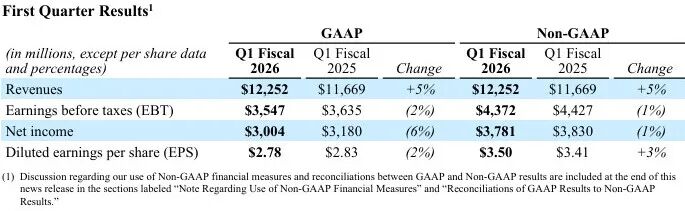
Core Viewpoint - Qualcomm reported record revenues of $12.25 billion for Q1 FY2026, a 5% year-over-year increase, surpassing Wall Street expectations of $12.13 billion. Adjusted earnings per share (EPS) were $3.50, exceeding the consensus of $3.39 [1][2]. Financial Performance - Total revenues reached $12,252 million, up from $11,669 million, reflecting a 5% increase [3]. - Earnings before taxes (EBT) decreased by 2% to $3,547 million, while net income fell by 6% to $3,004 million [3]. - Diluted EPS on a GAAP basis was $2.78, down 2% from $2.83, while non-GAAP diluted EPS increased by 3% to $3.50 [3]. Business Segments - The QCT segment contributed $10,613 million in revenues, a 5% increase from $10,084 million [6]. - The handset business generated $7,824 million, up 3% year-over-year, while automotive revenues rose 15% to $1,101 million [12][13]. - IoT revenues reached $1,688 million, reflecting a 9% increase, indicating strong growth in both industrial and consumer applications [12][13]. Market Challenges - Qualcomm's CEO acknowledged challenges in the smartphone market, particularly due to a severe shortage of memory chips, which is impacting production and pricing [7][8]. - The company provided a cautious revenue guidance for Q2 FY2026, estimating between $10.2 billion and $11.0 billion, which is below analyst expectations [10][16]. Strategic Outlook - Qualcomm is focusing on diversifying its business, with automotive and IoT sectors showing promising growth, contributing over 22% to total revenues [11][13]. - The company remains optimistic about achieving its long-term revenue goals for FY2029, despite current market pressures [16]. Market Sentiment - Following the earnings report, Qualcomm's stock fell nearly 10% in after-hours trading, indicating market skepticism despite the strong financial results [2]. - Analysts suggest that the current valuation of Qualcomm is significantly lower than the S&P 500 average, reflecting an overly pessimistic view on the smartphone market [18].