骁龙X Elite

Search documents
AMD产品路线图,令人失望
半导体行业观察· 2025-12-07 02:33
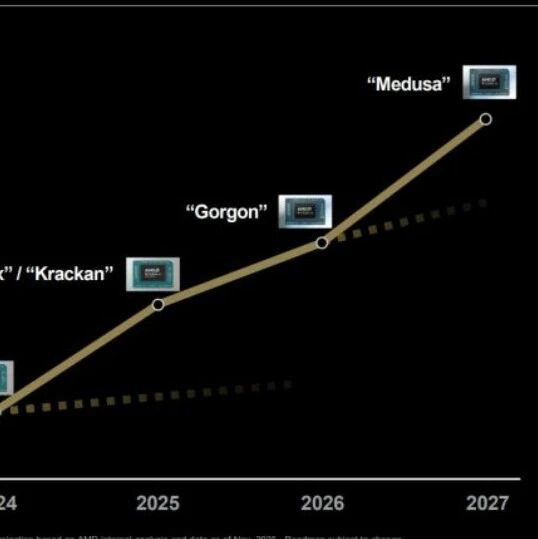
Core Insights - AMD's consumer product roadmap for 2026 appears underwhelming, particularly in the mobile and consumer laptop segments, where immediate success is unlikely [1][3] - The Gorgon platform, set to launch in 2026, will still utilize the Zen 5 architecture, which may not compete effectively against Intel's Panther Lake and Qualcomm's Snapdragon X Elite Gen 2 [3][10] - AMD's Zen 5 architecture is primarily designed for data centers, leading to higher heat generation and lower performance per watt in mobile applications [4][5] 2026 Product Launches - AMD plans to introduce the Gorgon platform in 2026, which will be based on a 4nm process, competing against Intel's 3nm offerings [9] - The Gorgon platform is expected to face challenges in battery life and performance per watt compared to its competitors [9][12] - The Strix Point platform, while gaining some design wins, lacks the energy-efficient solutions necessary to compete with Intel's offerings [5][10] Future Developments - The Medusa platform, expected in 2027, will be based on the Zen 6 architecture, which aims to improve performance and efficiency [11] - AMD's ability to enhance battery life and performance per watt remains uncertain, even with the upcoming Medusa platform [11][12] - AMD's goal is to increase its market share in the consumer segment to 40%, although this may occur in lower-margin segments [12] Competitive Landscape - Intel's Lunar Lake and Panther Lake architectures are positioned to outperform AMD's offerings in terms of efficiency and performance, particularly in the mobile segment [5][10] - AMD's current strategy may lead to a reliance on lower-margin products to fill gaps left by competitors [12] - The success of AMD's high-end desktop processors, such as the 9800X3D and 9950X3D, indicates that its data center-first strategy has yielded positive results in that market [8]


高通公司总裁兼CEO安蒙即将亮相COMPUTEX 2025,解读AI重塑PC的未来图景
Sou Hu Cai Jing· 2025-05-16 02:45
Group 1 - The annual COMPUTEX TAIPEI will focus on the latest advancements and applications in artificial intelligence, with Qualcomm's CEO Cristiano Amon set to discuss the significant progress of the Snapdragon X series platform in the AI era [1] - Qualcomm has developed the Snapdragon X series platform specifically for the next generation of PCs, which includes 12-core Snapdragon X Elite, 10-core, and 8-core Snapdragon X Plus, catering to various market segments from high-end to entry-level [3] - The Snapdragon X series processors feature 45 TOPS of NPU computing power, enabling efficient AI operations on the device side, reducing reliance on cloud computing, and enhancing response speed and data privacy [3] Group 2 - AI is transforming the PC user experience across consumer, enterprise, and industrial sectors, enhancing productivity and lowering creative barriers through automation and intelligent solutions [4] - The trend of AI capabilities moving from the cloud to endpoint devices is irreversible, with the Snapdragon X series chips emerging as a key player in this shift, integrating CPU, GPU, and NPU for improved AI performance and power efficiency [4] - The transition from cloud-based AI to endpoint AI is redefining traditional PCs, shifting human-computer interaction from application-centered to user-centered, with the Snapdragon X series acting as a significant accelerator in this transformation [5]


DeepSeek后更大的机遇:AI端侧推理创新 | 智在终端
量子位· 2025-03-11 05:24
Core Viewpoint - The article discusses the significant impact of DeepSeek on the AI industry, particularly in the consumer electronics and automotive sectors, highlighting the shift towards edge AI and the emergence of new applications and models [1][5][25]. Group 1: DeepSeek's Influence - DeepSeek has been rapidly integrated by major consumer electronics brands such as Honor, OPPO, and Xiaomi, showcasing its widespread adoption [2][4]. - Over 20 automotive companies, including Geely and BYD, have announced their integration with DeepSeek, indicating a strong trend of AI and automotive convergence [3][4]. - The article emphasizes that AI is entering a new era of reasoning innovation, with DeepSeek acting as a catalyst for this transformation [5][7]. Group 2: AI Model Evolution - High-quality, small-scale AI models are becoming feasible, with DeepSeek-R1 providing innovative solutions to long-standing cost issues in edge AI [12][14]. - The article outlines four key trends in AI model development, including rapid evolution of AI models, shrinking model parameters, and the increasing availability of high-quality models for developers [15][17][20]. - Techniques such as quantization, pruning, and distillation are enabling the transfer of performance from large models to smaller ones, enhancing their applicability [18][20]. Group 3: Qualcomm's Role - Qualcomm is positioned as a leader in the edge AI space, having anticipated the shift of AI processing from cloud to edge, as outlined in their white paper on hybrid AI [28][29]. - The company has developed high-performance, energy-efficient chips that support advanced AI capabilities across various devices, including smartphones and automotive systems [32][33]. - Qualcomm's comprehensive ecosystem strategy facilitates developers in deploying AI models across multiple platforms efficiently [41][42]. Group 4: Future Implications - The transition of large models from cloud to edge presents significant opportunities for widespread application and user engagement [43]. - The article concludes that the ongoing innovations in edge AI are just beginning to emerge, with the potential for transformative impacts across industries [45][47].