骁龙X2 Plus平台

Search documents
高通电话会:AI数据中心“抽干”DRAM产能,内存短缺将决定今年手机市场规模
Hua Er Jie Jian Wen· 2026-02-05 01:45
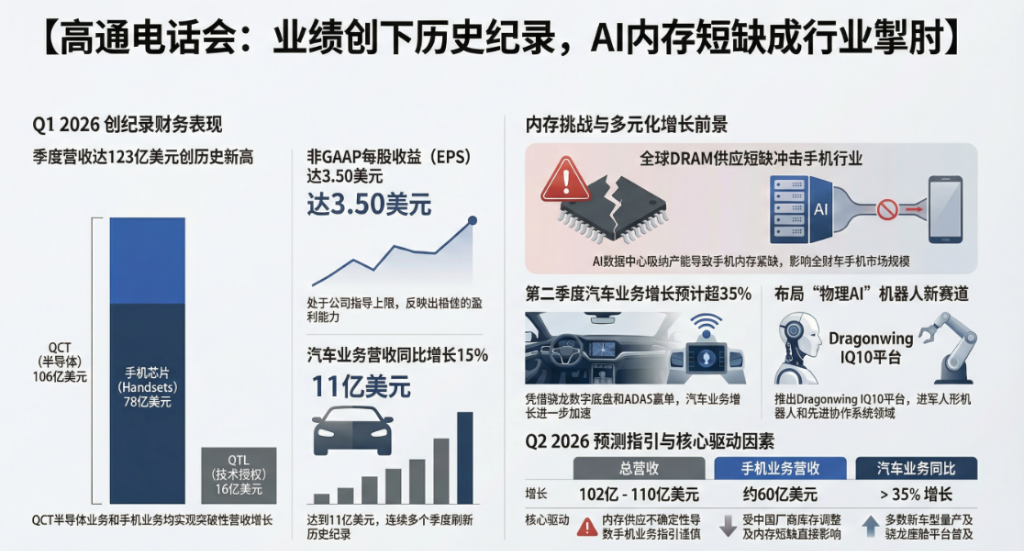
Core Insights - Qualcomm reported record earnings for Q1 FY2026, with revenue reaching $12.3 billion and non-GAAP EPS at $3.50, driven by strong performance in its QCT (chip business) segment, which generated $10.6 billion in revenue [16][24] - The company anticipates a decline in mobile chip revenue to approximately $6 billion in Q2 due to supply chain constraints, particularly in DRAM availability, which is expected to impact the overall mobile market size for the fiscal year [4][26] Financial Performance - Qualcomm's QCT segment achieved record revenue of $10.6 billion, with mobile revenue hitting $7.8 billion, benefiting from the launch of flagship smartphones [16][24] - The automotive business also set a record with $1.1 billion in revenue, reflecting a 15% year-over-year increase [16][24] - The company returned $3.6 billion to shareholders, including $2.6 billion in stock buybacks and $949 million in dividends [24] Supply Chain Challenges - Qualcomm's CEO highlighted a significant memory shortage affecting the mobile industry, primarily due to memory suppliers reallocating production capacity to HBM (High Bandwidth Memory) for AI data centers, leading to increased prices and supply constraints [4][16] - The company noted that several mobile OEMs are adopting a cautious approach, reducing chip inventory in response to the constrained supply environment [4][26] Market Position and Strategy - Despite supply challenges, Qualcomm maintains a strong position in the high-end smartphone market, expecting to retain approximately 75% market share with Samsung's upcoming flagship devices [5][17] - The company is also focusing on the emerging AI smartphone market, with ByteDance's launch of an AI smartphone being a significant milestone [5][18] Diversification and Growth Areas - Qualcomm's automotive business is projected to grow over 35% in Q2, supported by a long-term supply agreement with Volkswagen Group, which includes brands like Audi and Porsche [6][20] - In the PC sector, Qualcomm is advancing its Windows on ARM ecosystem, with the Snapdragon X2 Plus platform already featured in 18 new PCs showcased at CES [8][19] - The company is making significant strides in the robotics sector with the launch of the Dragonwing IQ10 series chips, aimed at accelerating the commercialization of various robotic applications [9][21] Data Center Ambitions - Qualcomm reiterated its commitment to the data center market, focusing on specialized inference chips for disaggregated data centers, with expectations of generating substantial revenue by 2027 [10][12][22] - The company is executing a dual strategy involving Oryon CPUs and RISC-V architecture, bolstered by acquisitions to enhance its data center capabilities [11][22]


AI泡沫退潮、落地为王,芯片巨头“拉帮结派”激战CES 2026
Tai Mei Ti A P P· 2026-01-07 08:01
Group 1 - NVIDIA's founder Jensen Huang emphasized the shift of AI from mere model competition to practical applications, focusing on "last mile" implementations during his keynote at CES 2026 [2][6] - The industry is transitioning from a "technology demonstration phase" to a "value realization phase," centering around real user scenarios [2] - AI technology is moving from "cloud-side intelligence" to "edge-side integration," becoming a fundamental infrastructure for human-computer interaction [2][6] Group 2 - CES serves as a platform for both tech giants and startups, particularly for Chinese companies to convert algorithms and technologies into tangible hardware [3] - AMD's CEO Lisa Su highlighted that AI is becoming a default capability in PCs, with AI performance improved by 1000 times over the past four years [9] - Intel introduced its third-generation AI PC processor, showcasing advancements in energy efficiency and CPU performance [11] Group 3 - Qualcomm launched the Snapdragon X2 Plus platform, featuring a 35% increase in single-core performance and a 43% reduction in power consumption [13] - IDC predicts that global AI PC shipments will reach 150 million units by 2027, with a penetration rate of 79% [13] - Major home appliance brands are now integrating AI into their products, focusing on enhancing core functionalities rather than superficial features [18] Group 4 - Companies like Hisense and TCL are showcasing advanced display technologies and AI-integrated home appliances at CES, with Hisense's RGB-Mini LED technology expected to see a significant increase in shipments [18][20] - Samsung plans to increase the number of mobile devices equipped with Google Gemini AI to 800 million by 2026 [22] - The competition among chip manufacturers is intensifying as they seek to define the future of physical AI [17] Group 5 - The CES 2026 highlighted the emergence of embodied intelligent robots and AI+AR glasses, indicating a shift from demonstration to market-ready products [29][34] - Startups are increasingly participating in CES to showcase innovative technologies and seek market opportunities [45] - The event serves as a critical platform for companies to adapt their strategies in response to rapid industry changes [47]