
高德导航

Search documents
马年春运背后的“鹰眼守护”,49亿次安全预警,覆盖用户超2亿人
Jin Rong Jie· 2026-02-24 10:23
Core Insights - The "Eagle Eye Guardian" warning system has effectively managed high travel demand during the Spring Festival travel rush, issuing over 4.9 billion safety alerts and covering more than 200 million users from February 2 to February 23, 2026 [1][3] Group 1: System Performance - The "Eagle Eye Guardian" system can perceive 24 types of potential traffic risks and provides alerts in seconds, significantly aiding drivers in making timely safety decisions [3] - On February 22, the peak travel day, the system issued over 480 million alerts in a single day, demonstrating its capacity to handle high alert volumes [3] Group 2: Specific Alerts and Incidents - The top three causes of alerts during the Spring Festival were slow vehicles, sudden braking, and oncoming traffic in curves, with nearly 70 million alerts related to large trucks issued during the holiday [5] - A notable incident occurred on February 11, where the system issued its first alert 10 seconds before a multi-vehicle collision, helping drivers to reduce speed and maintain safe distances, thereby mitigating further risks [5] Group 3: Future Developments and Recommendations - The company plans to continue providing real-time risk alerts to drivers, encouraging safe driving practices and the use of navigation and voice prompts [6] - During the Spring Festival, the system utilized over 57 trillion satellite positioning calls, supporting a total navigation distance of over 62.7 billion kilometers [6]


有的AI在算命,有的AI在救命
量子位· 2026-02-07 04:22
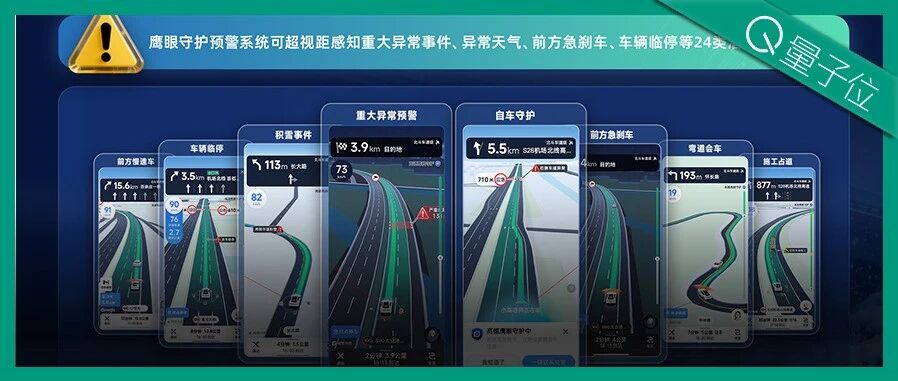
Core Viewpoint - The article discusses the increasing integration of AI in transportation safety, particularly through the "Eagle Eye" warning system developed by Gaode, which enhances driver awareness and reduces accident risks during the Spring Festival travel season [2][4][6]. Group 1: Spring Festival Travel - The Spring Festival travel volume is expected to reach a record high, with an estimated 9.5 billion trips over 40 days, and 80% of travelers opting for self-driving [1]. - The article highlights the unique aspects of this year's travel, emphasizing the role of AI in enhancing safety during journeys [1]. Group 2: AI's Role in Safety - The "Eagle Eye" system, developed in collaboration with the China Safety Production Science Research Institute, provides real-time risk awareness by detecting 24 types of potential hazards, including sudden braking and adverse weather conditions [4][6]. - The system has been upgraded to offer broader coverage and faster alerts, ensuring that it is accessible across various vehicles and road types [7]. Group 3: Technical Implementation - The core of the "Eagle Eye" system is the TrafficVLM model, which utilizes real-world traffic data to create a digital twin for training purposes [8][10]. - TrafficVLM enhances the system's ability to predict traffic conditions and provide timely warnings to drivers, thereby improving overall road safety [13][15]. Group 4: Performance Metrics - As of February 1, 2026, the "Eagle Eye" system has issued 11.2 billion warnings, averaging 88 million warnings per day, contributing to a 10% reduction in daily accident rates during peak travel times [16][18]. - The system's effectiveness is validated by real-world data, demonstrating its ability to help drivers avoid potential accidents [16][19].
“十一”假期支付数据出炉 出入境跨境消费猛增成最大亮点
Zhong Guo Jing Ying Bao· 2025-10-09 14:10
Group 1: Holiday Spending and Payment Trends - The 2025 National Day and Mid-Autumn Festival holiday saw a significant increase in payment transactions, with a total of 41.55 billion transactions processed, up by 9.52 billion from the previous year [1] - The total payment amount reached 13.26 trillion yuan, an increase of 1.86 trillion yuan compared to last year's holiday [1] - Cross-border payments emerged as a major highlight during the holiday, driven by outbound tourism and enhanced payment services for foreign visitors [1] Group 2: Inbound Tourism and Consumer Behavior - In the first five days of the National Day holiday, foreign tourists using Alipay saw a nearly 40% increase in spending compared to the same period last year, with a 500% increase in the "tap" payment method [2] - Popular spending categories for inbound tourists included dining, tourism, retail, and transportation, with retail payments increasing over 200% year-on-year [2] - The top cities for foreign tourists using mobile payments were Guangzhou, Shanghai, Shenzhen, and Beijing [2] Group 3: Outbound Tourism and Payment Usage - Outbound tourism also experienced a surge, with cross-border payment transactions increasing by 21% in the first five days of the holiday [3] - Countries benefiting from visa-free policies saw significant growth in payment transactions, with South Korea and Singapore experiencing increases of 46% and 32%, respectively [3] - The use of WeChat mini-programs for travel and dining abroad saw transaction growth of over 50% and 30%, respectively [3] Group 4: Payment Preferences and Emerging Markets - Alipay reported that one in two outbound tourists used its services, with Japan, South Korea, Malaysia, Thailand, and Singapore being the top destinations for spending [4] - Emerging markets such as Greece, Laos, Nepal, Portugal, and Turkey showed the fastest growth in spending by Chinese tourists [4] - The use of health consultation services and navigation apps also increased significantly among outbound travelers, indicating a trend towards utilizing digital tools for travel [5]
