鹰眼守护预警系统

Search documents
G40高速30秒3次预警避免二次事故
Xin Lang Cai Jing· 2026-02-26 13:34
Group 1 - The core viewpoint of the article highlights the effectiveness of the "Eagle Eye Guardian Warning System" in preventing secondary accidents during a multi-vehicle incident on the G40 highway by providing timely alerts to drivers [1] - The incident occurred on February 12, with the first warning about "abnormal parking 700 meters ahead" received at 3:37 AM, allowing a driver to reduce speed from approximately 110 km/h to 50 km/h [1] - The system identified the abnormal parking at 3:33:16, with 437 vehicles receiving the initial alert, followed by a "hard braking" warning at 3:33:55, which was sent to 79 vehicles within 17 minutes [1]
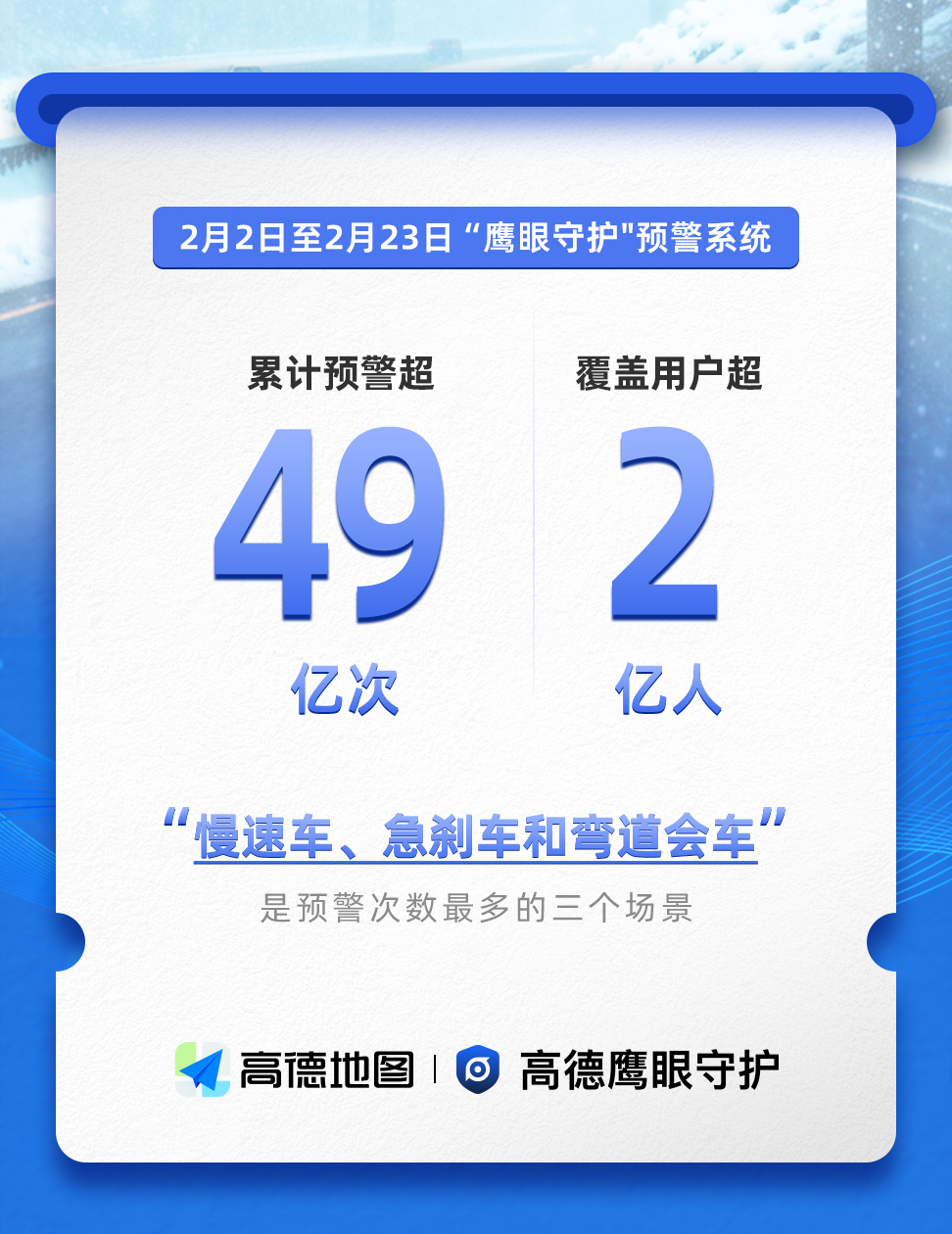
马年春运背后的“鹰眼守护”,49亿次安全预警,覆盖用户超2亿人
Jin Rong Jie· 2026-02-24 10:23
Core Insights - The "Eagle Eye Guardian" warning system has effectively managed high travel demand during the Spring Festival travel rush, issuing over 4.9 billion safety alerts and covering more than 200 million users from February 2 to February 23, 2026 [1][3] Group 1: System Performance - The "Eagle Eye Guardian" system can perceive 24 types of potential traffic risks and provides alerts in seconds, significantly aiding drivers in making timely safety decisions [3] - On February 22, the peak travel day, the system issued over 480 million alerts in a single day, demonstrating its capacity to handle high alert volumes [3] Group 2: Specific Alerts and Incidents - The top three causes of alerts during the Spring Festival were slow vehicles, sudden braking, and oncoming traffic in curves, with nearly 70 million alerts related to large trucks issued during the holiday [5] - A notable incident occurred on February 11, where the system issued its first alert 10 seconds before a multi-vehicle collision, helping drivers to reduce speed and maintain safe distances, thereby mitigating further risks [5] Group 3: Future Developments and Recommendations - The company plans to continue providing real-time risk alerts to drivers, encouraging safe driving practices and the use of navigation and voice prompts [6] - During the Spring Festival, the system utilized over 57 trillion satellite positioning calls, supporting a total navigation distance of over 62.7 billion kilometers [6]

自驾、赶飞机,春运出行看这里(信息服务台)
Ren Min Ri Bao· 2026-02-14 00:51
Core Viewpoint - The upcoming Spring Festival travel rush is expected to see a significant increase in passenger flow, with self-driving trips dominating the travel mode, accounting for approximately 80% of the total. The civil aviation passenger volume is projected to reach 95 million, surpassing historical records for both overall scale and daily peak [1]. Group 1: Self-Driving Travel - Self-driving remains the primary mode of travel, with 80% of travelers opting for this method [1] - New energy vehicle drivers can use the "e Road Smooth" app to check the status of charging stations in real-time, and should allow extra time for charging due to reduced efficiency in winter [2] - The upgraded "Eagle Eye Guardian" warning system provides real-time alerts for adverse weather and driving conditions, enhancing safety for self-driving travelers [3] Group 2: Car Rentals - Rental car orders are expected to surge during the Spring Festival, with companies optimizing pick-up and drop-off processes [4] - Shenzhou Car Rental offers free or low-cost options for returning cars in different locations, particularly in snow tourism hotspots [4] - Didi Car Rental provides free third-party damage assessment services to resolve disputes, while iRent continues to offer services like credit-free deposits and self-service returns [4] Group 3: Highway Travel - Small passenger cars will continue to enjoy free highway tolls during the Spring Festival, with the Ministry of Transport advising drivers to exit highways before the end of the free period to avoid full toll charges [5] Group 4: Air Travel - Passengers are advised to arrive at the airport 2-3 hours before their flight during the peak travel period to avoid missing flights [6] - Travelers can apply for temporary boarding passes through WeChat or Alipay if they forget their ID [7] - Specific guidelines for carrying and checking in seasonal goods, such as seafood and alcohol, are provided to ensure compliance with airline regulations [9][10] - Passengers should be cautious of scams involving fake calls about flight cancellations and verify information through official channels [11]

自驾、赶飞机,春运出行看这里
Bei Jing Ri Bao Ke Hu Duan· 2026-02-13 23:32
Core Viewpoint - The upcoming Spring Festival travel season is expected to see a peak in passenger flow, with self-driving trips remaining the primary mode of transportation, accounting for approximately 80% of total travel. The civil aviation passenger volume is projected to reach 95 million, surpassing historical records for both overall scale and single-day peak [1]. Self-Driving Travel - Charging and navigation tips include using the "e Road Smooth" app to check the status of charging stations in real-time, and being aware that charging efficiency may decrease in winter temperatures, necessitating more time for charging [2]. - Safety measures for self-driving include the upgraded "Eagle Eye Guardian" warning system, which provides real-time alerts for adverse weather conditions and critical driving scenarios, helping drivers to respond appropriately [3]. - Rental car services are enhancing their processes, with companies like Shenzhou Car Rental offering free or low-cost options for returning cars in different locations, and Didi Car Rental providing free third-party damage assessment services to avoid disputes [4]. Highway Travel - During the Spring Festival, small passenger cars will continue to enjoy free highway tolls, with the Ministry of Transport advising drivers to exit highways before the end of the free period to avoid full toll charges [5]. Air Travel - Passengers are advised to arrive at the airport 2-3 hours before their flight during the peak travel period to ensure timely check-in and customs clearance, especially for international flights [6]. - In case of forgetting identification, travelers can apply for a temporary boarding pass through WeChat or Alipay, or obtain a paper version at the airport police station [7]. - For carrying seasonal goods, it is recommended to properly package perishable items for checked baggage, while certain items like seafood are prohibited on international flights [9]. - Different airlines have varying policies for oversized luggage, such as ski equipment, and travelers should confirm these details in advance [10]. - Travelers are warned about potential scams involving impersonation of airline customer service representatives, and are advised to verify any flight changes through official channels [11].
“春运鹰眼”上线 织就公路智能安全网
Xin Lang Cai Jing· 2026-02-10 21:07
Core Viewpoint - The article discusses the launch of the "Eagle Eye Guardian" early warning system, aimed at ensuring traffic safety during the 2026 Spring Festival travel season, which is expected to see a record 9.5 billion trips, with self-driving travel accounting for about 80% of the total [1][4]. Group 1: System Features and Upgrades - The Eagle Eye Guardian system has been upgraded to include new features such as weather-related alerts for extreme conditions like ice and fog, and it now covers the entire road network and various travel scenarios [2][3]. - The system can provide dual-mode alerts through voice and map interfaces, even when users are in silent mode, ensuring timely communication of critical information [2][3]. - The system is capable of detecting abnormal events within 6 seconds and can automatically trigger the "Eagle Eye Alarm" to notify emergency response teams and nearby vehicles, significantly reducing the risk of secondary accidents [2][3]. Group 2: User Participation and Network - The Eagle Eye Guardian system is built on a network of over 1 billion users of the Gaode Map, creating a community-driven safety network where user participation enhances the accuracy and timeliness of alerts [3]. - Users who activate the Eagle Eye feature not only receive alerts but also contribute to the overall safety network, making the system more effective as more users join [3]. Group 3: Impact and Performance - Since its launch, the Eagle Eye Guardian system has issued a total of 11.2 billion alerts, averaging 88 million alerts per day, with over 147,000 alerts for multiple vehicle incidents [4]. - The system represents a shift in traffic management from reactive measures to proactive prevention, providing valuable data and intelligent tools for traffic governance [4]. - The collaboration between government and enterprises in developing and operating the system offers a replicable model for translating national research achievements into public safety benefits [4].
深度集成大模型能力 高德“鹰眼”护航春运路
Zheng Quan Ri Bao· 2026-02-09 16:18
Core Viewpoint - The 2026 Spring Festival travel season is expected to see a record 9.5 billion trips, with self-driving remaining the dominant mode of transport, accounting for about 80% of the total [1] Group 1: Safety Measures and Initiatives - The "Eagle Eye" safety alert system was launched in collaboration with Gaode to enhance road safety during the Spring Festival travel period [1] - The system integrates advanced model capabilities to provide precise, extensive, and rapid safety guarantees for large-scale highway travel [1][2] - The system has issued over 11.2 billion alerts since its launch, with an average of 88 million alerts per day [2] Group 2: System Upgrades and Features - The upgraded Eagle Eye system now includes minute-level alerts for adverse weather conditions and has optimized braking thresholds for trucks [3] - The system can detect accidents and trigger alerts within 6 seconds, creating a closed-loop for accident detection, alerting, and rescue [3] - The recall rates for major anomalies and sudden braking alerts have reached 95% and 85%, respectively, with response times reduced to under 5 seconds and 3 seconds [3] Group 3: Intelligent Warning Architecture - The Eagle Eye system employs a three-layer intelligent warning architecture to shift from passive response to proactive prevention [4] - The architecture includes a spatial-temporal location engine, a real-time traffic model, and a high-efficiency communication link to ensure rapid risk identification and user notification [4] Group 4: Risk Identification and User Coverage - The system identifies three high-frequency risks during the Spring Festival: slow-moving vehicles, sudden braking, and nighttime trucks [5] - The Eagle Eye system supports various travel modes, including navigation, cruise control, and ride-sharing, aiming to extend its alert capabilities to a broader user base [5] Group 5: Future Plans and Enhancements - Future plans include deep data mining to improve alert accuracy, recall rates, and timeliness, particularly for high-risk vehicle groups [6] - The Eagle Eye system is expected to play a more significant role in traffic safety, providing a reliable safety net for public travel [6]
春运首周“鹰眼守护”预警超11.4亿次,累计护航340亿公里导航里程
Huan Qiu Wang· 2026-02-09 13:20
Core Insights - The 2026 Spring Festival travel season began on February 2, with strong public intent for returning home and traveling during the extended nine-day holiday [1] - The "Eagle Eye" safety system, developed by the China Academy of Safety Science and Technology in collaboration with Gaode, has been upgraded to provide real-time alerts for various driving scenarios during the travel peak [1][4] Group 1: Travel Data and Trends - Gaode reported that during the first week of the Spring Festival travel period (February 2 to February 8), the platform utilized over 3.77 trillion satellite positioning calls, supporting a total navigation distance of over 34 billion kilometers, equivalent to approximately 850,000 laps around the Earth's equator [1] - The first peak day of travel (February 8) saw the "Eagle Eye" system issue over 2.2 billion safety alerts, with the most common alerts related to sudden braking, slow-moving vehicles, and trucks [1][4] - There has been a notable change in travel behavior, with a 12% year-on-year increase in navigation starts during the early morning hours of 4 AM to 6 AM, indicating a trend towards off-peak travel to avoid congestion [4] Group 2: Safety Measures and Technology - The "Eagle Eye" system has issued over 1.14 billion safety alerts in the first week of the Spring Festival, covering nearly 100 million travelers [1][4] - The system has been enhanced to include alerts for adverse weather conditions such as ice, fog, and specific road segments, allowing for real-time perception and efficient warnings across various driving scenarios [1][4] - The response time for the "Eagle Eye" alerts has been reduced to seconds, successfully preventing multiple traffic accident risks during the travel period [4] Group 3: Ride-Sharing Trends - Ride-sharing services are becoming a popular option for short-distance intercity travel during the Spring Festival, with the top ten routes concentrated within urban clusters [5] - User comments in ride-sharing orders reflect the festive spirit, with frequent mentions of traveling with elderly individuals, children, pets, and luggage, indicating a family-oriented travel approach [5]
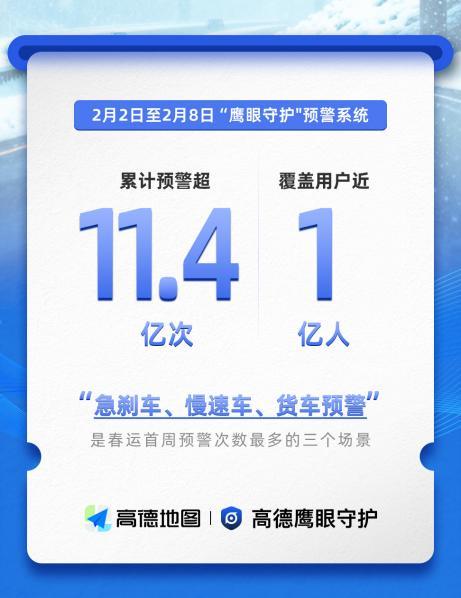
高德:春运首周“鹰眼守护”预警超11.4亿次,用户导航总里程超340亿公里
Feng Huang Wang· 2026-02-09 09:25
Core Insights - The article highlights the significant usage of the Beidou satellite positioning system during the Spring Festival travel peak, with over 3.77 trillion calls made to the system, supporting a total navigation distance of over 34 billion kilometers, equivalent to approximately 850,000 circumnavigations of the Earth [1] Group 1: Beidou Satellite System Usage - The Beidou satellite positioning system was called upon over 3.77 trillion times during the first week of the Spring Festival travel period [1] - The total navigation distance supported by the system exceeded 34 billion kilometers [1] Group 2: Safety and Warning Systems - The "Eagle Eye Guardian" warning system, upgraded in collaboration with the China Academy of Safety Science and Technology, issued over 1.14 billion safety alerts, covering nearly 100 million travelers nationwide [1] - On February 8, the first peak day of the Spring Festival travel, the system issued more than 220 million alerts in a single day [1] - The system demonstrated its effectiveness by enabling rapid police response to an accident within 5 minutes through the "Eagle Eye Alarm" feature [1] Group 3: Travel Behavior Trends - There was a 12% year-on-year increase in navigation starts during the early morning hours from 4 AM to 6 AM, indicating a clear trend towards staggered travel [1] - Ride-sharing services emerged as a supplementary option for short-distance intercity travel, with popular routes identified between city clusters such as Shenzhen-Dongguan and Foshan-Guangzhou [1] - Common requests in ride-sharing orders included "carrying luggage" and "bringing pets," reflecting changing consumer needs [1]

春运看发展 | 跨山越海 “流动的中国”活力四射
Yang Shi Wang· 2026-02-09 06:25
Core Viewpoint - The development of regional airports in China has significantly improved travel convenience, connecting remote areas and enhancing tourism opportunities, particularly during the Spring Festival travel season [1][6][11]. Group 1: Regional Airport Development - The number of regional airports has been increasing, with small airports now accounting for over 70% of the total number of airports in China [6]. - The newly opened Ruijin Airport has established three round-trip routes from major cities, providing significant travel convenience for returning passengers [2][4]. Group 2: Travel Trends and Statistics - The total number of air passengers in China has surpassed 500 million, making it the largest aviation population globally [7]. - During the Spring Festival, there has been a notable increase in passenger flow at regional airports, with some routes experiencing growth rates of up to 5 times [9]. - Self-driving remains the dominant mode of transportation during the Spring Festival, accounting for approximately 80% of travel [12]. Group 3: Impact on Tourism - The extensive network of domestic and international routes has facilitated travel experiences, allowing for a blend of family reunions and tourism during the holiday [7][9]. - The increase in long-distance routes has led to a surge in tourism, with specific routes seeing significant growth in popularity [9].
大数据透视春运“回家路” 科技护航让归途既有速度更有温度
Yang Shi Wang· 2026-02-09 04:44
Group 1 - The core point of the news is that the Spring Festival travel rush (Chunyun) in 2026 is expected to see a record high of 9.5 billion trips, with the first week alone projected to exceed 1.4 billion trips, averaging over 200 million trips per day, marking a 2% increase compared to the previous year [1][3]. - The Ministry of Transport anticipates that the peak passenger flow will occur around February 14, just before the Spring Festival [1]. - As of February 8, a total of 150 million train tickets have been sold for the Spring Festival travel period, with the railway expected to send 13.25 million passengers on that day alone [4][5]. Group 2 - The data indicates that self-driving will continue to dominate travel modes, accounting for approximately 80% of trips during this year's Spring Festival [5]. - High-tech support is evident, with over 31.9 trillion satellite positioning calls made in the first six days of the travel rush, covering a total navigation distance of 28.3 billion kilometers [7]. - The introduction of upgraded safety systems, such as the Eagle Eye warning system, aims to enhance road safety by providing real-time alerts for various traffic risks, thereby improving driver response times [11][12].