高通骁龙8775

Search documents
高通、地平线、黑芝麻激战舱驾一体,谁会胜出?
虎嗅APP· 2026-03-26 14:24
Core Viewpoint - The article discusses the emerging trend of "integrated cockpit and driving" (舱驾一体) in the automotive industry, highlighting the shift from traditional distributed architectures to centralized computing solutions that combine driving and cockpit functionalities, which is essential for the advancement towards L3 and L4 autonomous driving capabilities [2][45]. Group 1: Industry Trends - The integration of cockpit and driving functionalities is seen as a response to the increasing complexity and data demands of smart vehicles, with predictions indicating a compound annual growth rate of 36% for the integrated cockpit market in China from 2026 to 2030 [9]. - The upcoming 2026 Beijing International Auto Show is positioned as a critical battleground for showcasing advancements in integrated cockpit technologies, with major players like Qualcomm, Horizon Robotics, and Black Sesame Technology set to present their solutions [9][38]. Group 2: Chip Manufacturers - Qualcomm's Snapdragon 8775 is leading the market as the first integrated cockpit chip to achieve mass production, with partnerships established with multiple OEMs and Tier 1 suppliers [15][17]. - Horizon Robotics is leveraging its strengths in autonomous driving to extend into integrated cockpit solutions, with its Journey series chips already securing contracts with several automakers [18][20]. - Black Sesame Technology's Wudang series is designed from the ground up for integrated applications, with successful partnerships for mass production with major automotive manufacturers [21][23]. Group 3: Technical Advantages - Integrated cockpit chips promise to enhance computational efficiency by allowing dynamic resource allocation between driving and cockpit functions, potentially increasing overall utilization rates from below 30% to over 70% [30][33]. - The reduction in latency from milliseconds to microseconds is crucial for enabling L3 level human-machine collaboration, improving user experience significantly [33]. - A unified platform for software updates can accelerate over-the-air (OTA) updates, although regulatory requirements may complicate this process [30][34]. Group 4: Challenges and Risks - Safety isolation remains a significant technical challenge, as the complexity of cockpit software must be securely separated from driving functions to meet safety standards [34]. - The lengthy development cycle for integrated chips, which can exceed 18-24 months, poses a risk of misalignment with the rapid pace of vehicle model launches [36]. - The high costs associated with advanced chip manufacturing processes may deter manufacturers from adopting integrated solutions if vehicle sales do not meet expectations [36]. Group 5: Market Dynamics - The competition among chip manufacturers is intensifying, with each company adopting different strategies to capture market share in the integrated cockpit space [26][43]. - The upcoming auto show is expected to shift the focus from merely presenting solutions to demonstrating actual production capabilities, which will be critical for gaining consumer trust and market traction [46].




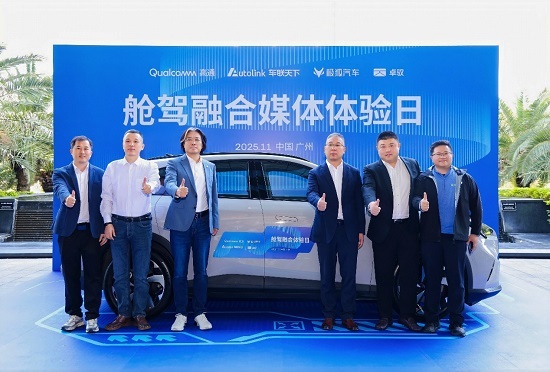
单芯片舱驾融合方案量产落地,车联天下展示全场景能力
Zhong Guo Jing Ji Wang· 2025-11-24 03:58
Core Insights - The event showcased the global first mass production of the AL-A1 cockpit and driving integration domain controller in the Extreme Fox T5, marking a significant milestone in the industry [1][3] - The AL-A1 controller, based on Qualcomm Snapdragon 8775, enhances data efficiency, computing power, and multimodal AI capabilities, aiming to improve user safety and trust in transportation [3][5] Group 1: Product and Technology - The AL-A1 cockpit and driving integration domain controller serves as the central computing platform for the vehicle, handling functions such as voice, video, navigation, and intelligent driving assistance [3][5] - The controller boasts an AI computing power of 144 TOPS and cross-domain collaborative processing capabilities, enabling a unified computing and control system for cockpit and driving assistance [5][7] - The Extreme Fox T5 is the first SUV in the 150,000 RMB price range to feature urban NOA (Navigation on Autopilot), demonstrating the transition of cockpit and driving integration technology from concept to mass production [5][7] Group 2: Industry Trends and Collaborations - Industry representatives discussed the trend of cockpit and driving integration as a necessary evolution in automotive electronic architecture, emphasizing the importance of technological innovation and cost reduction [7] - Qualcomm highlighted that cockpit integration will shift the industry from "function stacking" to "capability integration," paving the way for software-defined vehicles [7][8] - Since 2025, the company has focused on three product lines: intelligent cockpit domain controllers, cockpit and driving integration domain controllers, and regional controllers, establishing a complete technological path from single-domain control to central computing platforms [7][8]