
鳗鲡

Search documents
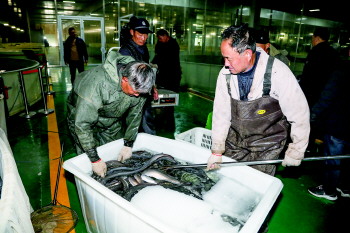
韩国食客点赞“弹牙”,秘诀来自微山
Xin Lang Cai Jing· 2026-01-13 16:42
Core Insights - The successful export of 10 tons of eel from the modern aquaculture industrial park in Weishan County to South Korea marks a significant market breakthrough for China's northernmost eel farming base, showcasing a new model for high-end aquatic product cultivation in northern regions [2][8] Group 1: Export Achievement - The 10 tons of eel were shipped from Weishan County to Korea, with a growth cycle of nearly two years, resulting in firmer and more elastic meat compared to the one-year growth cycle of southern eels [2][3] - In the South Korean market, the eels can fetch prices of 120,000 yuan per ton in bulk transactions and up to 150 yuan per jin in retail [2][3] Group 2: Unique Farming Techniques - The Weishan eel farming operation utilizes a "smart aquaculture" technology, which includes a circular water recycling system that maintains optimal water quality and promotes ecological balance [5][6] - The farming system allows for high-density cultivation, achieving a yield of 120 kg per cubic meter, significantly higher than traditional farming methods [6][7] Group 3: Market Demand and Support - The eels' superior quality has attracted South Korean customers, who are willing to pay an average of 20 yuan more per jin compared to domestic prices, enhancing economic benefits for the company [8] - The Jining Customs provided comprehensive support to help the company navigate export regulations and ensure compliance with South Korean market standards [8] Group 4: Infrastructure and Capacity - The industrial park spans 14,000 square meters for smart aquaculture and over 27,000 square meters for circular water farming, with an annual seedling capacity of 5 billion tails [9] - The facility has received multiple accolades, including being recognized as a national model for healthy aquaculture and a demonstration base for leisure fisheries [9]

践行大食物观的福建实践和经验启示(深学笃行阐释习近平经济思想)
Ren Min Ri Bao· 2025-11-30 22:20
Core Viewpoint - The article emphasizes the importance of food security in China, highlighting the "big food concept" proposed by Xi Jinping, which integrates various agricultural resources to ensure a stable food supply for the large population of over 1.4 billion people [1][3][10]. Background - Fujian province is characterized by limited arable land, with per capita farmland only one-fourth of the national average. In the 1980s, the region faced food shortages and a lack of diverse agricultural products, relying heavily on imports from other provinces [2]. Development of the Big Food Concept - Xi Jinping introduced the "big food concept" in 1988, advocating for comprehensive agricultural development. This concept has evolved under the leadership of the central government, emphasizing the need to utilize various resources, including land, sea, and forests, to enhance food production [3][4][10]. Achievements in Fujian - Over 30 years, Fujian has successfully implemented the big food concept, leading to significant increases in food production and diversity. For instance, meat production reached 3.14 million tons in 2024, a 2.5-fold increase since the early 1990s, with poultry meat production increasing 13 times [4][5]. - The province has also become a leading producer of aquatic products, with a per capita consumption of over 220 kg, the highest in the country. The cultivation of edible fungi has expanded significantly, with over 50 species cultivated commercially [4][5]. Key Practices and Results - Fujian has developed a diversified food supply system by integrating marine, forest, and facility agriculture. This includes the establishment of "marine granaries" to enhance seafood supply and "forest granaries" to tap into forest resources for food production [5][7][8]. - The province has also focused on facility agriculture, with over 2.4 million acres dedicated to modern agricultural practices, significantly boosting the supply of key agricultural products [8]. Quality and Safety Assurance - The province has implemented stringent measures to ensure food safety, including a comprehensive traceability system for agricultural products. The overall compliance rate for major agricultural product inspections has remained above 99% [9]. Lessons Learned - The experience in Fujian highlights the importance of a systematic approach to agricultural development, leveraging local resources to enhance food security. It underscores the need for technological innovation, market orientation, and sustainable practices to achieve a balance between ecological and economic benefits [10][11][12].
日本欧盟吵翻,殃及中国,就为了一条鱼?中国80%养殖户要慌了?
Sou Hu Cai Jing· 2025-08-18 13:30
Core Viewpoint - The conflict between Japan and the EU over eel trade highlights the tension between wildlife conservation and market demand, with Japan seeking to maintain its eel consumption while the EU pushes for stricter protections due to declining wild eel populations [1][10]. Group 1: EU Proposal and Its Implications - In June 2025, the EU plans to propose that all 18 species of eel be listed in Appendix II of the Washington Convention, which would impose strict trade limitations [2]. - Japan, as the largest consumer of eel, relies on imports for 70% of its eel consumption, primarily sourced from China, which produces 80% of the world's farmed eel [2][11]. - If the EU's proposal is approved, Japan's eel imports will significantly decrease, leading to skyrocketing prices and impacting consumer access to eel dishes [2][11]. Group 2: Eel Farming Challenges - Eel farming currently cannot achieve full artificial commercial breeding and heavily depends on wild-caught juvenile eels, leading to a vicious cycle of overfishing and declining wild populations [4]. - The wild eel population has drastically decreased due to overfishing and habitat degradation, with the European eel population shrinking by 90% since the 1990s [5]. - The demand for eels remains high, forcing farmers to increase their catch of wild juvenile eels, further exacerbating the decline [4][5]. Group 3: Conservation Efforts and Technological Challenges - Scientists are working on overcoming the challenges of artificial breeding, with some progress made in identifying breeding locations and techniques for artificial fertilization [7]. - However, high mortality rates and costs in artificially bred eel larvae remain significant obstacles, with commercial viability still a long way off [7]. - Both Japan and the EU recognize the importance of eel conservation, but their priorities differ, with the EU focusing on immediate protection and Japan on market needs [9][10]. Group 4: Impact on China and Global Eel Industry - China, as a major eel farming country, faces vulnerabilities in its industry, with previous policy changes leading to the bankruptcy of many farms reliant on European eel larvae [11]. - If the EU's proposal is enacted, China's eel farming and export scale could shrink dramatically, threatening the livelihoods of many farmers [11]. - Japan's potential success in commercializing artificial eel breeding could lead to lower prices and profit margins for Chinese farmers, highlighting the complex relationship between conservation and industry development [13].

厦门:水产种业充实“蓝色粮仓”
Ke Ji Ri Bao· 2025-06-14 05:51
Core Viewpoint - The artificial breeding research of eel has been revitalized in 2023, breaking seasonal limitations and achieving preliminary results in breeding under controlled temperature conditions, supported by the Xiamen Aquaculture Seed Industry Incubation Base [1][2]. Group 1: Eel Breeding Research - The artificial breeding of eel is a global challenge, with China accounting for over 80% of the world's eel farming output, making independent supply of eel seedlings crucial for industry development [1][2]. - The research team at Jimei University has established a year-round breeding system for Japanese and American eels, successfully breeding over 100,000 fry, laying a solid foundation for high-quality artificial breeding [2][3]. Group 2: Aquaculture Seed Industry Incubation Base - The Xiamen Aquaculture Seed Industry Incubation Base integrates various research teams from Xiamen University, Jimei University, and Fujian Provincial Aquatic Research Institute to focus on breeding and propagation of multiple aquatic species [2][4]. - The base has improved infrastructure for seawater extraction, purification, and wastewater treatment, creating a platform for innovation and application that attracts research institutions and aquaculture enterprises [4]. Group 3: Economic Impact and Innovations - The introduction of new species such as "Fuhai No. 1" abalone and "Fukui No. 1" oyster has led to significant economic benefits, generating hundreds of millions in annual revenue and enhancing China's independent innovation capabilities in aquaculture [3].
福建福州持续擦亮特色渔业品牌
Zhong Guo Chan Ye Jing Ji Xin Xi Wang· 2025-04-26 22:21
Core Viewpoint - Fuzhou is accelerating the construction of the "Offshore Granary" to enhance its marine economy and promote local seafood brands such as abalone, kelp, and eel [1][2] Group 1: Development Initiatives - Fuzhou is leveraging the opportunity to build a national marine economy development demonstration zone, focusing on deep-sea aquaculture and establishing a "1+6+4" marine innovation system [1] - The city plans to implement a revitalization action for aquatic seed industry, innovating and cultivating new aquaculture species suitable for local conditions [1] - Fuzhou aims to develop deep-sea aquaculture by constructing deep-sea farming sites and supporting the establishment of more deep-sea aquaculture platforms [1] Group 2: Industry Collaboration and Branding - The city is focusing on industrial synergy and implementing an industrial integration project, emphasizing the processing of abalone, kelp, and fish paste to strengthen local specialties like fish balls and Buddha Jumps Over the Wall [2] - Fuzhou is working on brand enhancement initiatives to promote local seafood brands and plans to establish a "Fuzhou Fish" brand promotion base [2] - The city is enhancing marine technology innovation capabilities and promoting the application of new technologies and products in the marine sector [2] Group 3: Financial and Regulatory Support - Fuzhou is deepening the reform of aquaculture rights and encouraging banks to collaborate with grassroots organizations to develop financial products that benefit fishermen [2] - The city is exploring socialized services for fishing vessel inspections through government procurement, aiming to separate inspection and management functions [2]