30年期日债

Search documents
高市早苗财政政策成日元“拖油瓶” 日本央行或被迫于4月提前加息
智通财经网· 2026-01-13 07:06
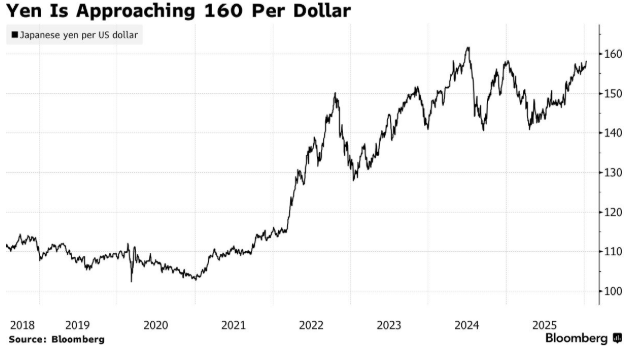
Core Viewpoint - The Japanese yen is weakening due to market concerns over Prime Minister Kishida's "dangerous" fiscal policy, leading to speculation that the Bank of Japan may raise interest rates as early as April [1][4]. Group 1: Interest Rate Expectations - Former Bank of Japan committee member Makoto Sakurai suggests that the central bank must raise rates at least once before June or July, with a possibility of an earlier increase in April [1]. - Market expectations indicate a 40% probability of a rate hike in April, which would be earlier than the consensus [4]. Group 2: Yen Depreciation and Fiscal Policy - The yen has depreciated significantly, reaching a one-year low of 158.50 against the dollar, influenced by reports of Kishida's plans for early elections [1]. - Concerns over Kishida's fiscal stance are expected to keep the yen weak, impacting the central bank's rate decisions due to rising import costs exacerbating inflation [4]. Group 3: Fiscal Measures and Market Reaction - Kishida has announced the largest supplementary budget since the pandemic and the largest initial budget for the next fiscal year, aiming for an active yet responsible fiscal policy [5]. - Despite rising tax revenues due to inflation, Sakurai criticizes Kishida's approach of committing to spending without securing funding sources, labeling it as a loose and dangerous practice [5]. - The yield on 30-year Japanese government bonds reached a historic high of 3.52%, reflecting market skepticism about the government's long-term fiscal position [5].

日本央行行长频频透露加息倾向 日债收益率连攀新高
Xin Lang Cai Jing· 2026-01-05 10:27
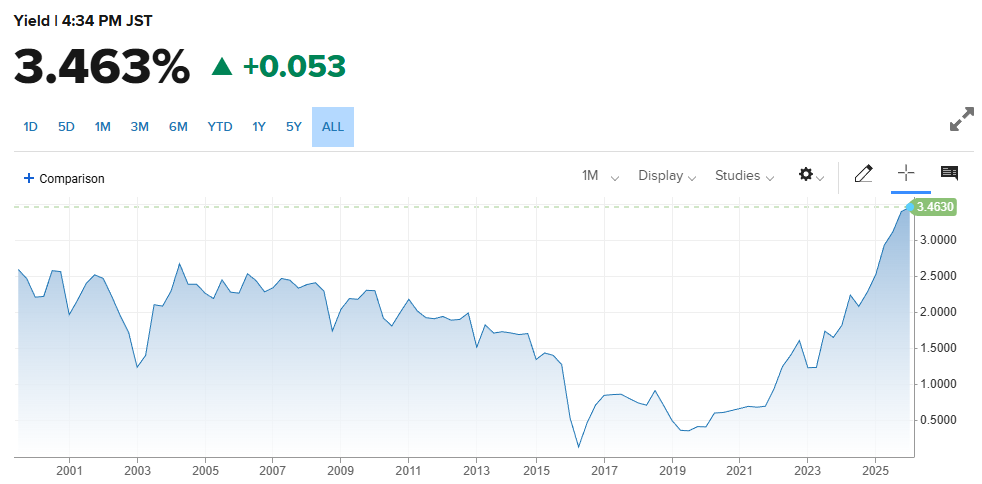
Group 1 - The Bank of Japan, led by Governor Kazuo Ueda, has indicated a renewed intention to raise interest rates, increasing pressure on Japanese government bonds, with yields reaching their highest levels since 1999 [1] - Ueda emphasized that timely adjustments to monetary easing policies are necessary to achieve stable inflation targets and promote long-term economic growth [1] - The recent increase of 25 basis points to a benchmark rate of 0.75% marks the end of nearly three decades of ultra-low interest rates in Japan, reflecting reduced risks to inflation and growth [1] Group 2 - The Japanese bond market reacted sharply, with the 10-year bond yield rising over 5 basis points to 2.125%, a new high since 1999, and the 30-year yield increasing nearly 6 basis points to a historical peak [2] - The yield on the 10-year bond has surged by 25 basis points in the past month and nearly 100 basis points over the past year, driven by rising interest rate expectations and a record-high government budget proposal [2] - Both the Bank of Japan and the government have expressed concern over bond yield volatility, with Ueda stating that significant fluctuations in long-term rates could lead to increased government bond purchases [2]
投资者押注日本央行加息,日债收益率触及17年高位
Xin Hua Cai Jing· 2025-09-23 00:10

Group 1 - Investors are betting that the Bank of Japan will soon choose to raise interest rates, leading to a significant increase in bond yields, with the 10-year Japanese government bond yield reaching its highest level in 17 years [1] - On the same day, the 10-year bond yield rose by 1.5 basis points to 1.654%, while the 2-year and 30-year yields also saw increases [1] - The 10-year bond yield briefly hit 1.669%, marking a new 52-week high and the highest level since July 2008, as investors reacted to the recent Bank of Japan meeting [3] Group 2 - The Bank of Japan indicated that the economy is moderately recovering, despite some signs of weakness, and noted a mild growth in the global economy [3] - Consumer inflation in Japan rose in August compared to the previous year, with the consumer price index excluding fresh food increasing by 2.7%, although this was a decrease of 0.4 percentage points from the previous month [3] - Food prices in Japan continue to surge, with an 8% year-on-year increase, and the average price of rice has approached historical highs [3] Group 3 - The Japanese Ministry of Finance announced plans to issue a 2-year bond worth 2.7 trillion yen on September 30 [4]