
316L不锈钢

Search documents
洞悉不锈钢板批发市场:选材、标准与趋势解读
Sou Hu Cai Jing· 2025-12-23 03:11
Group 1 - The stainless steel plate market is crucial for ensuring project quality and controlling procurement costs, emphasizing the need for precise industry information and product characteristics [2] - Stainless steel is defined by its corrosion resistance, attributed to the addition of alloying elements like chromium and nickel, leading to various types such as austenitic, ferritic, martensitic, and duplex stainless steels [3] - Common types in the wholesale market include 304 and 316L austenitic stainless steels, known for their excellent corrosion resistance and versatility in applications [3][4] Group 2 - Quality of stainless steel plates directly impacts the performance and lifespan of final products, making adherence to industry standards essential [5] - China follows national standards like GB/T 24511, which specify chemical composition, mechanical properties, dimensional tolerances, surface quality, and inspection methods for stainless steel plates [5] - Key considerations when purchasing include verifying chemical composition, mechanical properties, surface quality, and dimensional accuracy to ensure compliance with standards [5] Group 3 - The current stainless steel plate wholesale market is characterized by diversification and specialization, with increasing competition and fluctuating prices influenced by macroeconomic factors and raw material costs [7] - Future trends in the stainless steel industry will focus on technological innovation and green development, with new high-strength and corrosion-resistant materials emerging to meet demands in advanced sectors [7] - Companies like Shenghongxin An are committed to integrating quality steel resources and providing a full range of products, including customized services for various industries [7][8]

成都不锈钢制品加工厂的选择要点与行业趋势
Sou Hu Cai Jing· 2025-11-21 06:18
Core Insights - The stainless steel processing industry in Chengdu is experiencing unprecedented growth opportunities due to manufacturing upgrades and increasing consumer demand for high-quality stainless steel products [2] - Understanding industry standards and key purchasing points is crucial for selecting reliable processing service providers [2] Industry Trends - The industry is moving towards intelligent and refined development, with the concept of digital factories becoming more prevalent [7] - New processing technologies such as water jet cutting and three-dimensional laser cutting are expanding, allowing for more complex structures [7] - Environmental requirements are driving innovation in processing technologies, with traditional chemical polishing being replaced by mechanical and electrolytic polishing [7] Material Characteristics and Processing Techniques - Common stainless steel materials include 304 and 316L, each with specific chemical compositions and physical properties [3] - 304 stainless steel has 18% chromium and 8% nickel, offering good corrosion resistance and formability, while 316L has enhanced corrosion resistance due to the addition of molybdenum [3] - Processing techniques include cutting, forming, welding, and surface treatment, with laser cutting technology achieving precision of ±0.1 mm [3][4] Quality Standards and Requirements - The stainless steel processing industry adheres to strict quality standards, including national standards GB/T 20878-2007 and GB/T 3280-2015 [5] - Quality inspection is critical, with professional processing plants implementing comprehensive quality control systems throughout the production process [5][9] Selection Considerations for Processing Plants - Key factors for selecting a stainless steel processing plant include processing capacity, quality assurance systems, and service capabilities [6] - Larger processing plants in Chengdu are typically equipped with advanced machinery, enabling them to handle a range of processing tasks [6] - The demand for high-precision and specialized stainless steel processing is increasing, particularly in high-end equipment manufacturing, medical devices, and the food industry [6] Core Value of Professional Service Providers - Companies like Shenghongxin An integrate resources from well-known steel manufacturers, ensuring controllable raw material quality [8] - Advanced equipment and technical service capabilities are essential for meeting diverse industry requirements [8] - A stable supply chain is crucial for timely delivery and consistent quality [8] Quality Assurance Systems - A robust quality assurance system is fundamental for ensuring processing quality, with strict checks from raw material intake to finished product delivery [9][10] - Modern processing plants should be equipped with advanced testing equipment to accurately assess material properties and dimensions [10] After-Sales Service and Technical Support - A comprehensive after-sales service system is a hallmark of professional processing plants, providing guidance and addressing quality issues post-delivery [11] - Technical support, including process optimization and maintenance guidance, enhances customer experience [11] Industry Development Outlook and Recommendations - The stainless steel processing industry in Chengdu is poised for further growth, particularly in high-end equipment manufacturing, new energy, and biomedicine [12] - Companies are advised to consider technical strength, quality assurance capabilities, and service levels when selecting processing service providers [12] - Establishing long-term partnerships with qualified and experienced service providers can optimize supply chain efficiency and enhance product quality [12]
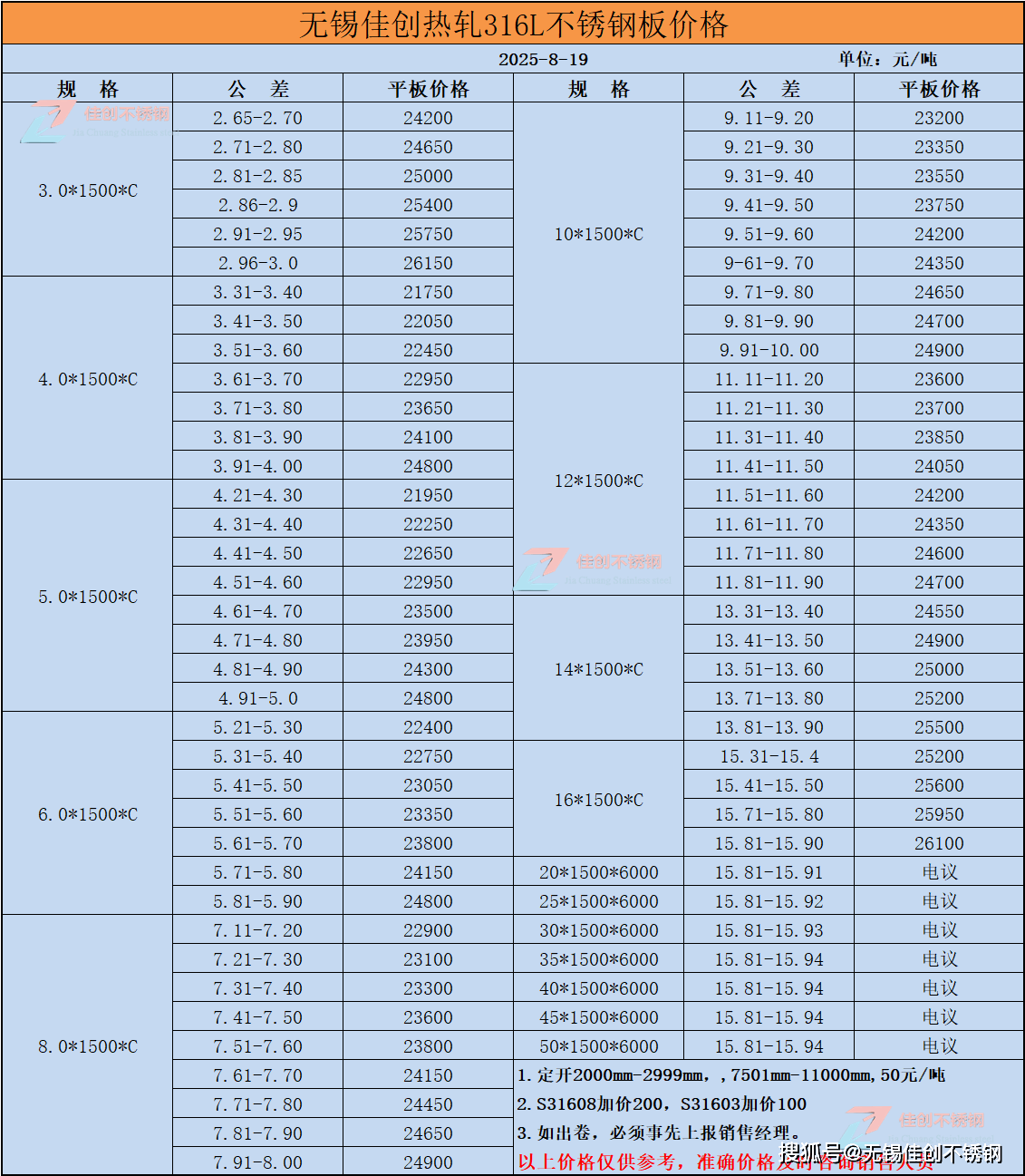
无锡316L不锈钢价格表【2025年8月19日佳创不锈钢最新报价】
Sou Hu Cai Jing· 2025-08-19 08:16
Core Insights - The price of 316L stainless steel hot-rolled futures for September has surged to 24,600 yuan/ton, marking an increase of 300 yuan/ton from the last opening price [1] - Rising raw material costs, particularly for molybdenum iron, are contributing to the upward trend in stainless steel prices, with cold-rolled 316L stainless steel currently quoted between 25,600 and 25,700 yuan/ton [1] - Factors such as steel mill shutdowns for maintenance, increasing raw material prices, and reduced procurement demand are influencing stainless steel prices, leading to a market primarily driven by essential needs with minimal stockpiling observed [1] Price Summary - The mainstream price for cold-rolled 316L stainless steel is currently between 25,600 and 25,700 yuan/ton, while hot-rolled 316L stainless steel is expected to approach around 25,000 yuan/ton [1] - A detailed price list for hot-rolled 316L stainless steel plates shows various specifications with prices ranging from 21,750 to 26,100 yuan/ton as of August 19, 2025 [2]
钼行业出现罕见的上下游“对抗”
Zheng Quan Ri Bao· 2025-08-16 01:50
Core Insights - Molybdenum prices have reached a new high, with ferromolybdenum prices rising to approximately 280,000 yuan per ton, marking a significant increase in the market [1][2] - The increase in molybdenum prices is attributed to a combination of tight supply from upstream sources and increased demand from downstream industries, leading to a notable rise in transaction volumes [2][4] - Major steel companies in China have issued a joint statement to halt ferromolybdenum purchases to stabilize the industry and resist speculative pricing [3] Price Trends - Since April, molybdenum prices have increased significantly, with molybdenum concentrate prices rising over 1,000 yuan per ton, reflecting a more than 35% increase [2] - The price of molybdenum concentrate reached 4,380 yuan per ton, while the main price for ferromolybdenum also surged to 280,000 yuan per ton [1][2] Supply and Demand Dynamics - The supply of molybdenum concentrate has been constrained due to production issues at some mines, leading to a decrease in output in August [2][5] - Molybdenum inventories are at their lowest levels in nearly three years, with downstream demand expected to grow, projecting a near 7% increase in molybdenum demand by 2025 [2][3] Industry Response - The joint statement from major steel companies emphasizes the need for industry self-discipline and cooperation to stabilize prices and ensure sustainable development across the molybdenum supply chain [3] - Despite the temporary halt in ferromolybdenum purchases by steel companies, the overall demand for ferromolybdenum remains strong, with significant bidding activity observed in August [4][5] Future Outlook - Analysts predict that the tight supply situation for molybdenum concentrate is unlikely to change in the short term, maintaining high cost levels for ferromolybdenum [4][5] - The upcoming traditional peak demand season in September and October is expected to further support molybdenum prices, driven by government infrastructure investments and policy support [4][5]
钼精矿、钼铁价格持续上涨 钼行业出现罕见的上下游“对抗”
Zheng Quan Ri Bao· 2025-08-15 16:41
Core Insights - Molybdenum prices have reached a new high, with ferromolybdenum prices rising to approximately 280,000 yuan per ton, marking a significant increase in demand and activity in the market [1][4] - The price of molybdenum concentrate has also surged, reaching 4,380 yuan per ton, driven by a combination of supply constraints and increased downstream demand [1][2] - The recent price increases are attributed to a tight supply situation and a recovery in demand, with expectations for continued growth in molybdenum demand through 2025 [2][5] Group 1: Price Trends - Molybdenum prices have been on an upward trend since April, with molybdenum concentrate prices increasing by over 1,000 yuan per ton, representing a rise of more than 35% [2] - The current price levels are the highest seen in the year, with significant activity in the market as major steel mills begin to bid for molybdenum [1][4] - The price increase is expected to benefit upstream molybdenum mining companies, while downstream companies may face increased operational pressures due to rising costs [2][3] Group 2: Supply and Demand Dynamics - The supply of molybdenum concentrate is at a near three-year low, with global molybdenum mine growth at only 1.2%, contributing to the price surge [2][5] - Domestic steel mills have reported a 10.47% increase in molybdenum bidding volume compared to the previous year, indicating strong demand [3] - Despite a recent joint statement from major steel companies to halt ferromolybdenum purchases, the overall market demand remains robust, with expectations for increased bidding activity in August [4][5] Group 3: Industry Responses - Major steel companies have called for a halt to speculative trading in the molybdenum market to stabilize prices and ensure they reflect true supply and demand [3] - The industry is focusing on maintaining a healthy supply chain for molybdenum, which is essential for high-end stainless steel production [3] - Analysts predict that the combination of government policies and increased infrastructure investment will support molybdenum demand in the coming months [4]
三大钢企联合暂停钼铁采购 剑指市场非理性炒作
Zhong Guo Jing Ying Bao· 2025-08-07 01:33
Core Viewpoint - The joint statement from major steel companies highlights the irrational price surge of molybdenum iron, leading to a suspension of its procurement to protect the supply chain of high-end manufacturing equipment [1][2][7]. Group 1: Market Dynamics - Molybdenum iron prices have significantly increased, with a rise from 238,000 RMB/ton to 272,000 RMB/ton in July, marking a 14.3% increase [2][3]. - The price surge is attributed to a supply-demand imbalance, exacerbated by a mining accident that affected a key producer, leading to heightened concerns over supply shortages [3][4]. - The demand for molybdenum iron is driven by the growth in high-end manufacturing and energy sectors, with expectations of continued price strength due to limited supply and increasing demand [4][5]. Group 2: Industry Response - The three steel companies called for a return to fundamental pricing, urging the industry to resist speculative trading and ensure prices reflect true supply and demand [7][8]. - They emphasized the importance of industry self-discipline and cooperation to stabilize prices of key raw materials like molybdenum iron and molybdenum concentrate [7]. - The companies committed to participating in industry dialogue and supporting the national initiative against excessive competition to ensure stable supply and reasonable pricing of molybdenum iron [7][8].

