5纳米工艺芯片

Search documents
台积电美国扩张遇冷?毛利率62%跌至8%,折旧黑洞成利润杀手
Sou Hu Cai Jing· 2026-01-06 12:12
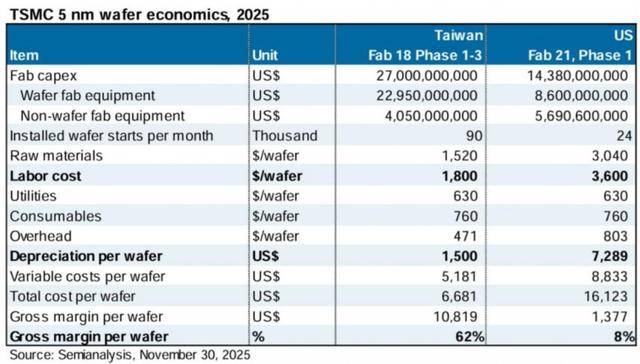
Core Viewpoint - TSMC's U.S. factory is projected to achieve profitability in the second half of 2025, but recent data reveals significant cost disparities compared to its Taiwan operations, raising concerns about the sustainability of this investment [2][4]. Cost Analysis - TSMC's Fab 18 in Taiwan has a capital expenditure of $27 billion, while Fab 21 in the U.S. has a capital expenditure of $14.38 billion [3]. - The total cost per wafer in Taiwan is $6,681, yielding a gross margin of 62%, whereas in the U.S., the total cost per wafer is $16,123, resulting in a gross margin of only 8% [3][24]. - Depreciation costs per wafer are significantly higher in the U.S. at $10,200 compared to $2,100 in Taiwan, primarily due to lower capacity utilization in the U.S. factory [6][24]. Labor Costs - Labor costs per wafer in the U.S. are $3,600, double that of Taiwan's $1,800, exacerbated by cultural differences affecting operational efficiency [8][10]. - U.S. labor regulations limit overtime, impacting productivity, with U.S. factories experiencing an average of 40 minutes more downtime per day compared to Taiwan [10][12]. Strategic Decisions - TSMC's decision to build in the U.S. is influenced by a $52 billion government subsidy, which comes with conditions that restrict expansion in other countries and mandate R&D spending in the U.S. [14][24]. - Major clients like Apple and Nvidia are pushing for supply chain diversification, with Apple already committing to using U.S.-produced wafers despite higher costs [16][18]. Long-term Outlook - TSMC's U.S. expansion is viewed as a strategic gamble, with potential long-term benefits as the global semiconductor industry undergoes significant geopolitical restructuring [20][24]. - By 2027, TSMC aims to increase local supply chain integration to 60%, and analysts predict that overall gross margins could exceed 60% by 2026, although U.S. operations may drag margins down by 2% to 3% [22][24]. - The shift towards regional supply chains is seen as a necessary evolution in the semiconductor industry, balancing efficiency with resilience [24][26].


台积电3nm和5nm产能被客户抢光
半导体行业观察· 2025-09-28 01:05
Core Viewpoint - TSMC's production lines are nearing full capacity due to unprecedented demand for its 3nm and 5nm processes, driven primarily by mobile and HPC customers amid the AI boom [2][3]. Group 1: Demand and Market Dynamics - TSMC is experiencing strong demand across all its processes, particularly from major clients like NVIDIA, AMD, and Apple, who are integrating TSMC's chips into their consumer products [3]. - The 3nm and 5nm production lines are expected to be fully booked by next year, with a significant portion allocated to mobile and HPC clients [3][4]. - The tight supply of wafers has made it increasingly difficult for tech giants to secure chips, indicating a shift in the semiconductor market where chips are viewed as a scarce resource [4]. Group 2: Future Projections and Investments - TSMC may be compelled to raise process prices to manage demand and expand its production lines, with plans for the N3 process to commence in Arizona, requiring substantial investment [4]. - The demand for the 5nm node is also robust, with reports suggesting that companies like Apple have pre-booked a significant portion of capacity well ahead of the 2nm process launch [4]. Group 3: Industry Implications - The semiconductor industry is heavily reliant on TSMC, making it one of the most critical assets for companies worldwide, which has prompted the U.S. government to seek diversification of production away from Taiwan [4].