
AI智能笔

Search documents
AI时代怎么做硬件出海,沈劲谈中国公司:该轮到我们定义品类了
创业邦· 2026-02-15 10:57
Core Viewpoint - The article discusses the evolution of Chinese consumer electronics from a phase of following global leaders to a phase of leading and defining new product categories, particularly in the context of AI and emerging technologies [5][14][36]. Group 1: Transition Phases in Chinese Consumer Electronics - The evolution of Chinese consumer electronics can be categorized into three phases: following, catching up, and leading. The "following" phase involved benchmarking against leaders and offering high cost-performance products, while the "catching up" phase focused on single-point innovations and high-end breakthroughs [10][12]. - The leading phase is characterized by a reconstruction of product paradigms and the discovery of new usage scenarios, with the expectation that 2025 will mark the year when China leads in smart cleaning technology [14][19]. Group 2: New Product Categories and Innovations - The article highlights the emergence of two new product categories: Ambient AI terminals and personal AI supercomputing centers. Ambient AI terminals focus on passive interaction and context establishment, while personal AI supercomputing centers emphasize offline intelligence and privacy protection [21][25]. - OpenAI's upcoming AI hardware is expected to fill specific gaps rather than replace smartphones, aligning with the identified market needs [25]. Group 3: Factors for Successful Category Definition - The ability to define product categories is broken down into five dimensions: trend recognition, scene selection, technology integration, experience closure, and scalability. Chinese companies have made significant progress in these areas, particularly in understanding overseas markets [27][29]. - The article emphasizes the importance of deeply understanding the lifestyles and values of different generations, such as Gen Z and Alpha, to successfully define and market new products [29][32]. Group 4: Historical Context and Future Outlook - The historical context of Chinese companies' evolution in consumer electronics is discussed, noting that past successes were often built on following established leaders. The current environment presents a "definer's dividend," where Chinese companies are positioned to lead in new categories [35][36]. - The article concludes with a call for entrepreneurs to strive for category definition, suggesting that the process of naming and defining new products is collaborative and iterative [42][43].


OpenAI与艾维合作研发AI智能笔,富士康或代工
Xin Lang Ke Ji· 2025-12-31 03:32
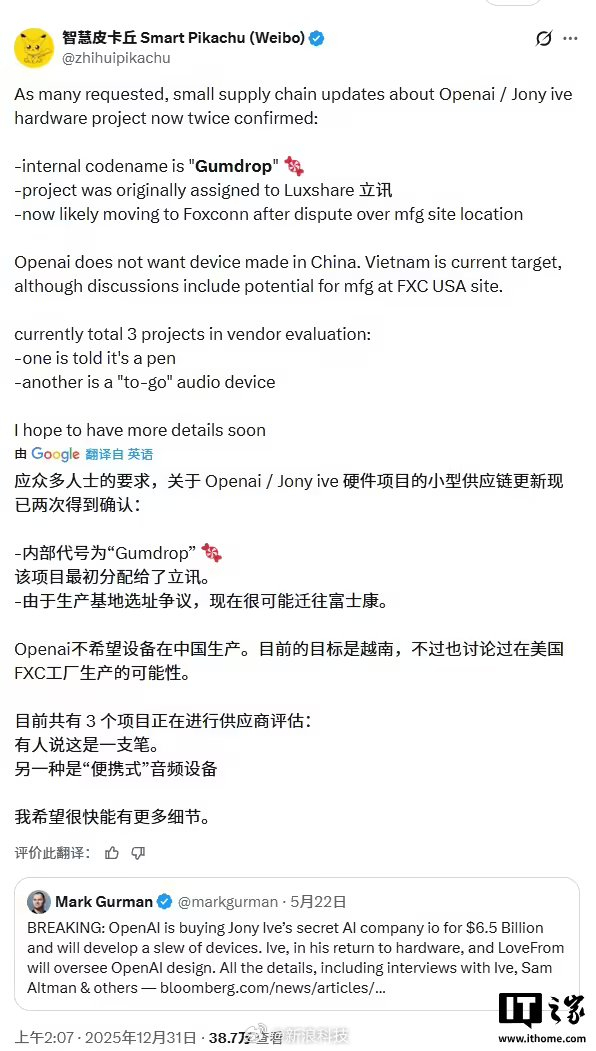
Core Insights - OpenAI is reportedly developing a device that integrates artificial intelligence, potentially in the form of a smart pen or portable audio device [1][2][3] - The internal codename for the project is "Gumdrop," which was initially assigned to Luxshare but is now likely moving to Foxconn due to disputes over manufacturing site location [2][3] - OpenAI prefers not to manufacture the device in China, with Vietnam currently being the target location, although discussions about potential manufacturing in the USA are ongoing [2][3] Group 1 - The device is expected to have capabilities for handwriting transcription and possibly audio interaction with the ChatGPT platform [1] - There are currently three projects under vendor evaluation, including a pen and a "to-go" audio device [2][3] - The collaboration involves Jony Ive, who is overseeing the design aspects of the project [2]
浙江笔类出口龙头企业跨界入局AI产品
Jing Ji Wang· 2025-12-30 10:22
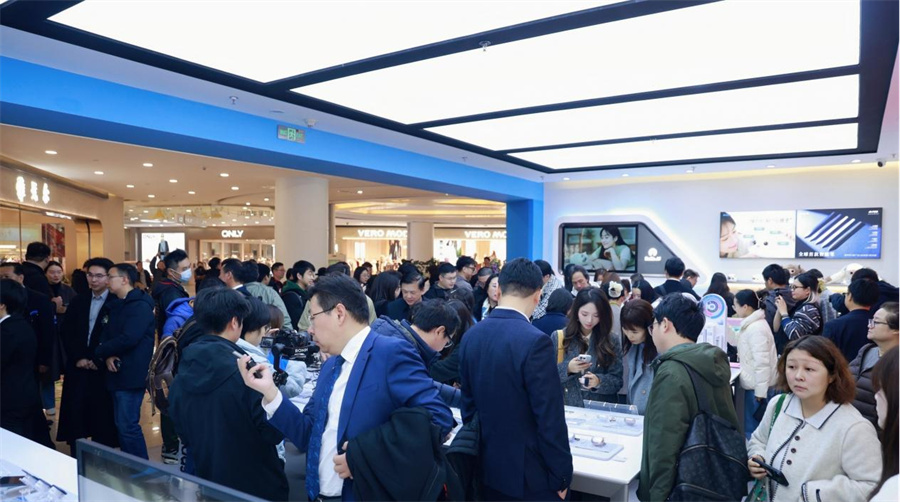
Group 1 - The core viewpoint of the article is that traditional manufacturing companies are increasingly transitioning to AI, exemplified by Beifa Group's launch of its first AI-focused retail store, "Beifa AI creative," in Ningbo, marking a strategic shift towards embracing the AI era [1][2] - Beifa Group is the largest exporter of stationery in China and is now venturing into the AI sector, generating significant consumer curiosity [2][4] - The "Beifa AI creative" store features a range of smart products, including AI smart pens, translation glasses, and health-related devices, aiming to provide an immersive smart experience [4][10] Group 2 - Beifa Group plans to expand its AI product offerings from stationery to smart devices, indicating a significant transformation in its business model [5][7] - The company aims to build a connected ecosystem around AI, focusing on practical applications rather than original innovations, leveraging existing AI models for application development [7][10] - The launch of the store and the accompanying AI cultural innovation forum highlight the company's commitment to integrating AI with the cultural and creative industries, showcasing a new path for traditional manufacturing in the digital age [8][10]
新粤商|小算力,大模型,云蝶科技如何率先跑出“盈利大模型”?
2 1 Shi Ji Jing Ji Bao Dao· 2025-05-14 11:16
Core Viewpoint - Guangzhou Yundie Technology Co., Ltd. has developed the "Xingzhi Large Model," which has been successfully applied in education, healthcare, and government sectors, achieving profitability and demonstrating the commercial value of AI applications [1][2][6]. Group 1: Company Overview - Yundie Technology focuses on vertical large model applications, emphasizing a "small but specialized" development approach, which has led to significant achievements in the AI sector [1][2]. - The company has developed AI hardware products, such as an AI smart pen and an AI smart mouse, which utilize the Xingzhi Large Model for real-time data collection and analysis [1][3][4]. - The Xingzhi Large Model can be trained in as little as 15 days at a cost significantly lower than that of general large models, making it accessible for various industries [4][5]. Group 2: Industry Context - The Haizhu District of Guangzhou is actively developing an AI large model application demonstration zone, with over 120 industry-specific large models implemented and more than 7,000 AI companies gathered [2][6]. - The district aims to leverage its rich industrial base and diverse application scenarios to establish itself as a "vertical model capital" in the AI landscape [6][7]. - The local government has introduced a plan to promote the application of AI large models across multiple industries, targeting over 5 billion yuan in revenue by 2026 [7][8]. Group 3: Future Prospects - Yundie Technology plans to continue investing in education, healthcare, and other public sectors, particularly in supporting balanced development in the Guangdong-Hong Kong-Macao Greater Bay Area [5][8]. - The company aims to enhance its technological innovation capabilities and deepen collaborations with industry giants to integrate the Xingzhi Large Model into broader industrial systems [8].