AI程序员

Search documents
ToB商业大变局,谁是新王?
3 6 Ke· 2026-01-26 06:05
Core Insights - The growth logic of China's enterprise services has relied on two main advantages: low-cost engineering talent and affordable sales and implementation teams. However, these advantages are rapidly diminishing due to demographic changes and rising wage levels [1][10] - The traditional To B business model is facing structural failure, necessitating a fundamental change in production relationships to sustain growth [1][10] - The evolution of enterprise services can be segmented into three eras: 1.0, 2.0, and the emerging 3.0, with each representing a shift in business models and operational strategies [1][2] Group 1: Era 1.0 - Control-Centric Approach - In the 1.0 era, companies like Yonyou and Glodon dominated the market by focusing on control over finances, inventory, and personnel, using a military-like organizational structure to capture market share [3][5] - Yonyou leveraged the widespread adoption of computerized accounting to establish a comprehensive distribution system, effectively creating a "ground army" for market penetration [5][6] - Glodon achieved deep market penetration in the construction sector by tying its software to national pricing standards, thus gaining significant pricing power and market dominance [6][7] Group 2: Era 2.0 - SaaS Aspirations and Challenges - The 2.0 era saw a shift towards SaaS models, with companies like Fenshangxiaoke and Beisen attempting to replicate successful Western models by leveraging capital and internet strategies [11][12] - Fenshangxiaoke's aggressive customer acquisition strategy faced challenges due to the rational decision-making of enterprise owners, leading to high customer churn rates [13][16] - Beisen adopted an integrated approach by offering a comprehensive suite of HR solutions, which successfully built a competitive moat but also significantly increased operational costs [14][15] Group 3: Era 3.0 - AI-Driven Transformation - The 3.0 era is characterized by companies like HeyGen and Manus, which utilize AI to redefine labor delivery models, moving away from traditional human resource dependencies [2][19] - HeyGen exemplifies extreme efficiency, achieving over $35 million in ARR with a small team, demonstrating that AI can replace traditional labor-intensive processes [22][36] - Manus represents a shift towards software functioning as a digital employee, capable of independently completing tasks, thus opening up new revenue streams by targeting labor budgets rather than IT budgets [23][39] Group 4: Changes in Business Models and Market Dynamics - The delivery model has shifted from providing tools to delivering results, eliminating the need for extensive training and reducing implementation friction [30][32] - The efficiency of 3.0 companies is starkly higher, with HeyGen achieving a revenue per employee of $1 million, compared to traditional SaaS companies that struggle to exceed $46,000 [33][36] - The market focus has transitioned from IT budget "rent" to labor budget "wages," significantly expanding the potential market size for AI-driven solutions [38][40] Group 5: Future Outlook - The future of China's To B market is expected to feature a bimodal structure, with established players like Glodon maintaining their market position while new entrants like HeyGen leverage AI for competitive advantage [41][42] - Companies in the middle ground, relying on outdated models, are at risk of being squeezed out as they cannot compete with either the efficiency of AI-driven firms or the entrenched advantages of legacy players [42] - The key for future entrepreneurs is to identify niches where AI can fully replace human labor, creating specialized tools that address specific problems [42]



90%的AI创业公司,在为另外90%AI公司打工
Hu Xiu· 2025-06-25 05:56
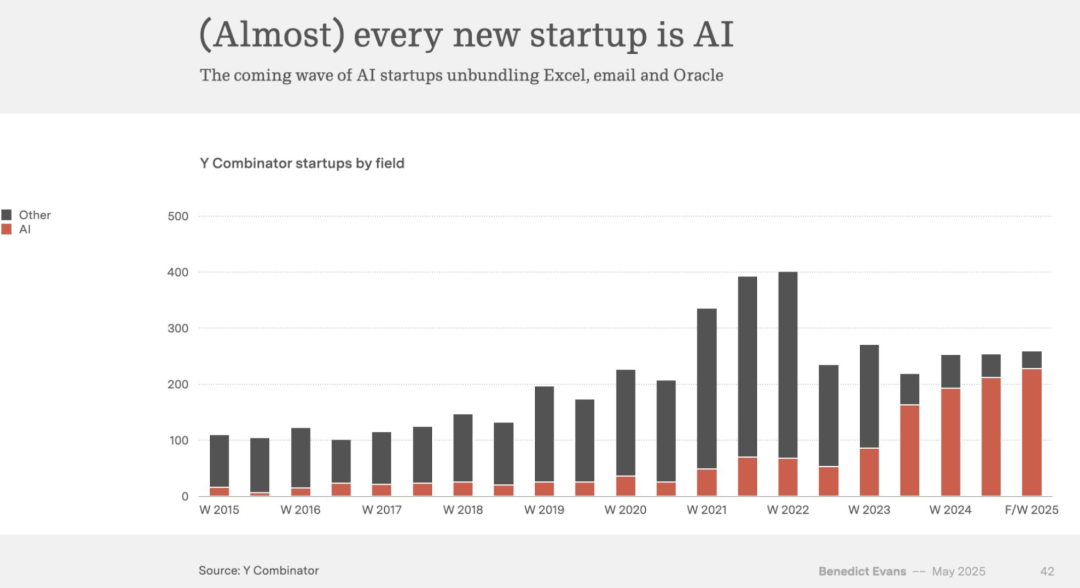
Core Insights - The surge in AI startups is currently the biggest opportunity in the AI sector, with many companies experiencing an average revenue increase of 300% this year, primarily driven by a significant rise in the number of AI entrepreneurs [3][4][6]. Group 1: AI Startup Landscape - The number of AI startups has exploded, with over 90% of new ventures now being AI-focused, compared to less than 50% two to three years ago [6]. - The primary customers for AI companies are other AI startups, which account for 90% of new client growth, indicating a self-reinforcing cycle within the industry [3][9]. Group 2: Business Models and Strategies - For B2B AI companies, the strategy involves capturing market share quickly through high-profile marketing and positioning as the first in a specific niche [12][17]. - The growth of AI companies is heavily reliant on their ability to integrate into the workflows of other startups, as exemplified by Cursor, which has rapidly grown by becoming essential for coding tasks [19][20]. Group 3: Challenges in B2C AI - B2C AI ventures face significant challenges due to a lack of demand growth, with the only variable being reduced costs in supply, making it harder to scale compared to B2B [22][24]. - The focus for B2C companies should be on growth first, followed by product development, as the market is saturated with good products but lacks visibility [24][27]. Group 4: Market Dynamics and Opportunities - The barriers to entry for startups have lowered significantly, allowing companies to launch with minimal funding, thus fostering a more competitive environment [30][31]. - The current landscape emphasizes the importance of identifying and capitalizing on existing trends and opportunities rather than relying solely on innovative product development [28][29].