AI购物

Search documents
千问:1.3亿人春节首次体验AI购物
Bei Ke Cai Jing· 2026-02-17 11:21
Core Insights - During the Spring Festival period, over 130 million people experienced AI shopping for the first time, making 5 billion requests using the phrase "Qianwen help me" [1] User Engagement - In the past two days, the number of AI orders for purchasing tickets increased by 22 times compared to the previous period [1] - The volume of AI orders for booking flight tickets and other transportation tickets surged over 7 times [1] Movie Ticket Sales - With the release of Spring Festival movies, AI orders for movie tickets skyrocketed by 372 times [1] - AI order volume from third- and fourth-tier cities increased dramatically, with a growth of 782 times [1] Demographics - Nearly half of all AI orders originated from county-level cities [1] - Approximately 4 million users aged 60 and above engaged in AI shopping [1]
阿里、谷歌接连“出手”,AI购物元年将至?
Feng Huang Wang· 2026-02-12 14:17
Group 1 - The core idea of the articles highlights the contrasting approaches to AI shopping between Google and Alibaba, with Google embedding AI shopping features into its search engine while Alibaba focuses on direct purchasing through its AI platform [1][2] - Google leverages its vast search engine capabilities to integrate transaction processes within user queries, following a model of "AI + advertising" for monetization [2] - Alibaba's approach is more pragmatic, allowing users to directly place orders through AI, exemplified by the success of its Qianwen app during the Spring Festival, where users made over 1.2 billion orders [1][2] Group 2 - The success of Alibaba's Qianwen app is attributed to its comprehensive AI technology and a robust consumption ecosystem, integrating various services from its platforms like Taobao and Tmall [2][3] - The differences in AI shopping strategies stem from Google's lack of checkout capabilities and delivery networks, while Alibaba has transformed its extensive logistics and e-commerce infrastructure into a foundation for AI-driven consumption [3] - The initial surge in user engagement during the Spring Festival is seen as just the beginning, with ongoing efforts to retain users and expand the range of products available through AI [4]


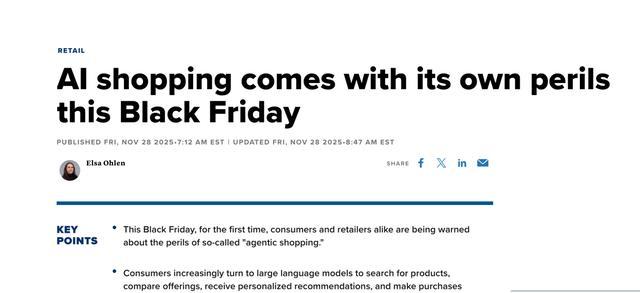
外媒:黑五折扣节,AI购物暗藏新风险
Huan Qiu Wang Zi Xun· 2025-11-30 01:34
Core Insights - The rise of AI shopping is leading to increased digital fraud risks for consumers, despite the benefits of personalized recommendations and convenience [1][3] - Retailers are warned to be cautious of the risks associated with "smart shopping" as consumers increasingly rely on AI for product searches and purchases [3][4] Group 1: AI Shopping and Fraud Risks - The use of AI agents for shopping has increased by 200% in the past six months, while AI-related fraud has surged nearly tenfold [3] - Fraud prevention experts suggest that banning AI shopping may not be a viable solution, as AI users can bring high-quality traffic to platforms [3][4] Group 2: Consumer Behavior and Economic Context - The fashion industry sees AI and digital tools as the biggest opportunities before 2026, necessitating a reevaluation of marketing and e-commerce strategies [4] - Consumer confidence is low, with the EU's economic sentiment index below long-term averages since mid-2022, and U.S. consumer confidence hitting its lowest point since April [4][5] - A "K-shaped economy" is emerging, where high-income consumers maintain strong spending power while others cut back due to price pressures [4]