
AI购物

Search documents
新动向!豆包开启AI购物内测,电商平台加码“一句话购物”
证券时报· 2026-03-20 08:07
Core Viewpoint - The article discusses the emergence of AI shopping, particularly focusing on the "one-sentence shopping" feature being tested by Doubao, a ByteDance product, highlighting its potential to revolutionize the e-commerce landscape by providing a seamless shopping experience and reducing operational costs [2][5]. Group 1: AI Shopping Development - Doubao has initiated a gray test for its AI e-commerce function, allowing users to make purchases directly through the app, with a full rollout expected by March [5][6]. - Major platforms like Alibaba, JD.com, Meituan, and Pinduoduo have also invested heavily in AI shopping, aiming to create differentiated experiences and capture the next generation of consumer engagement [9][10]. - The AI shopping trend is seen as a response to the saturation of traditional e-commerce growth, with a shift from "people finding goods" to "goods finding people" and ultimately to "AI handling transactions" [10][11]. Group 2: Market Dynamics and Competition - As of December 2025, Doubao is projected to lead the domestic AI-native app market with 226 million monthly active users, significantly surpassing its closest competitor [6]. - The competition among leading platforms is intensifying, with initiatives like JD.com's AI shopping app and Meituan's focus on instant retail and low-cost goods [9][10]. - The rapid adoption of AI in e-commerce is expected to create new growth opportunities, particularly in the travel sector, where AI-driven bookings have surged [9]. Group 3: Challenges and Bottlenecks - Despite the potential benefits, AI shopping faces challenges such as information inaccuracies, user trust issues, and fragmented ecosystems that hinder a seamless shopping experience [12][13]. - The high costs associated with AI shopping tools may pose a barrier for small and medium-sized businesses, despite the overall efficiency gains for larger merchants [13]. - For AI shopping to achieve widespread adoption, it must overcome technical challenges related to model accuracy and integrate various data and service channels effectively [13][14]. Group 4: Future Trends - The year 2026 is anticipated to mark the beginning of large-scale AI shopping, with trends expected to include full-scene integration across online and offline channels, expansion into underdeveloped markets, and the establishment of standardized practices [14].


春节AI大战复盘:字节防守稳健,阿里进攻坚决,腾讯误判社交
Sou Hu Cai Jing· 2026-02-25 07:28
Core Insights - The AI competition during the Spring Festival has concluded, with major players like ByteDance and Alibaba showing strong performances, while Tencent's efforts lag behind [1][6][7]. Group 1: ByteDance and Alibaba Performance - ByteDance and Alibaba are both rated as top contenders, with ByteDance securing a partnership for the Spring Festival Gala, which is a significant strategic move [1][3]. - ByteDance's product, Doubao, achieved 1.9 billion total interactions and generated over 50 million new Spring Festival avatars and 100 million New Year greetings, which is considered average compared to past performances [1]. - Alibaba's Qianwen is noted for its innovative approach to AI, aiming to transform existing internet operations, despite its current user experience being in the early stages [4][5]. Group 2: Tencent's Struggles - Tencent's Yuanbao is rated significantly lower than its competitors, with a projected marketing spend of 15 billion yuan for 2025, yet it only achieved 32 million monthly active users by September [7][11]. - The marketing strategies employed by Yuanbao, such as 1 billion yuan in red envelopes, have not yielded substantial results, indicating a misalignment in user engagement [7][8]. - The company faces challenges in enhancing its foundational AI model capabilities, which are crucial for competing effectively against ByteDance and Alibaba [11][12].

9天接待超1974万游客 消费总额破177亿元 杭州新春消费市场“马力全开”
Mei Ri Shang Bao· 2026-02-24 13:24
Core Insights - The article highlights the significant increase in tourism and consumption in Hangzhou during the Spring Festival, driven by the popularity of the TV drama "Tai Ping Nian" [1][2][3] Tourism and Visitor Statistics - Hangzhou received 19.74 million visitors during the Spring Festival, a year-on-year increase of 29.39%, generating tourism revenue of 12.71 billion yuan, up 26.1% [1] - Approximately 10.53 million visitors were from outside Hangzhou, averaging 1.17 million visitors per day, marking a 21% increase year-on-year [1] - The Wang Yuyuan Temple, featuring a special exhibition related to "Tai Ping Nian," attracted over 100,000 visitors, a 45% increase compared to the previous year [3] Consumption Trends - Total consumption across five major sectors (wholesale, retail, catering, accommodation, and entertainment) reached 17.75 billion yuan, a 7.6% increase year-on-year [1] - The hotel occupancy rate in Zhejiang increased by nearly 70%, and flight bookings rose by over 30% during the holiday [4] - External consumption in Hangzhou reached 3.167 billion yuan, a 27.3% increase year-on-year [4] Cultural and Thematic Activities - The city launched a series of activities themed around "Tai Ping Nian," including special bus routes and interactive experiences at historical sites, which attracted 363,000 participants [2] - Various districts in Hangzhou introduced themed tours and exhibitions, enhancing the historical experience for visitors [3] Technological Integration - The integration of technology in shopping experiences, such as AI shopping and digital interactions, significantly enhanced consumer engagement during the festival [6] - Sales of smart products, including ROKID smart glasses, saw a remarkable increase of 580% [6] Government Initiatives - The local government issued over 600 million yuan in consumer vouchers, stimulating spending in the tourism and retail sectors [7] - The "old for new" policy led to significant sales in the electric vehicle sector, with orders doubling compared to the previous year [7] Dining and Local Experiences - Restaurant consumption reached 3.845 billion yuan, a 15% increase year-on-year, with many restaurants fully booked for family gatherings [8] - Various cultural and traditional activities attracted significant tourist interest, contributing to the overall festive atmosphere [8]
千问发布数据:1.3亿人春节首次体验AI购物
Huan Qiu Wang· 2026-02-24 07:52
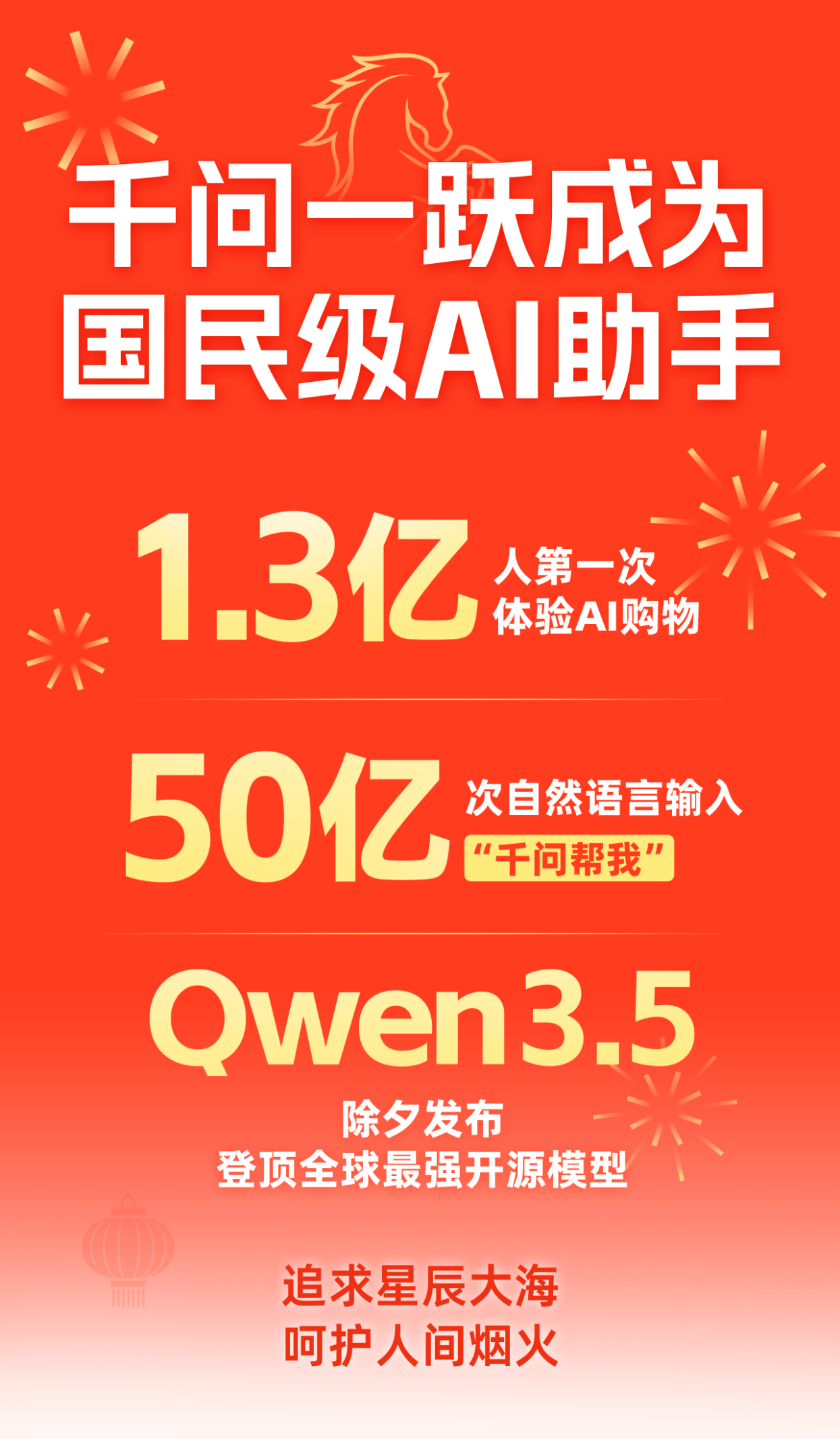
Core Insights - During the Spring Festival, over 130 million people experienced AI shopping for the first time, making 5 billion requests using "Qianwen help me" [1][6] - The number of AI ticket orders surged, with a 22-fold increase for event tickets and over 7-fold for flight tickets. Movie ticket orders increased by 372 times, particularly in lower-tier cities where orders rose by 782 times [1][6] - Nearly half of all AI orders originated from county-level cities, and around 4 million users aged 60 and above engaged in AI shopping [1][6] - Qianwen integrates with Alibaba's ecosystem, including Taobao, Alipay, and others, with plans to introduce additional features like AI taxi booking and mobile recharge [1][6] - As of February 7, Qianwen's daily active users reached 73.52 million, nearing Doubao's 78.71 million, achieving this in just three months [1][6] Model Development - On New Year's Eve, Alibaba released the new generation model Qwen 3.5-Plus, which is comparable to Gemini 3 Pro, marking it as the strongest open-source model globally [2][7] - This dual breakthrough in AI capabilities and application usage signifies a significant advancement for Alibaba's AI initiatives during the Spring Festival [2][7]

春节期间杭州实现消费总金额177.49亿元
Hang Zhou Ri Bao· 2026-02-24 02:44
Group 1 - The extended Spring Festival holiday has significantly boosted Hangzhou's consumption market, with total spending across five major sectors reaching 17.749 billion yuan, a year-on-year increase of 7.6% [1] - Retail sales amounted to 9.799 billion yuan, growing by 8.7%, while dining consumption reached 3.845 billion yuan, marking a 15.0% increase [1] - The consumption market is characterized by overall growth, structural optimization, and strong supply, with notable sales increases in green, smart, and health-related products [1] Group 2 - E-commerce platforms in Hangzhou saw government subsidies of 1.5538 million yuan during the Spring Festival, leading to over 45.47 million yuan in sales from more than 110,000 orders [2] - The city issued over 600 million yuan in consumption vouchers, with specific districts launching targeted subsidies that had a significant impact on sales [2] - The "trade-in" policy has been upgraded, resulting in over 14,000 transactions worth more than 62 million yuan in the Binjiang District alone during the holiday [2] Group 3 - Cultural and tourism activities in Hangzhou attracted significant visitor numbers, with daily attendance at the Grand Canal Park exceeding 20,000, a growth of over 700% [3] - The "Come to Hangzhou for the New Year" campaign, organized in collaboration with platforms like Alipay and Xiaohongshu, generated 3.167 billion yuan in external consumption, a 27.3% increase [3] - Traditional dining experiences have been enhanced, with notable sales increases in various restaurants, such as a 25% rise in key dining establishments in Chun'an County [3]
“新三样”增速抢眼 新场景火爆出圈
Xin Hua Wang· 2026-02-24 01:12
Core Insights - The consumption market in Hangzhou experienced a total amount of 177.49 billion yuan during the Spring Festival, marking a year-on-year growth of 7.6% [1] - The retail sector contributed 97.99 billion yuan with an 8.7% increase, while the catering sector saw a significant rise of 15.0% with 38.45 billion yuan in sales [1] Consumption Trends - New categories of products such as green, smart, and health-related items showed remarkable sales growth, becoming the "new three items" of this year's Spring Festival consumption market [2] - ROKID smart glasses sales surged by 580%, and Xiaomi AI home appliances increased by 10.8% [2] - The "Hangzhou Good Products" initiative saw government subsidies of 155.38 million yuan, leading to over 454.7 million yuan in sales [2] Policy Impact - The "old-for-new" policy has significantly boosted large-scale consumption, with over 14,000 transactions and sales exceeding 62 million yuan in the Binjiang District alone during the holiday [3] - The sales volume for new energy vehicles in the Xiaoshan District reached 150 million yuan, doubling compared to the previous year [3] Cultural and Tourism Integration - Various districts in Hangzhou organized events that attracted significant visitor numbers, such as the "Horse Power Full Open" event, which saw daily attendance exceeding 20,000, a growth of over 700% [3] - The integration of cultural and tourism elements has enhanced the overall consumer experience, with notable increases in visitor numbers across various attractions [3] External Consumption Growth - The "Come to Hangzhou for the New Year" campaign, in collaboration with platforms like Alipay and Xiaohongshu, generated 31.67 billion yuan in external consumption, reflecting a 27.3% increase [4] - The catering sector benefited from family gatherings and tourism, with some restaurants reporting over 25% growth in revenue [4] Technological Advancements - The use of AI technology during the Spring Festival allowed over 130 million people to experience AI shopping for the first time, resulting in a significant increase in orders across various categories [4] - The adoption of voice command ordering has rapidly gained popularity, enhancing the shopping experience during the holiday season [4]
1.3亿人春节首次体验AI购物
Zhong Guo Ji Jin Bao· 2026-02-17 12:32
Core Insights - Over 130 million people in China experienced AI shopping for the first time during the Spring Festival, with "Qianwen help me" becoming a national-level AI assistant [1][2][3] Group 1: User Engagement and Growth - During the Spring Festival, AI ticket purchasing orders surged, with a 22-fold increase for event tickets and over 7-fold for flight tickets [3] - Movie ticket orders via AI skyrocketed by 372 times, particularly in third and fourth-tier cities, where orders increased by 782 times [3] - Nearly 400,000 users aged 60 and above engaged in AI shopping, indicating a broad demographic reach [3] Group 2: Ecosystem Integration - Qianwen integrates with Alibaba's ecosystem, including Taobao, Alipay, and other platforms, to enhance user service [3] - Future functionalities will include AI ride-hailing, mobile top-ups, and group buying [3] Group 3: Model Development and Performance - Alibaba launched the Qianwen 3.5 model, which is considered the strongest open-source model globally, achieving a significant leap from text-only to multimodal capabilities [5] - Qianwen 3.5 outperformed competitors in various benchmarks, scoring 87.8 in MMLU-Pro and 88.4 in GPQA, surpassing GPT-5.2 and Claude 4.5 respectively [5] - The model's performance in instruction-following and general agent evaluations also exceeded that of Gemini 3 Pro and GPT-5.2 [5]
1.3亿人春节首次体验AI购物!千问吴嘉:“中国AI应用将走在世界前列”
Guang Zhou Ri Bao· 2026-02-17 11:20
Core Insights - Alibaba's AI application "Qianwen" has become a national phenomenon during the Spring Festival, driven by its "one-sentence ordering" and "Spring Festival free order" activities, attracting over 130 million first-time users and achieving 5 billion user interactions with the phrase "Qianwen help me" [1][2] Group 1: User Engagement and Performance - During the initial free order event on February 6, Qianwen exceeded expectations with over 15 million actual orders in one day, which was 15 times the company's forecast [1][2] - On February 7, Qianwen's daily active users (DAU) reached 73.52 million, nearly matching Doubao's 78.71 million, achieving this in just three months [2] - The user behavior has shifted from chat-based interactions to task execution, indicating a deeper integration of AI into daily life [2][3] Group 2: Service Expansion and Ecosystem Integration - Qianwen has integrated with various Alibaba ecosystem resources, leading to a significant increase in cross-category consumption, with hotel demand growing over 4 times and movie ticket orders increasing by 372 times [3] - The launch of the "Daily First Order Discount" activity aims to transition seasonal promotions into regular usage, allowing users to enjoy discounts across multiple platforms [3][4] Group 3: Strategic Vision and Future Developments - The company aims to embed AI into everyday life, moving beyond promotional activities to establish AI as a daily habit for users [4][5] - Future plans include expanding functionalities to cover more services such as ride-hailing and mobile top-ups, enhancing the AI assistant's capabilities [4] - The launch of the new open-source model Qwen 3.5-Plus positions Alibaba at the forefront of AI technology, emphasizing the importance of practical applications in consumer decision-making [5]
继“DeepSeek时刻”之后 中国AI又迎来“千问周期”
Zhong Guo Jing Ji Wang· 2026-02-17 08:58
Core Viewpoint - The Chinese AI industry is entering a new "Qianwen Cycle," marked by significant advancements and innovations, particularly led by Alibaba's Qianwen AI family, which is set to redefine AI applications and capabilities in the market [1][6][12]. Group 1: Model Development - Alibaba's Qianwen AI family has launched the Qianwen-Image-2.0 model, positioning it alongside leading models like Google's Nano Banana Pro and GPT Image 1.5 [4]. - The newly open-sourced Qianwen 3.5-Plus model features a total of 397 billion parameters, outperforming larger models like Qianwen 3-Max, and offers competitive performance against top closed-source models such as GPT-5.2 and Gemini-3-Pro [9]. - Qianwen has released over 400 open-source models, making it the most widely adopted open-source model globally, with a download count exceeding 1 billion [7][9]. Group 2: Application and Market Impact - The Qianwen App has initiated a "Spring Festival 3 billion free order" campaign, achieving over 10 million orders in just 9 hours, indicating a strong market response and consumer engagement [4]. - The app's focus has shifted from merely being a conversational AI to a more functional assistant, emphasizing the ability to perform tasks and meet user needs effectively [11]. - AI shopping, as a key feature of the Qianwen App, aims to connect users with resources in a streamlined manner, enhancing user experience and creating new consumption opportunities [11][12]. Group 3: Strategic Vision - Alibaba is addressing fundamental questions about the capabilities and responsibilities of AI, aiming to guide the future direction of Chinese AI development [6][12]. - The "Qianwen Cycle" represents a commitment to making advanced AI accessible to small businesses and individuals, fostering a more inclusive technological landscape [14]. - The overarching goal is to integrate advanced technology with everyday applications, ensuring that AI serves practical human needs while driving innovation [14].

千万发布数据:1.3亿人春节首次体验AI购物
Huan Qiu Wang· 2026-02-17 05:00
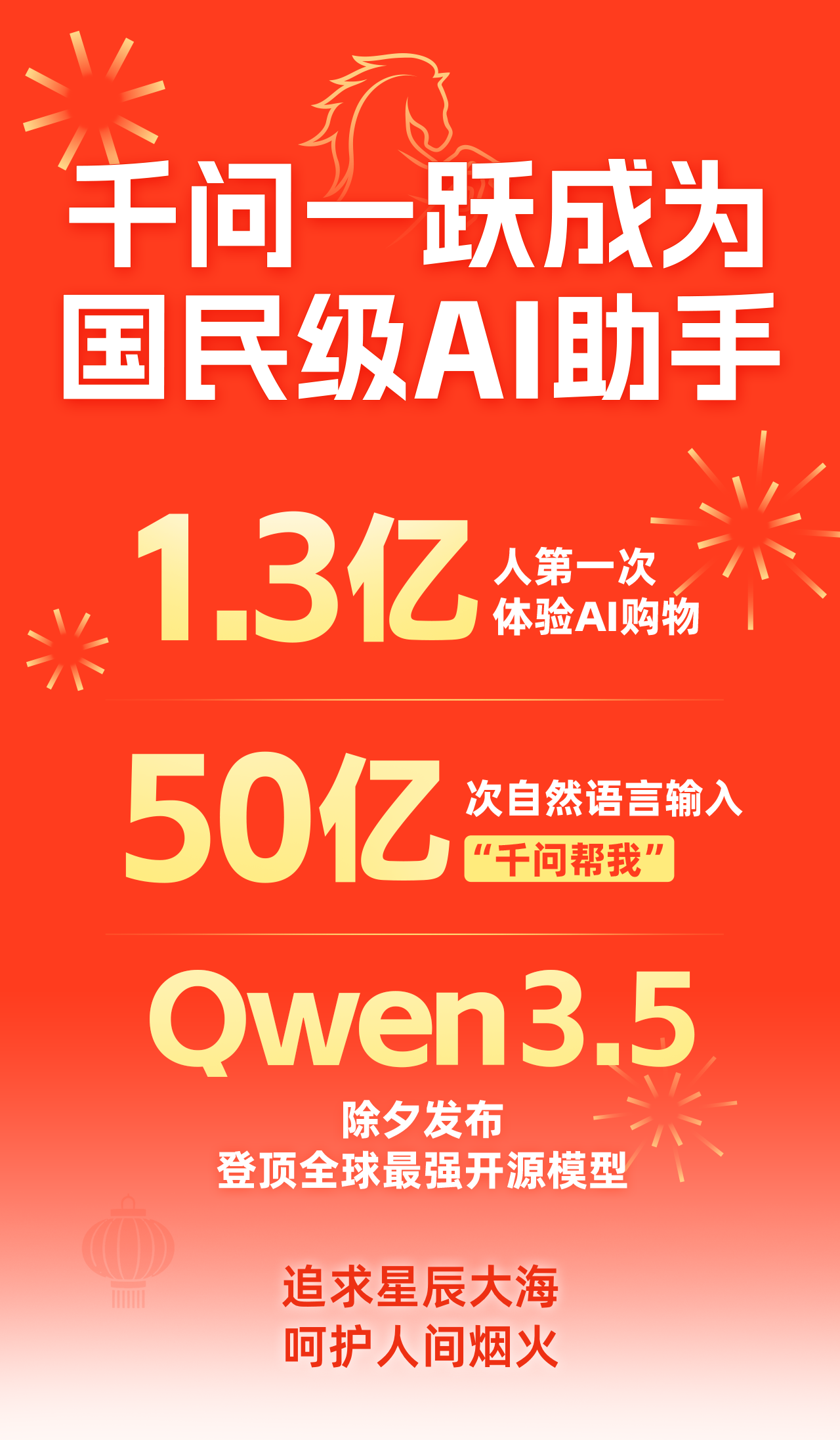
Group 1 - During the Spring Festival, over 130 million people experienced AI shopping for the first time, making 5 billion requests using "Qianwen help me" [1] - Orders for AI ticket purchases increased by 22 times, while AI bookings for flights and other transportation tickets grew over 7 times; movie ticket orders surged by 372 times, particularly from third and fourth-tier cities, which saw an increase of 782 times [1] - Nearly half of all AI orders originated from county-level cities, with around 4 million users aged 60 and above engaging in AI shopping [1] Group 2 - Alibaba launched the new generation open-source model Qwen 3.5-Plus on New Year's Eve, which is comparable in performance to Gemini 3 Pro, making it the strongest open-source model globally [2][4] - The AI application saw significant growth during the Spring Festival, indicating a dual explosion in both open-source model capabilities and app usage [2]