AMD EPYC系列

Search documents
冰与火之歌:英特尔的绝地反击与王者归来
3 6 Ke· 2026-01-22 10:36
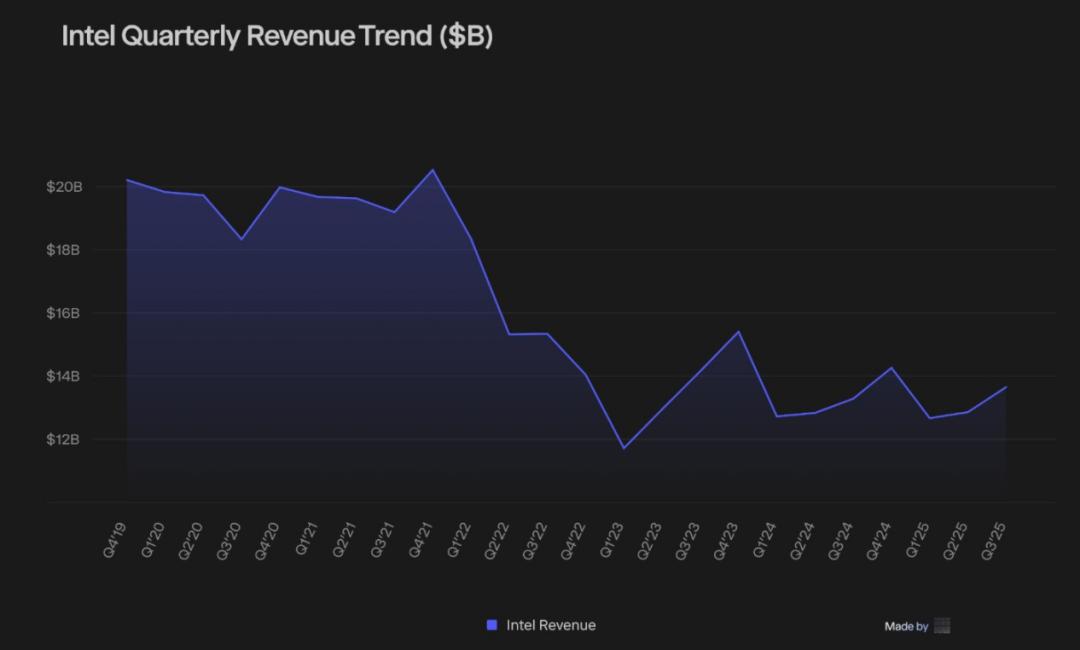
Core Viewpoint - Intel, once a dominant player in the PC market, faced significant challenges over the past five years, including a $2.92 billion loss in Q2 2025 and a declining market share due to competition from AMD and TSMC. However, a series of strategic investments and internal reforms have positioned the company for a potential turnaround by late 2025, driven by government support and partnerships with industry giants like NVIDIA [1][2][3][5][11]. Group 1: Challenges Faced - Intel reported a net loss of $2.92 billion in Q2 2025, with a gross margin falling below 30% and core business struggles [2]. - AMD's EPYC series captured over 40% market share, leading to a 15% year-over-year decline in orders for Intel's Xeon series due to its lagging 10nm technology [2]. - The company's foundry business has been unprofitable, with a market share of less than 3% and quarterly losses exceeding $1 billion [2]. Group 2: Strategic Turnaround - In August 2025, the U.S. government invested $8.9 billion to acquire a 9.9% stake in Intel, becoming its largest shareholder, signaling a commitment to U.S. chip independence [3][5]. - SoftBank invested $2 billion in Intel's foundry business, while NVIDIA invested $5 billion at a 14% premium to the government's share price, marking a significant partnership for AI chip development [4][5]. - Intel's cash reserves increased to $30.9 billion following these investments, providing a financial cushion for future operations [5]. Group 3: Internal Reforms - CEO Pat Gelsinger initiated a major restructuring, laying off 35,000 employees to reduce annual operating costs by $23.3 billion, with funds redirected to advanced process technology and AI teams [6][7]. - The company reintroduced a "20% free time" policy for engineers to foster innovation, leading to significant improvements in the yield of its 18A process technology [7]. - Intel has begun to embrace an open business model, securing orders from Apple for M-series chips and negotiating future iPhone production contracts [7]. Group 4: Market Dynamics - By 2026, Intel faced a "happy trouble" with a chip shortage driven by unexpected demand for server CPUs, particularly in data centers and AI applications [8]. - However, this shortage was complicated by a mismatch in production capacity, as Intel and OEMs overestimated demand for next-generation CPUs while the majority of demand remained for older models [9]. - The price increases for Intel CPUs were largely driven by OEMs paying "supply chain congestion fees," contrasting with AMD's pricing strategy [9]. Group 5: Future Outlook - Intel's revival is seen as a case study in corporate transformation, highlighting the importance of aligning with national strategies and industry trends while fostering internal innovation [11]. - Despite the positive momentum, challenges remain, including the need for successful mass production of the 18A process and ongoing competition from AMD [11]. - The upcoming Q4 2025 financial report will be critical in assessing Intel's recovery trajectory and its role in the global semiconductor landscape [11].


通富微电(002156):公司深度报告:AI浪潮下,AMD合力与先进封装的价值重估之路
KAIYUAN SECURITIES· 2025-10-22 06:13
Investment Rating - The investment rating for Tongfu Microelectronics (002156.SZ) is "Buy" (maintained) [1]. Core Views - The report emphasizes that Tongfu Microelectronics is well-positioned to benefit from the AI wave and the strategic partnership with AMD, which has led to significant revenue growth and enhanced capabilities [4][5]. - The company has achieved record-high quarterly revenue and net profit in Q2 2025, driven by strong contributions from major clients and successful diversification into various sectors [3][4]. - The report forecasts substantial revenue and profit growth for the company from 2025 to 2027, with expected revenues of 282.49 billion, 328.74 billion, and 382.07 billion yuan, and net profits of 10.49 billion, 15.95 billion, and 21.31 billion yuan respectively [3]. Summary by Sections 1. Partnership with Major Clients - Tongfu Microelectronics has established a strong partnership with AMD, securing over 80% of AMD's orders, which includes high-end processors, graphics cards, and server chips [4][22]. - The collaboration has evolved through three phases since 2015, leading to significant technological advancements and operational synergies [17][19]. - The company has successfully integrated advanced packaging technologies, achieving a high production capacity for AMD's 7nm and 5nm products [23][24]. 2. Advanced Packaging as a Core Solution - The report highlights that advanced packaging technologies, particularly Chiplet designs, are crucial for the AI era and align with domestic semiconductor policies [5][14]. - Tongfu Microelectronics is recognized as a leading domestic player in high-end advanced packaging, with a significant market share and continuous expansion of production capabilities [25][24]. - The demand for advanced packaging is expected to remain strong due to the ongoing competition in the computing power industry [5][14]. 3. Financial Performance and Forecast - In Q2 2025, the company reported revenues of 69.46 billion yuan, a year-on-year increase of 19.8%, and a net profit of 3.11 billion yuan, up 38.6% year-on-year [3]. - The financial projections indicate a robust growth trajectory, with a projected revenue increase of 18.3% in 2025 and continued growth in subsequent years [6]. - The report provides a detailed financial summary, including revenue, net profit, gross margin, and P/E ratios for the years 2023 to 2027, showcasing a positive outlook for the company's financial health [6].

国产芯片大佬并购国内算力巨头 影响几何?
Xi Niu Cai Jing· 2025-06-04 02:46
Core Viewpoint - The recent merger between Haiguang Information and Zhongke Shuguang is a significant event in the semiconductor industry, marking a shift from fragmented competition to a more systematic approach in domestic computing power, potentially creating a giant with a market value of nearly 400 billion yuan covering the entire industry chain from chip design to server manufacturing and computing power services [2][3]. Group 1: Merger Details - Haiguang Information plans to merge with Zhongke Shuguang through a share swap, which will enhance the domestic server CPU market share, where Haiguang holds 53.6% and ranks first, while also having over 30% of the domestic GPU market, ranking second [3]. - The merger is expected to accelerate the domestic replacement process, leveraging Zhongke Shuguang's strengths in high-end computing, storage, security, and data centers [3]. Group 2: Market Impact - The combination of Haiguang's DCU chips with Zhongke Shuguang's liquid-cooled servers is anticipated to improve cost-effectiveness and challenge the market shares of international giants like NVIDIA and AMD in AI training [3][4]. - The merger may gradually erode the market share of Intel and AMD in China, where their combined market share exceeds 70%, due to the technological synergy and ecosystem created by the new entity [4]. Group 3: Industry Chain Effects - The merger will likely compress the market bargaining power of mid-tier foundries, as the new entity will create a complete ecosystem that reduces reliance on external partners [5]. - Foundries like Hon Hai (Foxconn) and Quanta Computer may face declining bargaining power and profit margins due to the integrated ecosystem formed by the merger [5][9]. Group 4: Cloud Computing Sector - The merger could lead to price wars in the cloud computing sector, as the new entity may offer competitive mixed cloud solutions, potentially increasing pressure on third-party cloud service providers like UCloud and QingCloud [10][12]. - Despite the growth in revenue driven by the demand for computing power, net profits in the cloud computing market have not kept pace, indicating a challenging environment for existing players [11][12].