
Arm Neoverse数据中心芯片

Search documents
【ARM(ARM.O)】FY26Q2指引相对平淡,自主芯片设计挑战和机遇并存——FY2026Q1业绩点评(付天姿/董馨悦)
光大证券研究· 2025-08-03 23:06
Core Viewpoint - The company's FY26Q1 performance met guidance, but FY26Q2 guidance appears weak, indicating potential challenges ahead in revenue growth and profitability [3]. Group 1: Financial Performance - FY26Q1 revenue was $1.053 billion, a year-over-year increase of 12% but a quarter-over-quarter decrease of 15%, aligning with the company's previous guidance of $1.0 to $1.1 billion [3]. - Non-GAAP EPS for FY26Q1 was $0.35, down 12.5% year-over-year, consistent with the company's guidance range of $0.30 to $0.38 [3]. - FY26Q2 revenue guidance is set at $1.01 to $1.11 billion, with a midpoint indicating a year-over-year increase of 25.6% and a quarter-over-quarter increase of 0.7%, but below market expectations [3]. Group 2: Revenue Breakdown - FY26Q1 licensing revenue was $468 million, a slight year-over-year decrease of 0.8%, affected by the timing of high-value licensing agreements [4]. - Royalty revenue for FY26Q1 reached $585 million, a year-over-year increase of 25%, driven by the increased adoption of the Armv9 architecture and growth in data center usage [5]. - The annual contract value (ACV) for FY26Q1 was $1.528 billion, reflecting a year-over-year increase of 28%, supported by new collaborations and high-value licensing agreements [4]. Group 3: Strategic Initiatives - The company plans to increase R&D investment focusing on CSS, AI computing, and chiplets, which may enhance future revenue streams [3]. - The company is considering expanding into self-designed chips based on the Arm IP ecosystem, which could increase average transaction value but also poses risks related to customer relationships and profit margins [6]. Group 4: Market Dynamics - Geopolitical factors have a limited direct impact on the company, with FY26Q1 revenue from China accounting for 21%, showing a quarter-over-quarter increase of 6 percentage points and a year-over-year increase of 7 percentage points [3]. - The company has seen significant growth in its data center market share, with over 70,000 enterprises running AI workloads on Arm Neoverse chips, a 14-fold increase since 2021 [5].


反转,Arm承认下场自研芯片
3 6 Ke· 2025-08-01 07:28
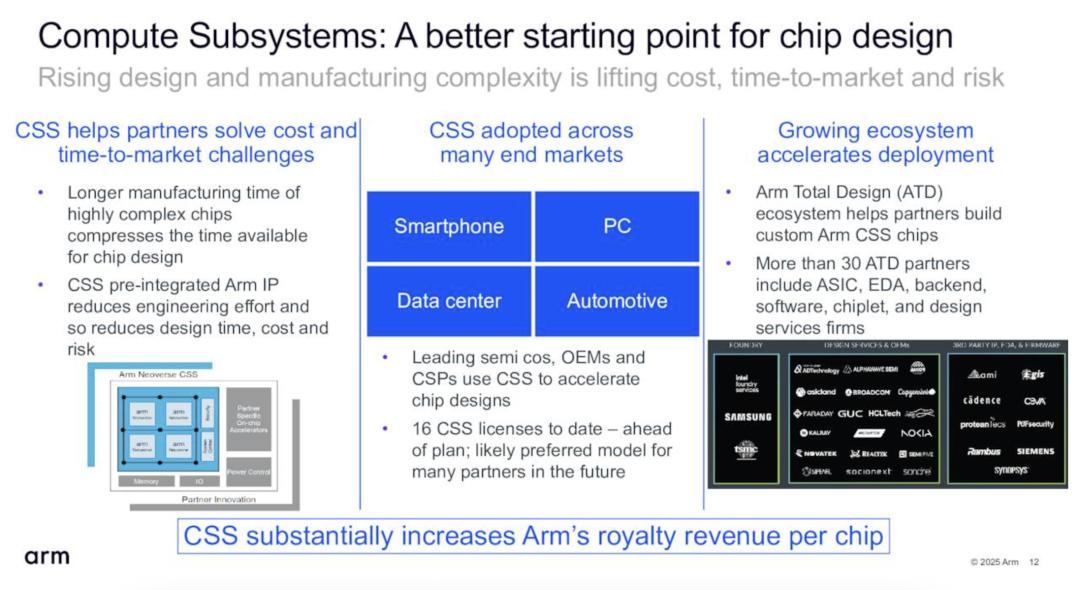
Core Insights - Arm has announced its strategic shift towards developing its own chips, moving away from its traditional model of licensing chip design blueprints to other companies [1][2][10] - The first self-developed chips are expected to be launched as early as summer 2023, with TSMC as the foundry partner and Meta potentially being one of the first customers [3][10] Group 1: Strategic Shift - Arm's CEO René Haas confirmed the company's decision to invest more in developing physical chips, which are seen as a tangible representation of their existing Compute Subsystem (CSS) products [2][3] - The move to self-developed chips is a response to the growing demand for high-performance chips in the data center market, which is projected to be a trillion-dollar industry [10][11] Group 2: Financial Performance - Arm's Q1 revenue was reported at $1.05 billion, slightly below market expectations of $1.06 billion, with adjusted earnings per share at $0.35, in line with expectations [3] - For Q2, Arm forecasts adjusted earnings per share between $0.29 and $0.37, with revenue expectations of $1.01 billion to $1.11 billion, aligning with market predictions [3] Group 3: Key Developments - Arm's collaboration with SoftBank on the "Stargate" project aims to support a broader AI vision, leveraging Arm's technology as the core CPU for various applications [4][5] - The company has seen a 40% year-over-year increase in enterprises running AI workloads on Arm Neoverse data center chips, with a 14-fold increase since 2021 [5] - Arm's CSS platform has signed 16 licenses with 10 companies, more than doubling from the previous year, indicating strong demand for its technology [6] Group 4: Chiplet Development - Arm is actively developing Chiplets, which allow for modular design and independent scaling of compute or memory, supported by over 70 partners [9] - The Chiplet architecture is seen as a way to diversify product offerings without requiring significant investment in single-chip SoC designs [9] Group 5: Market Impact - The introduction of self-developed chips may disrupt Arm's long-standing relationships with existing clients, as it transitions from a partner to a competitor [10] - This strategic move is viewed as a necessary step for Arm to achieve higher profit margins compared to its licensing model, especially in the booming AI-driven data center market [10][11]

ARM(ARM.US)2026财年Q1电话会:预计今年ARM芯片在超大规模数据中心市场份额接近50%
智通财经网· 2025-07-31 08:15
Core Viewpoint - ARM's Q1 FY2026 earnings call highlighted significant growth in cloud computing, with over 70,000 enterprises running AI workloads on Arm Neoverse data center chips, a 40% year-over-year increase, and a 14-fold increase since 2021. The company's market share in large-scale data centers is expected to approach 50% this year, up from approximately 18% last year [1][4]. Cloud Computing - ARM is developing many small chips (chiplets) based on its intellectual property (IP) and is evaluating the feasibility of expanding beyond existing platforms into more subsystems and complete solutions [1][2]. - The growth in ARM's market share in large-scale data centers is driven by its ability to capture general workloads from x86 and dominate AI workloads with integrated Arm designs [4][6]. Financial Performance - The company's royalty revenue grew by 25%, slightly below the previous quarter's expectations of 25%-30%, primarily due to slower-than-expected growth in the smartphone segment [3][11]. - ARM's Q1 revenue from China accounted for 21%, an increase from 15% in the previous quarter and 14% year-over-year, aligning with global growth trends [1][13]. Strategic Developments - ARM is positioned uniquely to provide solutions across a wide range of devices, from small devices to large data centers, and is exploring further integration in its ASIC and complete terminal solutions strategy [2][10]. - The second generation of CSS (Compute Subsystem) transactions is expected to have royalty rates exceeding 10%, indicating potential for further revenue growth [8][11]. Market Dynamics - The increase in capital expenditures by large enterprises is expected to positively impact ARM's royalty revenue from existing ASIC designs and long-term CSS licensing opportunities [11]. - ARM's Chinese market is developing in sync with global trends, with no significant impact from recent GPU export controls [12][13]. Future Outlook - ARM's confidence in its market share growth beyond 50% is supported by its customizable architecture and the increasing adoption of AI in data centers [6][11]. - The company is actively pursuing opportunities in the automotive sector, particularly in ADAS applications, which are expected to drive future growth [16].