Atlas V

Search documents
他,中国民营火箭卷王
3 6 Ke· 2026-01-04 23:52
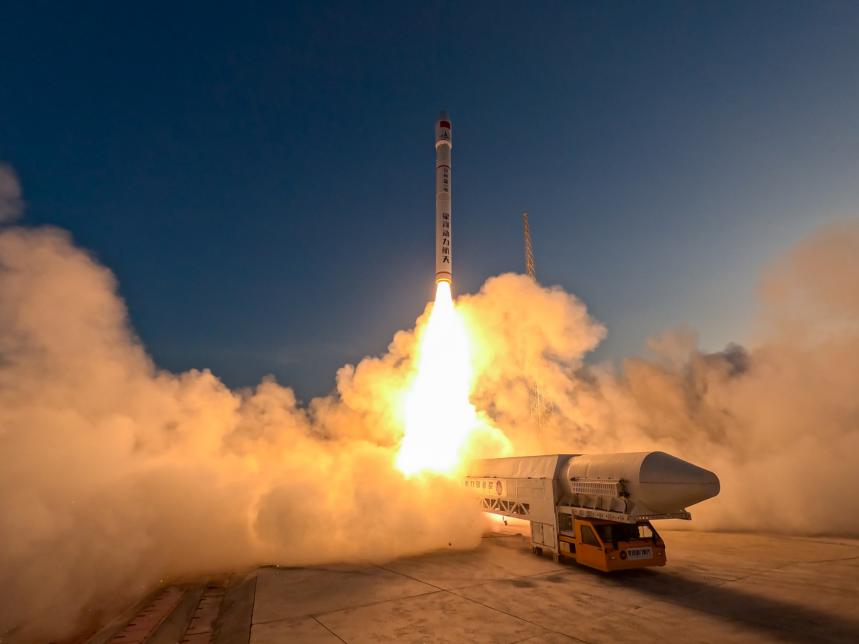
Core Viewpoint - The article highlights the rapid development and success of the private aerospace company Star River Dynamics, particularly its "Vesta-1" rocket, which has achieved multiple successful launches, marking a significant shift in China's commercial space industry [3][24]. Group 1: Company Overview - Star River Dynamics has established itself as a leader in China's private rocket sector, achieving 20 successful commercial launches by September 2025, making it the most frequently launching private rocket company in the country [23][24]. - The "Vesta-1" rocket has become a representative product for Star River Dynamics, successfully completing various milestones, including the first commercial satellite launch into a 500 km sun-synchronous orbit by a private company in China [22][23]. Group 2: Industry Context - The commercial space industry in China has gained momentum since the 2014 policy encouraging private investment in space infrastructure, leading to a surge in private rocket companies [9][10]. - The success of SpaceX in the U.S. has influenced the global commercial rocket competition, prompting a shift in China's approach to private space ventures [6][8]. Group 3: Financial Developments - Star River Dynamics has attracted significant investment, completing a record 2.4 billion yuan D-round financing in September 2025, the second-highest single financing amount in China's commercial space sector [25]. - The company has initiated the process for an IPO, positioning itself alongside other private rocket firms in the race for the title of "first private rocket stock" in China [25].

商业航天腾飞:Q1迎接更大进展,十五五攻坚开启
2025-12-24 12:57
Summary of Key Points from the Conference Call Industry Overview - The Chinese commercial space industry is rapidly developing, aiming to achieve a total of 4,000 tons of in-orbit spacecraft quality by 2030, requiring hundreds of launches annually [1][2] - The Long March 10B rocket is expected to have its maiden flight in April next year, while the Long March 10A rocket plans to conduct recovery tests, indicating China's efforts to catch up with international standards [1][2] Core Insights and Arguments - Successful launches of Long March 12A and Zhuque 3 rockets have demonstrated strong commercial potential, although complete success in first-stage recovery was not achieved [4] - The need for new launch sites using non-toxic fuels is critical, with ongoing constructions in Hainan and Lianli Island to meet increasing demand [6][7] - Reusable technology is essential for cost reduction, with a target to lower transportation costs to $2,000-$3,000 per kilogram from the current $5,000-$10,000 [7] - Private companies like Blue Origin and Galactic Glory are actively participating in the commercial space sector, injecting innovation into the industry despite some project delays [8] Challenges and Future Directions - China faces challenges in reusable rocket technology, primarily due to insufficient experimental data regarding engine performance in recovery conditions [5] - Future improvements will include testing new engines in Long March 12B and exploring novel recovery methods like net recovery [5] - The commercial space sector is expected to grow significantly, with projections of 100 rocket launches annually by 2030, compared to SpaceX's anticipated 150 launches in 2025 [2] Investment Opportunities - Investment opportunities in the rocket supply chain are emerging, particularly in companies that are vertically integrated and developing their engines, such as Blue Arrow and Tianbing [10] - The shift towards reusable rockets may reduce the demand for new engines but increase the need for maintenance and reassembly services [11] - China's rocket companies, like China Rocket and Yuanshen, are gaining attention due to asset securitization and significant orders for rockets like Long March 8A [15][16] Market Dynamics - The U.S. market features key players like SpaceX's Falcon 9 and Blue Origin's New Glenn, with a trend towards large, low-cost rockets expected by 2030 [9] - Starlink, a major player in satellite internet, is projected to generate approximately $15 billion in annual revenue, with significant competition from Amazon's LEO project [3][17] Conclusion - The Chinese commercial space industry is poised for rapid growth, with significant investments and technological advancements expected in the coming years. However, challenges related to reliability and production capacity must be addressed to achieve the ambitious goals set for 2030 [24][25]
ULA Launches Amazon Project Leo (LA-04) Launch from SLC-41 Cape Canaveral, Florida
The Launch Pad· 2025-12-11 19:24
Project Overview - Project Kuiper, an Amazon subsidiary, is launching 27 satellites into low-Earth orbit [1] - The launch is aboard a United Launch Alliance (ULA) Atlas V rocket [1] - The launch is taking place from Space Launch Complex 41 (SLC-41) at Cape Canaveral Space Force Station in Florida [1] Media and Community Engagement - The Launch Pad is providing live coverage of the launch [1] - The Launch Pad encourages viewers to join their community Discord [1] - The Launch Pad offers membership with benefits like early video access and behind-the-scenes live streams [1] - The Launch Pad promotes its YouTube channels, TLP Space News and The Launch Pad [1]


SpaceX launches competitor Amazon's Project Kuiper satellites
TechXplore· 2025-07-17 13:20
Core Insights - The article discusses the competitive landscape between Amazon's Project Kuiper and SpaceX's Starlink, highlighting the recent collaboration between the two companies for satellite launches [1][2]. Launch Details - A SpaceX Falcon 9 rocket successfully launched 24 of Amazon's satellites on July 16, marking the first launch of Amazon's satellites by SpaceX [2][4]. - This launch adds to the 27 satellites previously launched by Atlas V missions, bringing the total to 78 satellites, with a target of 1,600 satellites to be launched by July 2026 [5]. Amazon's Strategy - Initially, Amazon avoided contracting SpaceX for satellite launches, opting for United Launch Alliance (ULA) and Blue Origin due to delays faced by ULA's Vulcan, Blue Origin's New Glenn, and Arianespace's Ariane 6 rockets [3][4]. - Amazon has established a satellite processing facility at Kennedy Space Center to expedite the availability of its satellites [8]. Future Plans - SpaceX has been contracted for two additional Falcon 9 launches for Amazon, while ULA has six more Atlas V launches planned [6][8]. - The full constellation of 3,236 satellites for Project Kuiper is expected to be launched by July 31, 2029 [5].
Amazon Doubles Project Kuiper Satellite Fleet in Race to Catch Up to SpaceX's Starlink
CNET· 2025-06-23 19:02
Core Insights - Amazon successfully launched 27 Kuiper satellites, increasing its operational broadband satellite count to 54 [1] - Project Kuiper is a $10 billion initiative aimed at creating a network of 3,236 satellites to provide high-speed internet, particularly in underserved areas [2] - The launch was executed without issues, following a previous scrub due to a rocket booster problem [3] Launch and Operations - The Atlas V rocket released the satellites approximately three hours post-launch, transferring control to Amazon's mission center [3] - Amazon plans to conduct around 80 launches to complete its satellite network, utilizing various rockets including Atlas V, Vulcan Centaur, Blue Origin, and SpaceX [4] Regulatory and Competitive Landscape - Amazon must launch half of its satellite fleet by mid-2026 to comply with FCC regulations, making each launch critical [5] - Competing with SpaceX's Starlink, which has a significant lead in launches and market share, presents challenges for Amazon despite its financial resources and retail presence [5]

LIVE! ULA 2nd Amazon Project Kuiper Launch from Cape Canaveral, Florida
The Launch Pad· 2025-06-07 19:45
Mission Overview - ULA launched the second operational batch of Amazon's Project Kuiper satellites on Atlas V to LEO [1] - The launch took place from Space Launch Complex 41 (SLC-41) at Cape Canaveral Space Force Station [1] Companies and Projects - The launch involves ULA, Amazon's Project Kuiper, and The Launch Pad [1] - The Launch Pad aims to inform and inspire the explorers of tomorrow [1] Community Engagement - The Launch Pad encourages viewers to join their Discord community [1] - They also promote subscriptions to their YouTube channels and memberships for exclusive content [1]
Boeing Space Joint Venture to Launch 12 Times in 2025, and Double That in 2026
The Motley Fool· 2025-04-05 11:07
Core Insights - United Launch Alliance (ULA) has received certification from the U.S. Space Force for its Vulcan Centaur rocket, allowing it to launch national security missions and compete in the multibillion-dollar National Security Space Launch (NSSL) program [2][3] - ULA plans to conduct a total of 12 launches in 2025, significantly increasing from the five launches in 2024 and four in 2023, marking a return to a launch frequency not seen since 2016 [4][8] - The anticipated increase in launches could lead to substantial profits for ULA, with projections suggesting a potential profit of $320 million in 2025, translating to $160 million for each co-owner, Boeing and Lockheed Martin [9] ULA's Launch Plans - ULA's next launch will utilize an already-certified Atlas V rocket for a commercial mission with Amazon, followed by national security missions using the Vulcan rocket [4] - The company aims to establish a regular launch cadence of two per month by year-end 2025, although this may slow down in 2026 [5] Financial Implications - ULA's revenue may have been delayed due to certification issues, but the company is not expected to miss any launches, which is positive for its financial outlook [6][7] - In 2016, ULA generated $650 million in profit, and with the expected increase in launches, similar profitability could be achieved in 2025 despite heightened competition from SpaceX [8][9]