Azure Cobalt

Search documents
Will Nebius' Toloka and ClickHouse Stakes Fund Its AI Expansion?
ZACKS· 2025-10-17 14:36
Core Insights - Nebius Group N.V. (NBIS) is experiencing significant revenue growth, with a 625% increase last quarter, driven by the surging demand for AI infrastructure, particularly in generative AI and high-performance computing applications [1][9] - The company has signed a substantial $17.4 billion deal with Microsoft to provide dedicated GPU capacity from its new data center in Vineland, NJ [1][9] Company Expansion and Strategy - Nebius is expanding its AI infrastructure with new data centers being constructed in New Jersey, the UK, and Israel, along with capacity expansion in Finland, targeting nearly 1 gigawatt of total capacity by 2026 [2] - The rapid expansion necessitates significant capital, and investors are keen to understand how Nebius plans to fund this growth phase [2] Financial Position and Equity Stakes - Management has indicated that Nebius has significant cash reserves and will approach additional capital raising opportunistically based on market conditions [3] - The company holds a 28% stake in ClickHouse, valued at approximately $6 billion, which could serve as a capital source if monetized [3] - Other equity stakes include Toloka, TripleTen, and Avride, which may also provide value drivers for the company [3][5] Investor Confidence and Future Valuation - Toloka recently raised growth capital, indicating strong investor confidence in its AI data business, and Nebius sees significant upside potential in Toloka's future valuation [4] - The company aims to monetize its non-core businesses effectively to support its core operations while minimizing shareholder dilution [5] Competitive Landscape - Microsoft is both a client and competitor, investing heavily in AI infrastructure and expanding its data center footprint, with over 400 data centers across 70 regions [6][7] - CoreWeave (CRWV) is emerging as a serious competitor, with significant contracts and aggressive data center expansion plans [8][10] Financial Performance and Valuation - Nebius shares have increased by 30.7% in the past month, contrasting with a slight decline in the Internet – Software and Services industry [11] - The company's shares are trading at a price/book ratio of 7.68X, higher than the industry average of 4.61X [12] - The Zacks Consensus Estimate for NBIS' earnings for 2025 has been revised upwards over the past 60 days [13]


NBIS vs. MSFT: Which AI Infrastructure Stock is the Smarter Bet?
ZACKS· 2025-09-29 17:36
Core Insights - Nebius Group N.V. (NBIS) is emerging in the AI infrastructure market, while Microsoft Corporation (MSFT) is a well-established leader in the tech industry [1][2] - AI infrastructure spending is projected to exceed $200 billion by 2028, benefiting both companies but in different magnitudes [2] Nebius Group N.V. (NBIS) - NBIS reported a remarkable revenue increase of 625% year-over-year, reaching $105.1 million, with AI cloud infrastructure revenues growing over nine times [3][9] - The company has raised its year-end Annual Recurring Revenue (ARR) guidance to between $900 million and $1.1 billion, up from a previous estimate of $750 million to $1 billion [4] - NBIS has secured a significant deal with Microsoft, providing dedicated GPU capacity valued at approximately $17.4 billion through 2031, with potential to increase to $19.4 billion [5][9] - The company plans to achieve a connected power capacity of 220 megawatts by 2025 and aims for a 1 GW capacity target by 2026 [4] - NBIS has raised $4 billion in debt and closed a public offering, with proceeds aimed at business growth and data center expansion [7] Microsoft Corporation (MSFT) - MSFT's Azure cloud platform is the second-largest globally, with annual revenues of $75 billion and a growth rate of 34% [9][10] - The company has invested $13 billion in OpenAI, gaining exclusive rights to OpenAI's IP for its products [12] - MSFT's AI business has surpassed a $13 billion annual revenue run rate, growing 175% year-over-year in the fourth quarter of fiscal 2025 [13] - The company plans over $30 billion in capital expenditures for the first quarter of fiscal 2026, supported by a significant cash reserve of $94.56 billion [14] Stock Performance and Valuation - Over the past month, NBIS shares have increased by 57.7%, while MSFT stock has seen a modest rise of 1% [15] - Both companies are considered overvalued, with NBIS trading at a Price/Book ratio of 6.73X and MSFT at 11.07X [18] - Current earnings estimates for NBIS have been significantly revised downward, while MSFT has seen marginal upward revisions [20][22] Investment Outlook - NBIS currently holds a Zacks Rank of 3 (Hold), while MSFT has a Zacks Rank of 2 (Buy), indicating a preference for MSFT as a more favorable investment at this time [23]
GPU王座动摇?ASIC改写规则
3 6 Ke· 2025-08-20 10:33
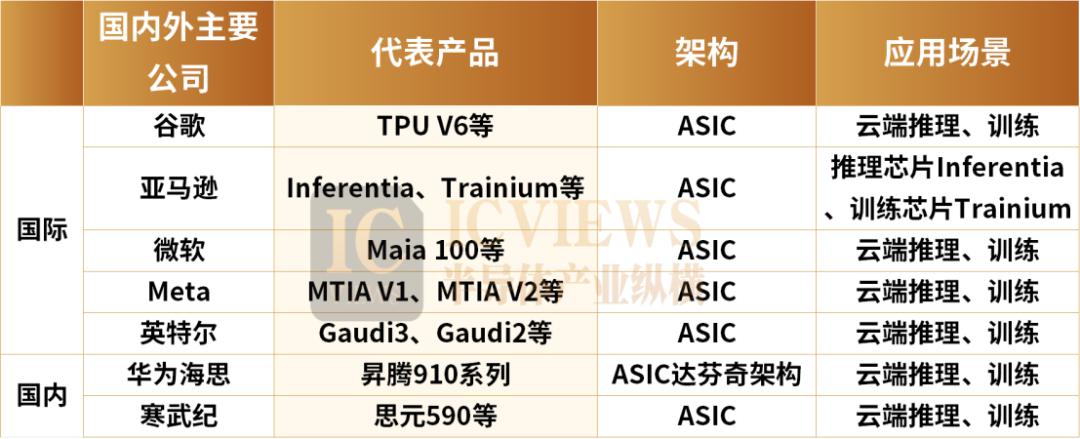
Core Insights - The discussion around ASIC growth has intensified following comments from NVIDIA CEO Jensen Huang, who stated that 90% of global ASIC projects are likely to fail, emphasizing the high entry barriers and operational difficulties associated with ASICs [2][3] - Despite Huang's caution, the market is witnessing a surge in ASIC development, with major players like Google and AWS pushing the AI computing market towards a new threshold [5][6] - The current market share shows NVIDIA GPUs dominate the AI server market with over 80%, while ASICs hold only 8%-11%. However, projections indicate that by 2025, the shipment volumes of Google’s TPU and AWS’s Trainium will significantly increase, potentially surpassing NVIDIA’s GPU shipments by 2026 [6][7] ASIC Market Dynamics - The ASIC market is expected to see explosive growth, particularly in AI inference applications, with a projected market size increase from $15.8 billion in 2023 to $90.6 billion by 2030, reflecting a compound annual growth rate of 22.6% [18] - ASICs are particularly advantageous in inference tasks due to their energy efficiency and cost-effectiveness, with Google’s TPU v5e achieving three times the energy efficiency of NVIDIA’s H100 and AWS’s Trainium 2 offering 30%-40% better cost performance in inference tasks [17][18] - The competition between ASICs and GPUs is characterized by a trade-off between efficiency and flexibility, with ASICs excelling in specific applications while GPUs maintain a broader utility [21] Major Players and Developments - Major companies like Google, Amazon, Microsoft, and Meta are heavily investing in ASIC technology, with Google’s TPU, Amazon’s Trainium, and Microsoft’s Azure Maia 100 being notable examples of custom ASICs designed for AI workloads [22][24][25] - Meta is set to launch its MTIA V3 chip in 2026, expanding its ASIC applications beyond advertising and social networking to include model training and inference [23] - Broadcom leads the ASIC market with a 55%-60% share, focusing on customized ASIC solutions for data centers and cloud computing, while Marvell is also seeing significant growth in its ASIC business, particularly through partnerships with Amazon and Google [28][29] Future Outlook - The ASIC market is anticipated to reach a tipping point around 2026, as the stability of AI model architectures will allow ASICs to fully leverage their cost and efficiency advantages [20] - The ongoing evolution of AI models and the rapid pace of technological advancement will continue to shape the competitive landscape between ASICs and GPUs, with both types of chips likely coexisting and complementing each other in various applications [21]




CRWV vs. MSFT: Which AI Infrastructure Stock is the Better Bet?
ZACKS· 2025-06-24 13:50
Core Insights - CoreWeave (CRWV) and Microsoft Corporation (MSFT) are key players in the AI infrastructure market, with CRWV focusing on GPU-accelerated services and Microsoft leveraging its Azure platform [2][3] - CRWV has shown significant revenue growth driven by AI demand, while Microsoft maintains a strong position through extensive investments and partnerships [5][9] CoreWeave (CRWV) - CRWV collaborates with NVIDIA to implement GPU technologies and was among the first to deploy NVIDIA's latest clusters for AI workloads [4] - The company reported revenues of $981.6 million, exceeding estimates by 15.2% and increasing 420% year-over-year, with a projected global economic impact of AI reaching $20 trillion by 2030 [5] - CRWV has a substantial backlog of $25.9 billion, including a strategic partnership with OpenAI valued at $11.9 billion and a $4 billion expansion agreement with a major AI client [6] - The company anticipates capital expenditures (capex) between $20 billion and $23 billion for 2025 to meet rising customer demand, with interest expenses projected at $260-$300 million for the current quarter [7] - A significant risk for CRWV is its revenue concentration, with 77% of total revenues in 2024 coming from its top two customers [8] Microsoft Corporation (MSFT) - Microsoft is a dominant force in AI infrastructure, with Azure's global data center coverage expanding to over 60 regions [9] - The company invested $21.4 billion in capex in the last quarter, focusing on long-lived assets to support its AI initiatives [10] - Microsoft has a $315 billion customer backlog and is the exclusive cloud provider for OpenAI, integrating AI models into its services to enhance monetization opportunities [12] - The company projects Intelligent Cloud revenues between $28.75 billion and $29.05 billion for Q4 fiscal 2025, with Azure revenue growth expected at 34%-35% [14] Share Performance - In the past month, CRWV's stock surged by 69%, while MSFT's stock increased by 8% [17] - Current Zacks Rank indicates MSFT as a better investment option compared to CRWV, which has a lower rank [18]