Bambu Lab X1系列高速多色3D打印机

Search documents
深圳博士造打印设备,5年跑出100亿隐形冠军
2 1 Shi Ji Jing Ji Bao Dao· 2026-02-02 00:58
Core Insights - The company,拓竹科技, has established a "2026 Alumni Fund" with a donation of 100 million yuan to 10 universities, reflecting its commitment to giving back to the educational institutions that shaped its employees [2][5]. - Founded by陶冶 and a team of engineers from DJI,拓竹科技 has rapidly captured 29% of the global consumer 3D printing market within five years, achieving annual revenues exceeding 10 billion yuan [3][8]. - The company emphasizes a unique hiring strategy based on personal connections and values experience over formal education, which has contributed to its strong team dynamics and growth [5][7]. Company Development - The company was founded in 2020, focusing on consumer-grade 3D printing devices, and has since developed innovative products like the Bambu Lab X1 series, which incorporates AI and laser radar technology [3][9]. - In April 2022, the company launched its first product, which quickly gained traction, generating nearly 50 million yuan in global orders within the first month [9]. - The introduction of the A1 mini model in 2023 lowered the entry price for consumer-grade 3D printers to 1,199 yuan, significantly boosting the company's revenue [9]. Community and Ecosystem -拓竹科技 has created a 3D model community called MakerWorld, which has attracted nearly 10 million monthly active users and over one million 3D models within two years [10][11]. - The company invests several hundred million yuan annually to support creators on the platform, incentivizing them through a token system [11]. Competitive Landscape - The company faces increasing competition from emerging players like Tencent-backed创想三维 and深圳纵维立方, which are also making strides in the 3D printing market [14]. - The relationship with DJI has evolved, with DJI investing in a competing 3D printing company, indicating a potential talent drain and heightened competition in the industry [12][14]. Future Outlook - With a revenue milestone of over 10 billion yuan achieved, the company is preparing for further growth and expansion in the 3D printing sector [14].
大疆撕扯“小大疆”
3 6 Ke· 2025-11-28 08:15
Core Insights - The rivalry between DJI and its former employees who have founded new companies, particularly Tuo Zhu, has intensified, highlighting a battle for talent, technology, and market space [1][2][19] - DJI's investment in a 3D printing company, Smart Pie, has been perceived as a direct attack on Tuo Zhu, indicating a shift from value investment to competitive aggression [1][4][19] - The emergence of "DJI alumni" companies has created a competitive landscape where these startups are increasingly attracting talent away from DJI, posing a significant threat to its market dominance [13][14][16] Company Dynamics - DJI has historically been a breeding ground for talent, with many former employees establishing successful startups that often compete directly with DJI [8][9][13] - Tuo Zhu, founded by former DJI employee Tao Ye, has rapidly grown to capture a significant market share in the 3D printing sector, achieving approximately 60 billion RMB in revenue and a 29% market share by 2024 [11][19] - The competitive landscape has shifted, with candidates increasingly choosing Tuo Zhu over DJI, even when offered similar compensation, indicating a change in the perceived value of working for each company [4][13] Market Trends - The global drone market is experiencing stagnation, with growth rates around 5% in 2023 and a decline in consumer drone sales, which poses challenges for DJI's traditional business model [16][17] - DJI is diversifying its product offerings into new areas such as robotic vacuums, panoramic cameras, and outdoor power supplies, as it seeks to find new growth avenues amidst a saturated market [17][18] - The rise of "DJI alumni" companies is creating a closed loop of talent migration, where former employees leverage their DJI experience to attract investment and build competitive startups [14][15]

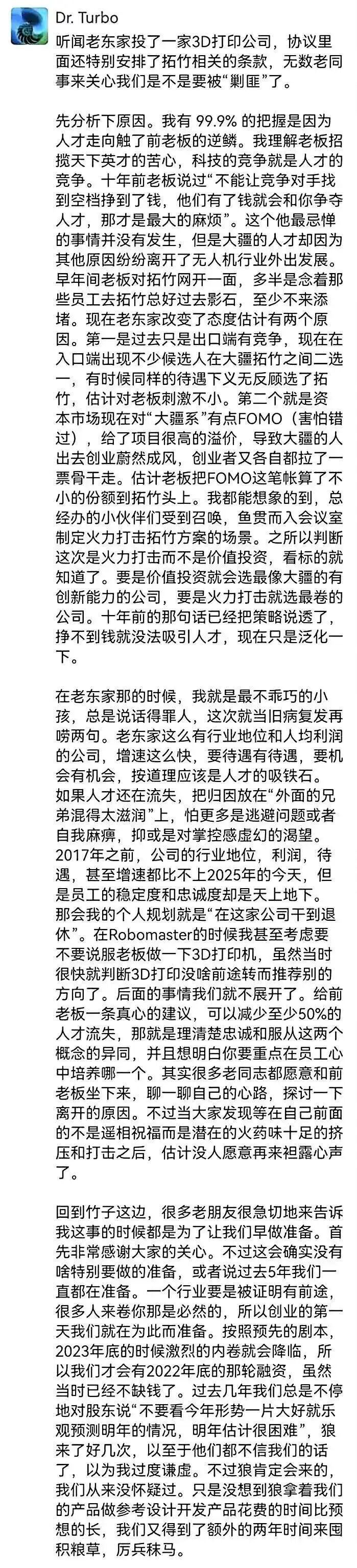
大疆“叛将”反击战,拓竹创始人手撕汪滔“伤疤”
阿尔法工场研究院· 2025-11-18 00:07
Core Viewpoint - The article discusses the increasing dissatisfaction of DJI's founder, Wang Tao, towards the talent outflow to TuoZhu Technology, highlighting the competitive dynamics and management issues within DJI [3][15][16]. Group 1: Talent Flow and Management Issues - TuoZhu's founder, Tao Ye, criticizes Wang Tao's management style, suggesting that despite DJI's strong market position and profitability, talent continues to leave, indicating deeper issues within the company [4][18]. - The article notes that talent is increasingly choosing TuoZhu over DJI, which has led to a shift in DJI's approach towards TuoZhu, including special clauses in investment agreements [4][5]. - Tao Ye emphasizes the need for DJI to differentiate between loyalty and obedience to retain talent, suggesting that a lack of open communication has contributed to the talent exodus [4][6][18]. Group 2: TuoZhu's Rapid Growth - TuoZhu Technology, founded in 2020, achieved a remarkable revenue milestone of over 5 billion yuan within four years, surpassing DJI's growth trajectory [7][13]. - The founding team of TuoZhu consists of key former DJI employees, which has contributed to its rapid success and adoption of similar management practices [9][10]. - TuoZhu's innovative product development and strict supply chain management have allowed it to establish a dominant position in the 3D printing industry, with a market share of 29% and a projected revenue of 5.5 to 6 billion yuan in 2024 [13][10]. Group 3: DJI's Historical Context and Challenges - The article outlines Wang Tao's past experiences with talent retention issues during DJI's early years, which have shaped his management philosophy and contributed to current challenges [17][18][22]. - Wang Tao's critical view of the external environment and his management style, which some describe as harsh, have led to a culture of fear among employees, further exacerbating talent loss [23][28]. - The narrative suggests that Wang Tao's distrust of others has created a negative feedback loop, driving away both talent and potential collaborators [28][29].

继美团、高翎之后,大疆杀入3D打印赛道
2 1 Shi Ji Jing Ji Bao Dao· 2025-11-17 15:14
Core Insights - The founder of Tuozhu Technology, Tao Ye, revealed in a social media post that DJI has invested in a 3D printing company, indicating a strategic interest in the growth potential of consumer-grade 3D printing technology [1][3] - The consumer-grade 3D printing market is experiencing significant growth, with a 60% price drop in printers over the past three years, making them more accessible to consumers [2][4] - Tuozhu Technology leads the market with a projected revenue of 5.5 to 6 billion yuan and a net profit close to 2 billion yuan for 2024, while its competitors are also seeing substantial growth [4][5] Market Dynamics - The entry price for consumer-grade 3D printers has decreased to under 2,000 yuan, supported by improved software tools that lower the creative barrier for users [2] - The global shipment of entry-level 3D printers is expected to exceed 1 million units by Q1 2025, with Chinese suppliers contributing 95% of this volume [3][4] - The competitive landscape has shifted from fragmented competition to a market dominated by a few Chinese brands, particularly in Shenzhen, which has become a hub for 3D printing innovation [3][4] Company Performance - Tuozhu Technology, along with three other Shenzhen companies, holds 90% of the global market share for entry-level 3D printers, earning the nickname "Four Little Dragons of Shenzhen" [3][4] - In Q1 of this year, Tuozhu's revenue reached 2 billion yuan, indicating strong performance and market demand [4] - Smart派, another player in the market, is projected to achieve sales of 1.6 billion yuan and ship 550,000 units in 2024, showcasing rapid growth in the entry-level segment [5] Competitive Landscape - The 3D printing industry is evolving from a niche market to a mainstream business, with applications expanding into education, customized toys, and small part manufacturing [4][5] - The industry is characterized by a focus on product quality, with companies needing to excel in hardware, software, and content ecosystems to maintain competitive advantages [6][7] - The establishment of user communities and ecosystems is crucial for enhancing customer loyalty and driving repeat purchases, as seen with Tuozhu's MakerWorld platform [7][8] Future Outlook - The 3D printing sector is expected to face intensified competition, with companies preparing for challenges ahead [9] - The rapid assembly capabilities and responsiveness to market changes in Shenzhen's manufacturing environment contribute to the competitive edge of local firms [8]

大疆杀入3D打印赛道 拓竹创始人发声
2 1 Shi Ji Jing Ji Bao Dao· 2025-11-17 15:13
Core Insights - The founder of Tuozhu Technology, Tao Ye, publicly shared a post indicating that his former employer, DJI, has invested in a 3D printing company, which includes specific clauses related to Tuozhu [1] - DJI confirmed the investment in a 3D printing company, citing its belief in the growth potential of consumer-grade 3D printing technology [1] - The 3D printing market is evolving from a niche hobbyist sector to a mainstream consumer market, with significant growth in demand and technological advancements [3][4] Industry Overview - The price of consumer-grade 3D printers has decreased by 60% over the past three years, with entry-level models now available for under 2000 yuan [2] - Four Shenzhen companies, including Tuozhu Technology, control 90% of the global entry-level 3D printer market, highlighting a significant competitive landscape shift [2][3] - The production of 3D printing equipment has seen a year-on-year increase of 40.5% in the first three quarters, outpacing growth in industrial robots and electric vehicles [3] Company Performance - Tuozhu Technology is projected to achieve revenues between 5.5 billion to 6 billion yuan in 2024, with a net profit nearing 2 billion yuan [4] - In the first quarter of this year, Tuozhu's revenue reached 2 billion yuan, indicating strong market performance [4] - Smart派, another player in the market, is expected to generate sales of 1.6 billion yuan in 2024, with a shipment of 550,000 3D printers [5] Competitive Landscape - The competitive dynamics in the consumer-grade 3D printing market have shifted from fragmented competition to a landscape dominated by a few Chinese brands [3] - Shenzhen has emerged as a hub for 3D printing, with a complete industry chain encompassing modeling systems, materials, equipment, and application services [3][8] - The industry is characterized by rapid technological advancements, with companies focusing on enhancing product performance and user experience [6][7] Community and Ecosystem - Tuozhu Technology's MakerWorld community has gained significant traction, boasting nearly 10 million active users and over one million 3D models available for printing [7] - The establishment of robust ecosystems and communities is crucial for enhancing user engagement and driving repeat purchases in the 3D printing sector [7] - Companies are increasingly integrating their own slicing tools and 3D model libraries to improve user experience and maintain competitive advantages [7]
继美团、高翎之后,大疆杀入3D打印赛道
21世纪经济报道· 2025-11-17 15:04
Core Viewpoint - The article discusses the recent investment by DJI in a 3D printing company, highlighting the growth potential of the consumer-grade 3D printing market and the competitive landscape dominated by Shenzhen-based companies [1][6][10]. Group 1: Investment and Market Dynamics - DJI's investment in a 3D printing company is confirmed, reflecting its confidence in the growth potential of consumer-grade 3D printing technology [1][6]. - The consumer-grade 3D printer prices have decreased by 60% over the past three years, making entry-level models available for under 2000 yuan [3][6]. - The global entry-level 3D printer shipment is expected to exceed 1 million units by Q1 2025, with Chinese suppliers contributing 95% of this market, primarily from companies like拓竹科技 and 创想三维 [6][10]. Group 2: Competitive Landscape - Four Shenzhen companies, including 拓竹科技, 创想三维, 纵维立方, and 智能派, hold 90% of the global entry-level 3D printer market share, earning the nickname "Four Little Dragons of Shenzhen" [5][6]. - 拓竹科技 is projected to achieve revenues between 55 billion to 60 billion yuan in 2024, with a net profit nearing 20 billion yuan [7][8]. - 智能派 is rapidly increasing its market presence, with expected sales of 1.6 billion yuan and a shipment of 550,000 3D printers in 2024 [8][10]. Group 3: Industry Trends and Innovations - The 3D printing industry is evolving from a niche market to a mainstream business, with applications expanding into education, customized toys, and small part manufacturing [8][10]. - The establishment of a comprehensive 3D printing ecosystem in Shenzhen, including modeling systems, materials, equipment, and application services, is enhancing the region's competitive edge [6][11]. - The community aspect, such as 拓竹科技's MakerWorld, plays a crucial role in user retention and lowering usage barriers, with nearly 10 million monthly active users and over a million models available [11][12].