Blackwell架构的新款GPU产品

Search documents
没了H20,英伟达狂飙的信心也没了
美股研究社· 2025-08-29 14:33
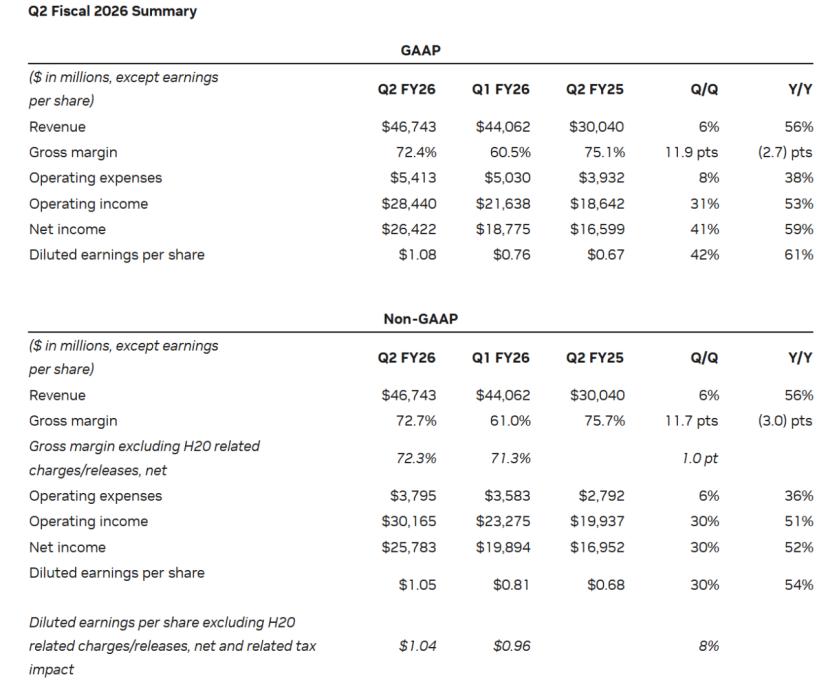
Core Viewpoint - Nvidia's Q2 FY26 financial report shows strong growth, with total revenue reaching $46.743 billion, a 6% increase quarter-over-quarter and a 56% increase year-over-year, despite a stock price drop post-announcement [5][6][7]. Financial Performance - Total revenue for Q2 FY26 was $46.743 billion, with a gross margin of 72.4% under GAAP and 72.7% under non-GAAP [10][11]. - Operating income was $28.44 billion, a 31% increase quarter-over-quarter and a 53% increase year-over-year [10][11]. - Net income reached $26.422 billion, reflecting a 59% year-over-year growth, with diluted earnings per share at $1.08 [12]. Business Segments - The data center business generated $41.1 billion, accounting for approximately 88% of total revenue, with a year-over-year growth of 56% [9]. - The gaming segment achieved $4.3 billion in revenue, growing 14% quarter-over-quarter and 49% year-over-year, despite its declining share of total revenue [12]. - Professional visualization and automotive segments also showed growth, with revenues of $601 million and $586 million, respectively [12][14]. Geopolitical Challenges - Nvidia's sales to China were significantly impacted by U.S. export controls, with the company reporting no sales of the H20 chip to Chinese customers in Q2 [18][20]. - The geopolitical landscape poses a risk to Nvidia's growth, as the company navigates between U.S. regulations and the potential loss of a significant market in China [21][25]. Future Outlook - Nvidia expects Q3 FY26 revenue to reach $54 billion, indicating a potential slowdown in growth compared to previous quarters [16][17]. - The company anticipates maintaining a non-GAAP gross margin of around 73.5% for the upcoming quarter [17]. - The rapid growth of China's AI chip market and the emergence of local competitors could pose long-term challenges for Nvidia's market position [28][29].


没了H20,英伟达狂飙的信心也没了
36氪· 2025-08-29 11:00
Core Viewpoint - Nvidia's Q2 FY2026 financial report shows strong growth, but geopolitical factors, particularly related to China, pose significant challenges for the company [5][20][22]. Financial Performance - Nvidia reported total revenue of $46.743 billion for Q2 FY2026, a 6% increase from the previous quarter and a 56% increase year-over-year [6][7]. - The data center business generated $41.1 billion, accounting for approximately 88% of total revenue, with a 5% quarter-over-quarter growth and a 56% year-over-year growth [10]. - Gross margin was reported at 72.4% under GAAP and 72.7% under non-GAAP, indicating strong profitability despite operational expenses rising by 38% year-over-year [12]. - Net income reached $26.422 billion, a 59% increase year-over-year, with diluted earnings per share at $1.08 [11][12]. Business Segments - The gaming segment generated $4.3 billion, with a 14% quarter-over-quarter growth and a 49% year-over-year growth, despite its revenue share dropping below 10% [13]. - Professional visualization revenue was $601 million, up 18% quarter-over-quarter and 32% year-over-year, while automotive and robotics revenue reached $586 million, growing 3% quarter-over-quarter and 69% year-over-year [14][16]. Cash Flow and Shareholder Returns - Nvidia held $56.791 billion in cash and equivalents, with total assets increasing to $140.74 billion [16][17]. - The company returned $24.3 billion to shareholders through stock buybacks and cash dividends in the first half of FY2026, with an additional $60 billion stock buyback authorization [17]. Future Outlook - Nvidia expects Q3 FY2026 revenue to reach $54 billion, indicating a potential slowdown in growth compared to previous quarters [18][19]. - The company anticipates maintaining a non-GAAP gross margin of around 73.5% for the upcoming quarter [19]. Geopolitical Challenges - The report highlights significant geopolitical risks, particularly regarding sales to China, with no sales of the H20 chip reported for the quarter [20][22]. - Nvidia's leadership faces challenges in navigating U.S. export controls while trying to maintain market share in China, which has been a crucial market for the company [22][23]. - The geopolitical landscape is creating a protective environment for Chinese competitors, potentially leading to a long-term reduction in Nvidia's market presence in China [27][29].


没了H20,英伟达狂飙的信心也没了
3 6 Ke· 2025-08-28 10:18
Core Viewpoint - Nvidia reported strong financial growth for Q2 FY26, with total revenue reaching $46.743 billion, marking a 6% increase quarter-over-quarter and a 56% increase year-over-year [2][3]. Financial Performance - Total revenue for the quarter was $46.743 billion, with a gross margin of 72.4% under GAAP and 72.7% under non-GAAP [5][6]. - Operating income was $28.44 billion, a 31% increase from the previous quarter and a 53% increase year-over-year [5][6]. - Net income reached $26.422 billion, reflecting a 59% year-over-year growth, with diluted earnings per share at $1.08 [7]. Business Segments - The data center business generated $41.1 billion in revenue, accounting for approximately 88% of total revenue, with a year-over-year growth of 56% [4]. - The gaming segment achieved $4.3 billion in revenue, with a year-over-year growth of 49%, despite its declining share of total revenue [7]. - Professional visualization and automotive segments also showed growth, with revenues of $601 million and $586 million, respectively [7][9]. Cash Flow and Shareholder Returns - The company generated a net cash flow from operating activities of $15.365 billion, indicating strong cash generation capabilities [10]. - Nvidia returned $24.3 billion to shareholders through stock buybacks and cash dividends in the first half of FY26, with an additional $60 billion stock buyback authorization approved [10]. Future Outlook - Nvidia expects Q3 FY26 revenue to reach $54 billion, indicating a potential slowdown in growth compared to previous quarters [11][12]. - The company anticipates a non-GAAP gross margin of 73.5% for the upcoming quarter, maintaining a strong profitability outlook [12]. Geopolitical Challenges - The financial report highlighted significant geopolitical risks, particularly related to sales restrictions in the Chinese market, which have impacted Nvidia's revenue projections [14][15]. - The company has faced challenges due to U.S. export controls, which have limited its ability to sell advanced chips to China, a previously crucial market [14][15][17]. - The emergence of a self-sufficient AI chip ecosystem in China poses a long-term threat to Nvidia's market position, as local companies are rapidly developing competitive technologies [19][22].