
ChatGPT翻译

Search documents
AI周报|ChatGPT广告来了;台积电最新季度净利润创新高
Di Yi Cai Jing Zi Xun· 2026-01-18 00:59
Group 1: TSMC Financial Performance - TSMC reported record net profit of NT$505.7 billion (approximately US$16 billion) for Q4 2025, a year-on-year increase of 35%, marking the seventh consecutive quarter of double-digit growth [1] - The company's revenue for the quarter reached NT$1.046 trillion (approximately US$33.73 billion), reflecting a 20.5% year-on-year growth, with 77% of total revenue coming from advanced processes of 7nm and below [1] - TSMC's growth is significantly driven by strong AI demand, with expectations for Q1 2026 revenue projected between US$34.6 billion and US$35.8 billion [1] Group 2: OpenAI Advertising Initiative - OpenAI announced plans to test advertisements in ChatGPT for free and entry-level subscription users, while Plus, Pro, Business, and Enterprise subscribers will remain ad-free [2] - The initiative aims to diversify revenue streams amid pressures for sustainable growth, as previous monetization attempts have not yielded significant results [2] - User reactions to the ad integration have been mixed, with some expressing discomfort at the idea of advertisements in a conversational AI context [2] Group 3: Nvidia Copper Usage Controversy - Nvidia's blog initially claimed that a 1GW data center using traditional 54V DC power systems could require up to 500,000 tons of copper, a statement later corrected to 200 tons following scrutiny [3] - The initial claim had been leveraged to suggest that AI data centers would significantly increase global copper demand, but analysts believe this narrative may be overstated [3] - Goldman Sachs noted that the current copper market does not show signs of significant supply tightness, predicting a slight surplus by 2026 [3] Group 4: Apple and Google Collaboration - Apple announced a partnership with Google to utilize Google's Gemini model architecture for the next generation of Apple Foundation Models, which will support an upgrade to Siri [4] - Reports suggest Apple will pay Google approximately US$1 billion annually for technology licensing, indicating a strategic shift from potential collaboration with OpenAI [4] - This partnership raises concerns about the concentration of power among a few tech giants in the AI space, as highlighted by industry figures [4] Group 5: DeepSeek's New Research - DeepSeek published a new paper focusing on conditional memory modules for large models, proposing that this will be a core component of the next generation of sparse large models [5][6] - The research aims to optimize resource allocation by separating tasks between specialized modules, enhancing efficiency and performance [6] - DeepSeek is expected to release its flagship model, DeepSeek V4, in February, which reportedly surpasses competitors in programming capabilities [6] Group 6: Alibaba's Qianwen App Upgrade - Alibaba's Qianwen app has integrated various services from its ecosystem, including Taobao and Alipay, enhancing its functionality significantly [7] - The app has seen rapid user growth, surpassing 1 million monthly active users within two months of launch, indicating strong market reception [7] - The upgrade positions Qianwen as a competitive AI assistant, differentiating it from other AI tools in the market [7] Group 7: UBS on AI Bubble in China - UBS analysts believe the probability of an AI bubble forming in China is low compared to the US, citing the lack of excessive financing among leading model firms [8] - Chinese AI companies are reportedly more prudent in capital expenditure, with a total of approximately 400 billion yuan spent last year, significantly less than their US counterparts [8] - The report suggests that by 2026, the development paths of AI in China and the US will diverge, impacting foreign investment strategies [8] Group 8: US Tariffs on Semiconductor Imports - The US government announced a 25% tariff on certain imported semiconductors and related products, including Nvidia's AI chips [9] - This move aligns with the US's push for domestic semiconductor manufacturing, although companies like Nvidia still rely on overseas supply chains [9] - The tariffs apply to a limited range of products, with some essential for US technology supply chains exempted [9] Group 9: OpenAI's Power Purchase Agreement - OpenAI plans to purchase up to 750 megawatts of computing power from Cerebras over three years, integrating their chips into OpenAI's solutions [10] - The contract is valued at over US$10 billion, indicating a significant investment in enhancing AI response capabilities [10] - Cerebras, a competitor to Nvidia, aims to diversify its revenue sources through this partnership, which could help it compete more effectively in the market [10] Group 10: ChatGPT's Entry into Translation Market - OpenAI has launched a standalone translation tool, ChatGPT Translate, which is currently free for all users [12] - The tool aims to compete directly with established services like Google Translate, although it currently supports fewer languages and lacks advanced features [12] - The launch appears rushed, with some functionalities still under development, indicating that ChatGPT's translation capabilities are in the early stages [12]


OpenAI入局翻译市场 正面挑战谷歌?
Di Yi Cai Jing· 2026-01-16 05:14
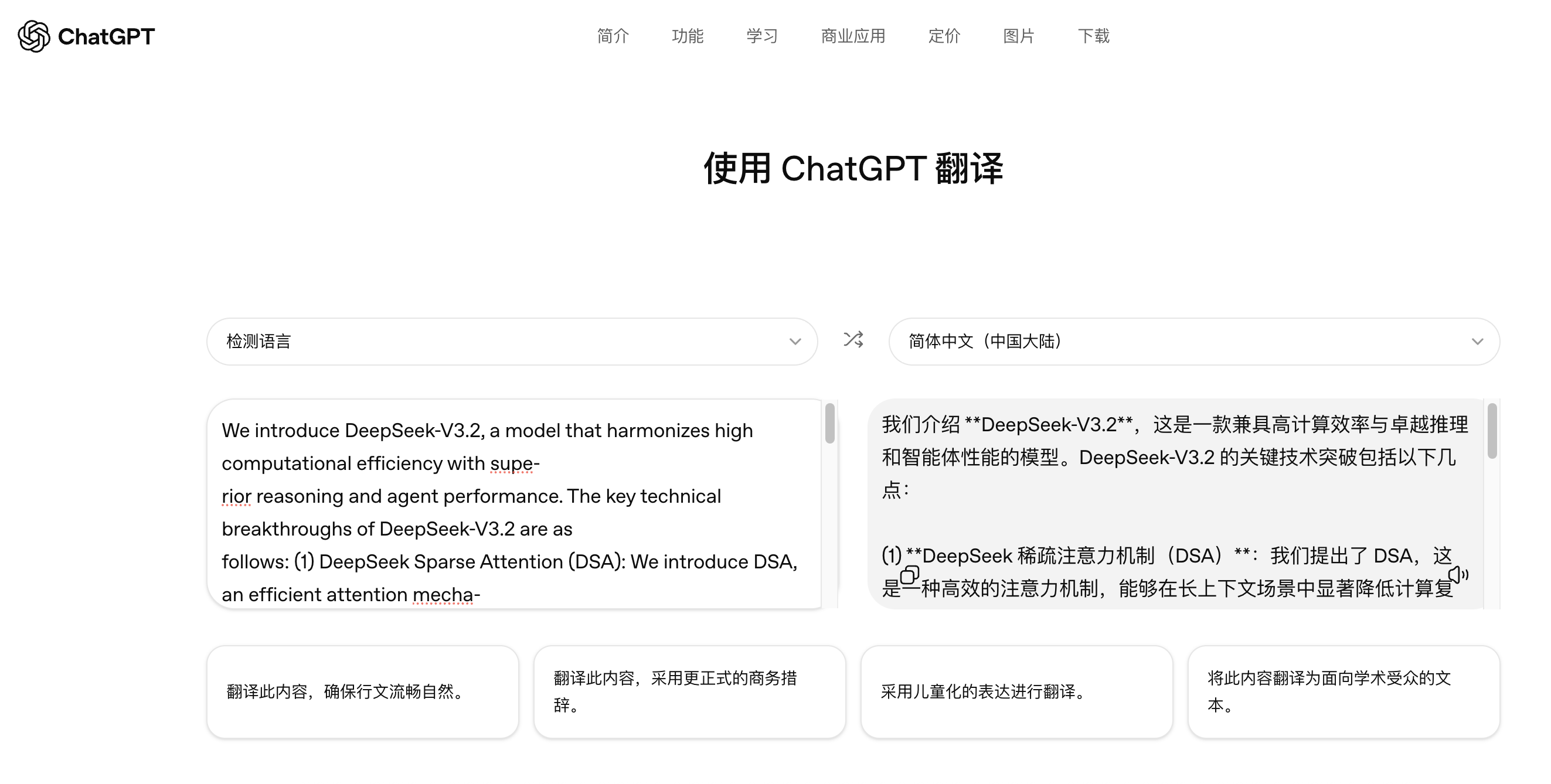
Core Viewpoint - OpenAI has accelerated the deployment of applications, recently launching a standalone web-based translation tool, "ChatGPT Translation," which is currently free for all users, aiming to compete directly with Google Translate [1][6]. Group 1: Product Features - ChatGPT Translation supports over 50 languages for instant translation, while Google Translate supports 243 languages and offers text, image, document, and webpage translation [1]. - The tool claims to understand context and tone, allowing for translations in various styles, such as formal, casual, or localized expressions [1]. - Users have reported that the interface lacks features for voice and image input, which were mentioned in the official description [1]. Group 2: Comparative Analysis - A comparison test showed that while both ChatGPT Translation and Google Translate have their strengths and weaknesses, Google still holds an advantage in translation quality [2]. - ChatGPT Translation exhibits a heavier "machine translation" feel, with less precise translations of professional terms, although it corrects errors in original text formatting [4]. - Google Translate provides more natural expressions and accurate translations of professional terms, but it does not optimize original text punctuation [6]. Group 3: Market Position and Future Outlook - The current experience with ChatGPT Translation is considered underwhelming and still in its early stages, lacking the capability to disrupt Google's market dominance [6]. - Industry experts believe OpenAI's move may be a strategic positioning to accumulate users and data for future iterations [6]. - Google continues to evolve its translation capabilities, integrating the Gemini model and introducing features like "real-time translation Beta" for simultaneous interpretation [6].


OpenAI入局翻译市场,正面挑战谷歌?
第一财经· 2026-01-16 04:53
Core Viewpoint - OpenAI has accelerated the application of its technology by launching a standalone web-based translation tool, "ChatGPT Translation," aiming to compete directly with Google Translate, despite its current limitations in features and language support [3][4]. Group 1: Product Features and Comparison - ChatGPT Translation currently supports over 50 languages for instant translation, while Google Translate supports 243 languages and offers text, image, document, and webpage translation [3][4]. - The interface of ChatGPT Translation resembles that of Google Translate, featuring a source language box on the left and a translation output on the right [3]. - ChatGPT Translation claims to understand context and tone, allowing for translations in various styles, such as formal or casual expressions [3][4]. Group 2: Performance Evaluation - A comparison test using a segment from a DeepSeek paper revealed that while ChatGPT Translation has some advantages, Google Translate still outperforms it in translation quality [4][6]. - ChatGPT Translation exhibits a heavier "machine translation" feel, with less precise translations of specialized terms, although it corrects errors in original text formatting [4][6]. - Google Translate provides more accurate translations for professional vocabulary but lacks optimization in original text punctuation [6]. Group 3: Market Position and Future Outlook - The industry perceives OpenAI's launch as a strategic move to position itself in the translation market, aiming to gather user data for future improvements [6]. - Google has integrated its Gemini model into its translation system, enhancing its ability to handle idioms and complex language, and has introduced a "real-time translation Beta" feature for simultaneous interpretation [6]. - For OpenAI to gain a significant share of the translation market, it will need to invest more in technology refinement and user experience [6].
OpenAI入局翻译市场,正面挑战谷歌?
Di Yi Cai Jing· 2026-01-16 03:54
Core Insights - OpenAI has accelerated the deployment of applications, recently launching a standalone web-based translation tool called "ChatGPT Translation" to compete directly with Google Translate [1] - The new tool currently supports over 50 languages for instant translation, while Google Translate supports 243 languages and offers more mature features [1][6] - ChatGPT Translation aims to provide contextual understanding and varied expression styles, but its current functionality is limited compared to Google Translate [1][6] Group 1 - OpenAI's ChatGPT Translation tool is now available for free to all users, lacking a mobile app version and some features like image translation [1] - The interface of ChatGPT Translation resembles that of Google Translate, with a source language box on the left and a translation box on the right [1] - Initial testing shows that while ChatGPT Translation has some advantages, such as correcting errors in original text, Google Translate still outperforms it in overall translation quality [2][4] Group 2 - ChatGPT Translation exhibits a noticeable "machine translation" feel, with some inaccuracies in professional terminology, while also providing smoother language flow [4][6] - Google Translate's translations are generally more precise, although it lacks optimization for original text punctuation [6] - The industry views OpenAI's move as a strategic positioning to gather users and data for future improvements, but acknowledges that Google continues to enhance its translation capabilities [6]