Cosmos Reason 2

Search documents
英伟达3D模型打造“AI建筑师特工队”,8位华人合著,包括千问实习生
3 6 Ke· 2026-02-03 11:44
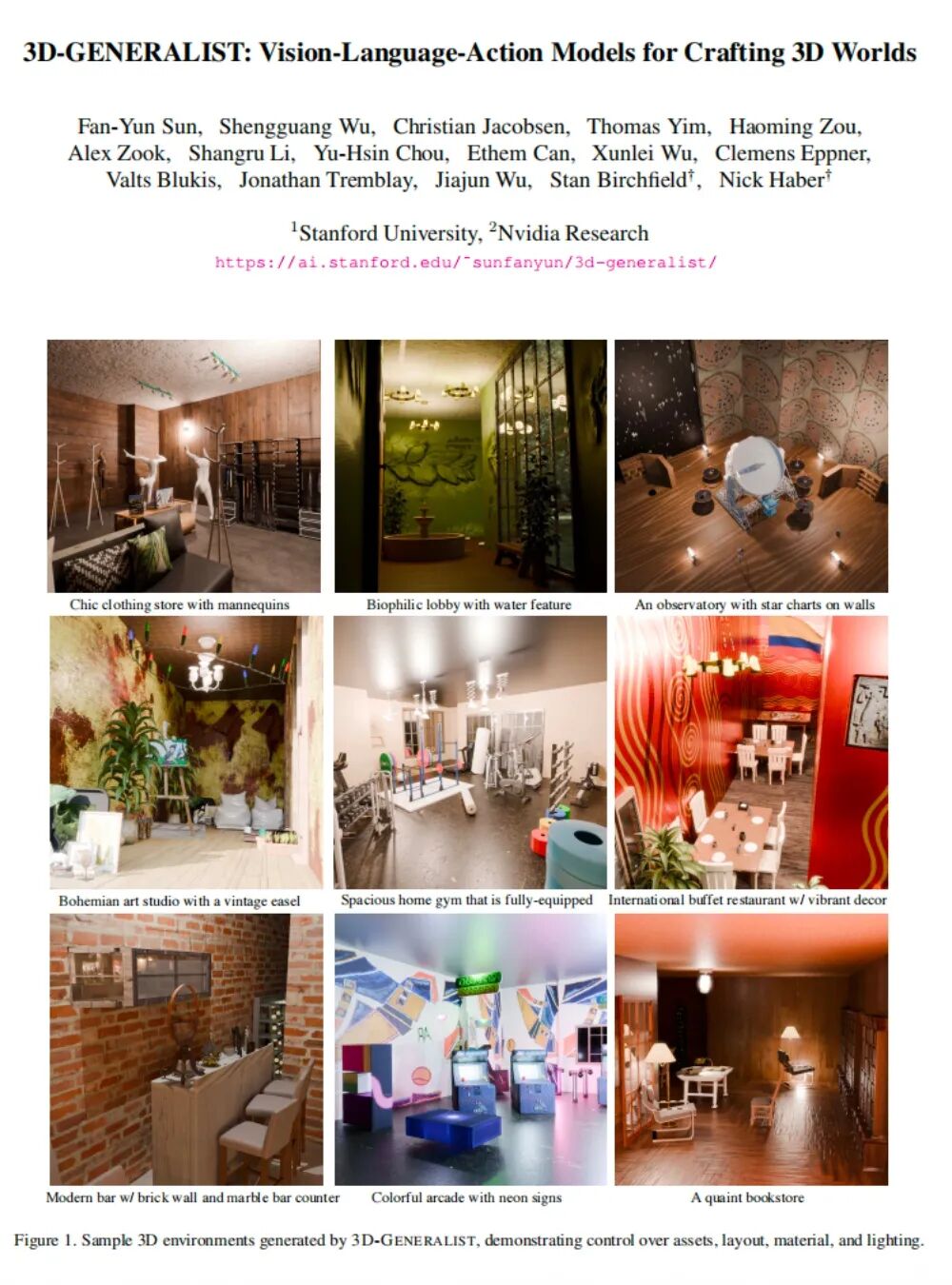
Core Insights - Nvidia announced a new 3D generalist model, 3D-GENERALIST, which aims to revolutionize the construction of 3D worlds by using AI-generated synthetic data to significantly reduce the costs associated with visual model pre-training [1][12] - The model integrates four core elements of 3D environment generation—layout, material, lighting, and assets—into a unified decision-making framework, enhancing the efficiency and physical realism of complex 3D scene construction [1][46] Group 1: Current Challenges - Existing technologies primarily focus on single aspects of 3D generation, such as layout or texture synthesis, making it difficult to achieve collaborative optimization across all elements [13] - Current generated scenes lack separable and operable objects, limiting their applicability in tasks requiring precise annotations or robotic interaction simulations [13] Group 2: Research Methodology - The research team expanded the role of a "designer" into a "team of architects," breaking down the construction process into specialized tasks [14] - A three-step "scene strategy" was introduced, utilizing a panoramic diffusion model to generate guiding images, followed by structural extraction and programmatic generation of 3D rooms [16] Group 3: Key Technologies - The model employs a self-improvement mechanism that generates multiple candidate action sequences, selecting the optimal one based on CLIP scores for further fine-tuning [20] - A domain-specific language was established to standardize action command formats, ensuring compatibility with tool APIs [23] Group 4: Performance Validation - 3D-GENERALIST achieved a collision-free score of 99.0 and an overall physical semantic alignment score of 67.9, surpassing baseline methods [24][25] - The model's CLIP score reached 0.275 after three rounds of fine-tuning, significantly higher than versions without fine-tuning [27] Group 5: Research Team - The paper features eight Chinese authors, including notable figures from Stanford University and Tsinghua University, highlighting a strong academic background in AI and computer science [2][30][39] Group 6: Conclusion - 3D-GENERALIST integrates various modeling aspects into a cohesive decision-making sequence, demonstrating the feasibility of high-quality synthetic data as a scalable alternative to manual annotation, potentially lowering the cost barriers for downstream visual and robotic model training [46]


英伟达想做“物理AI”的“安卓”
Hua Er Jie Jian Wen· 2026-01-06 04:01
Core Insights - Nvidia is establishing a default platform in the robotics sector, aiming to replicate Android's dominance in smartphone operating systems [1] - The company has released multiple open-source foundational models to enable robots to reason, plan, and adapt across various tasks and environments, all available on the Hugging Face platform [1] - Nvidia's new Jetson T4000 graphics card and the open-source command center OSMO are designed to support the entire robotics development workflow [1][4] - The trend of AI migrating from the cloud to the physical world is evident, driven by decreasing sensor costs, advancements in simulation technology, and improved generalization capabilities of AI models [1][6] Model Matrix Construction - The foundational models released by Nvidia form the core capabilities layer of physical AI [2] Data Generation and Evaluation - Cosmos Transfer 2.5 and Cosmos Predict 2.5 are responsible for data synthesis and robot strategy evaluation, allowing validation of robot behavior in simulated environments [3] - Cosmos Reason 2 is a reasoning-based visual language model that enables AI systems to observe, understand, and act in the physical world [3] - Isaac GR00T N1.6 is a visual language action model specifically developed for humanoid robots, utilizing Cosmos Reason for full-body control [3] - The Isaac Lab-Arena, launched at CES, is an open-source simulation framework hosted on GitHub, addressing industry pain points in robot capability validation [3] Hardware Accessibility - The Jetson T4000 graphics card, part of the Thor series, offers a cost-effective upgrade with 1.2 trillion floating-point AI operations and 64GB of memory, while maintaining power consumption between 40 to 70 watts [4] Strategic Partnerships - Nvidia has deepened its collaboration with Hugging Face, integrating Isaac and GR00T technologies into the LeRobot framework, connecting 2 million robot developers with 13 million AI builders [5] - The open-source humanoid robot Reachy 2 now supports Nvidia's Jetson Thor chips, allowing developers to test various AI models without being locked into proprietary systems [5] - Early signs indicate that Nvidia's strategy is effective, with robotics becoming the fastest-growing category on the Hugging Face platform and Nvidia's models leading in download numbers [5]
黄仁勋最新演讲,涉及下一代芯片和自动驾驶
Wind万得· 2026-01-06 00:20
Group 1: Core Insights - Nvidia's CEO Jensen Huang announced that the robotics field has entered a "ChatGPT moment" and introduced a series of open-source "physical AI" models [2] - The new AI chips have achieved "full-scale production" with a fivefold increase in computing power compared to the previous generation, specifically designed for AI applications like chatbots [6] - Nvidia's new platform, Vera Rubin, is set to launch in late 2026 and is expected to have a profound impact on the future of AI due to the industry's heavy reliance on Nvidia's technology [10] Group 2: Robotics and AI Models - Huang showcased two robots, BDX and GR00T, demonstrating how they learn and interact with their environment [4] - The Nvidia Cosmos Transfer 2.5 and Cosmos Predict 2.5 models can generate realistic synthetic data for evaluating robot performance in a safe virtual environment [4] - The Nvidia Isaac GR00T N1.6 model allows for precise control of humanoid robots using visual language action capabilities [4] Group 3: AI Chip Advancements - The new AI chip's performance leap is attributed to the proprietary data format developed by Nvidia, which allows for significant performance improvements with only a 60% increase in transistor count [8] - The chip includes a "context memory storage" layer to enhance response times in conversational AI applications [8] - Nvidia has partnered with Groq to strengthen its position in the AI inference market [8] Group 4: Autonomous Driving Initiatives - Nvidia plans to initiate robotaxi trials with partners as early as 2027, showcasing its ambition in the autonomous driving sector [14] - The company has developed a decision-making software named Alpamayo for autonomous vehicles, which records decision processes for engineers to review [12] - Nvidia's Drive AGX Thor onboard computer is priced around $3,500 and is designed to help automakers save development time and accelerate feature deployment [15]